Mythologist | Author | Speaker | Illustrator

-
Articles

How Southeast Asia Adapted Indian Ideas to Local Needs
Across Southeast Asia, from the Mekong Delta (in present-day Vietnam and Cambodia) to Java island of Indonesia, major archaeological sites reveal how Indian ideas travelled not through conquest but through trade, pilgrimage, and court patronage between 500 AD and 1500 AD. These sites show a layered interaction of Buddhism and Hinduism, reshaped by local ecology,…
-
Articles

Forgotten Horses of the Silk and Golden Roads
Peter Frankopan’s The Silk Roads and William Dalrymple’s The Golden Roadwith strikingly similar book covers (title within circle), share a striking silence. They speak at length of roads, trade, ideas, monks, merchants, and empires, but largely ignore the animal that made most premodern power possible: the horse…
-
Articles

Hindu Temples in Cambodia and Thailand
The recent skirmish between Cambodia and Thailand caught Indian attention not because of Buddhist politics but because the fight was over a Hindu temple perched on the border of two Buddhist nations. …
-
Articles
Kailasa in Cambodia
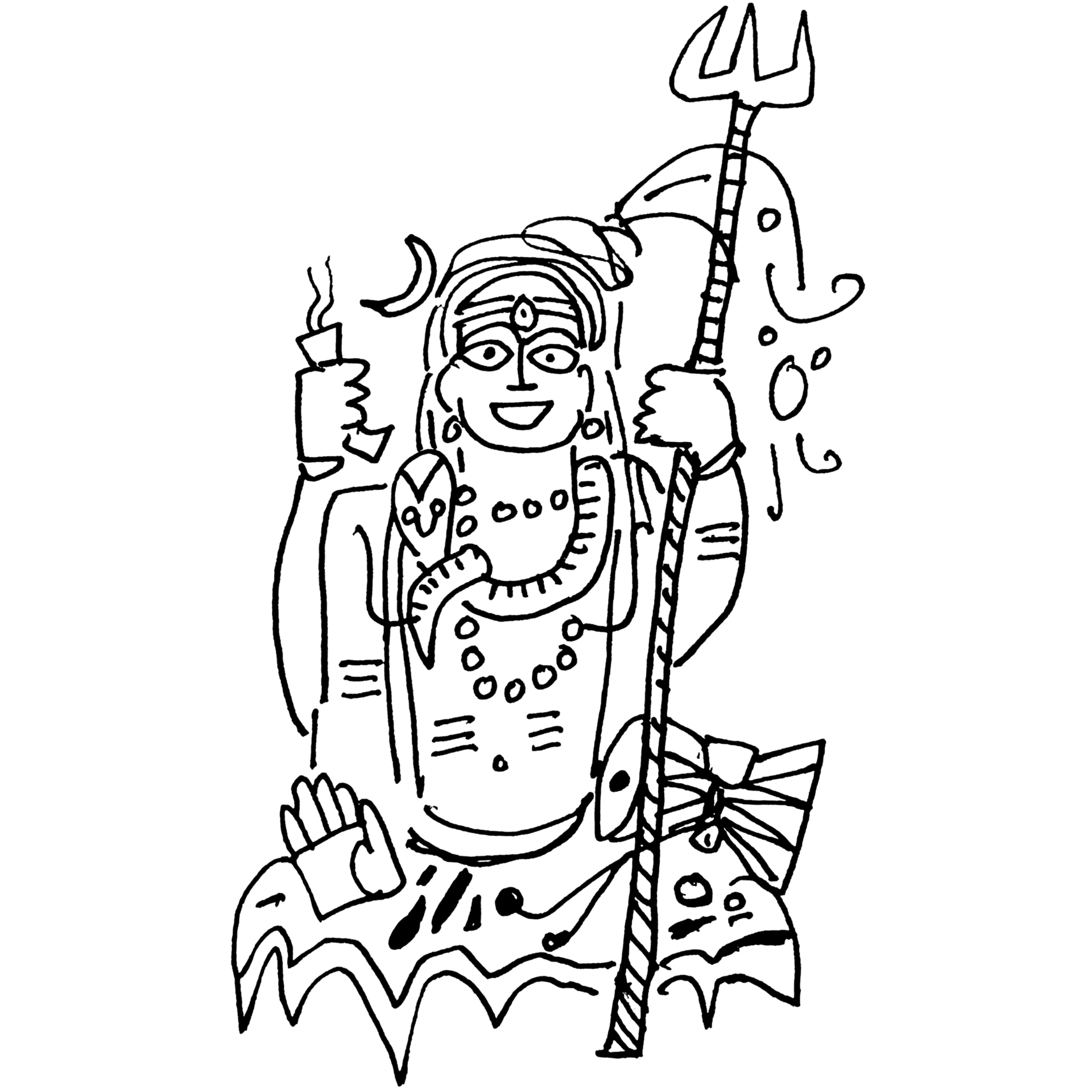
A few decades before the Chola king Rajaraja I built the Brihadeeswara Temple in Tamil Nadu, around 1000 AD, a Khmer king called Jayavarman IV had begun building a temple to replicate the Kailasa mountain in Cambodia, at Koh Ker, complete with a tank that would replicate the river Ganga. …
-
Articles
A Starry Network of Arabian Trade
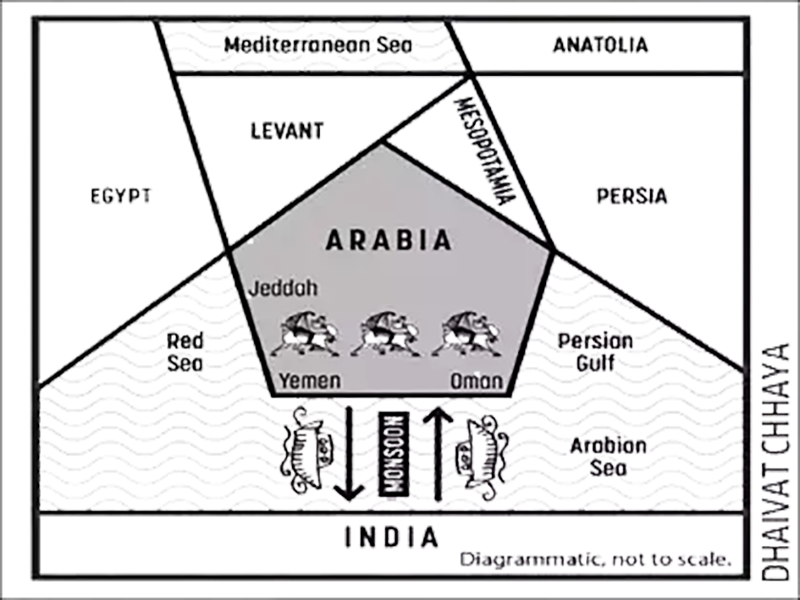
The word monsoon comes from the Arabic word ‘mausam’, meaning season. Incidentally, the word ‘ara’ in Sanskrit means desert…
-
Articles

Song and Dance For a Thai God
When you go to Bangkok, in the Sukhumvit area, you find a temple dedicated to a god called Erawan. The deity has four heads, eight hands, and he is associated with Brahma…
-
Articles

Origins of the Rice Goddess
The oldest Indian mythology of rice can be found among the Bonda tribal people, who live in Odisha, who are linked to the Munda and Austroasiatic communities who entered India from the Southeast, and brought rice growing technology with them over 4,000 years ago…
-
Articles

Diversity and Inclusion is a radical idea in the West because of monotheism
In the USA, a section of activists prefer the word ‘birthing people’ to ‘mothers’. This is erasure of womanhood, say feminists. Such feminists are deemed TERF (trans exclusionary radical feminists). Inclusion of trans-women seems to demand rejection of traditional definitions of womanhood, which is seen as a social construct imposed by patriarchy. Feminists argue that…
-
Articles

Ravana in Malaysia and Indonesia
The Ramayana has been retold by several communities and several people over a period of 2,000 years and over a region that spreads over 5,000 miles. Scholars have found the Ramayana retellings even in faraway places such as Thailand, Malaysia and Indonesia. The story was taken there by seafaring merchants. …
-
Articles

Who are the power-broking landlord monks of Tamil Nadu?
Sengol is a staff of royal authority. We can call the symbol of justice in the spirit of wordplay, when a symbol of monarchy is made the symbol of democracy. …
-
Articles
The Hindu History of Bengal
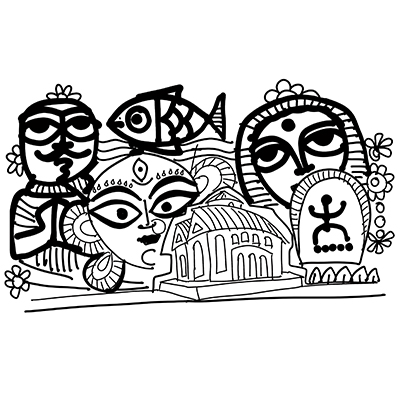
Published on 6th May, 2023, in Times of India. When we talk about Bengal, we speak of its partition. The eastern part became Muslim Bangladesh, the western part became communist West Bengal. It almost seemed as if Hinduism had been wiped out in this eastern corner of India. Yet, this is where Hinduism was defined…
-
Articles

Why Puranas Represent a Wider Indian Ethos Than the Vedas
Published on 5th April, 2023, in Times of India. The Puranas are called the fifth Veda, but they are not quite Vedic. We realise this from a single incident that took place in Maharashtra at the start of the 20th century. During the royal rituals of Shahu Maharaj of Kolhapur, the Brahmin priests chanted Puranic…
-
Articles

Forgotten Ballads Of Indian Merchants
Published on 1st April, 2023, in Economic Times. India was famous for trading with Southeast Asia and the Middle East since ancient times. However, Hindu scriptures shunned mercantile economy and focussed on agricultural economy. Value was placed on land tax, not on toll tax. By contrast, Buddhism and Jainism greatly value merchants. This is why…
-
Articles

Tibetan Ramayana
Published on 12th March, 2023, in Mid-day. In the early 20th century, six incomplete manuscripts containing excerpts of the Ramayana were found in the Mogao caves of Dunhuang, an archaeological site at the eastern end of the Silk Road in Xinjiang province of China. Written in an early Tibetan language, dated to approximately the 8th…
-
Articles

Why the Location of Shiva’s Pillars Has Become So Controversial
Published on 25th February, 2023, in Times of India. The Assam government’s claim that the Bhimashankar Jyotirlinga is located in the northeastern state has spawned yet another religious flashpoint. This is what happens when mythology is assumed to be history Until recently, most people believed that Bhimashankar Jyotirlinga is located in Maharashtra. But then the…