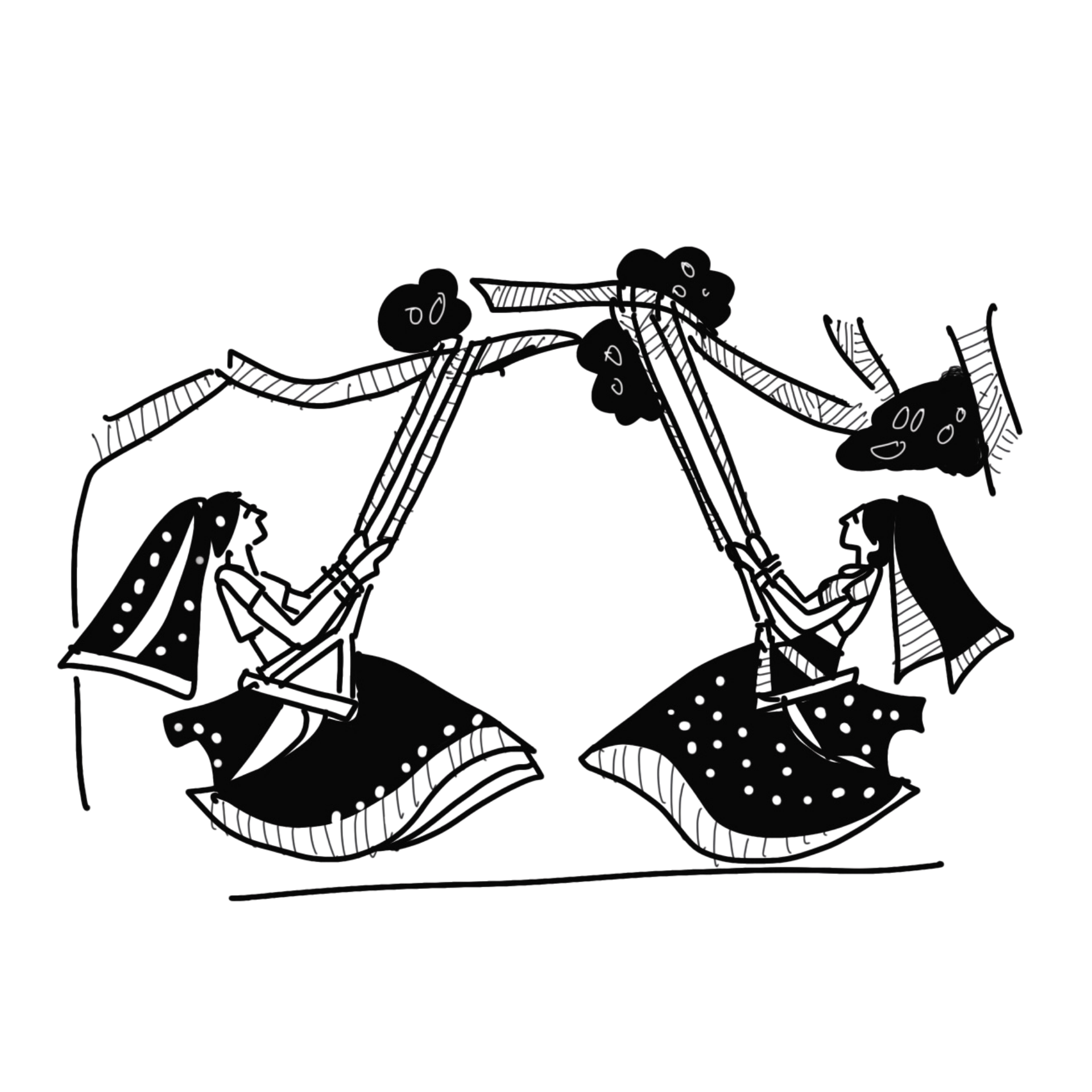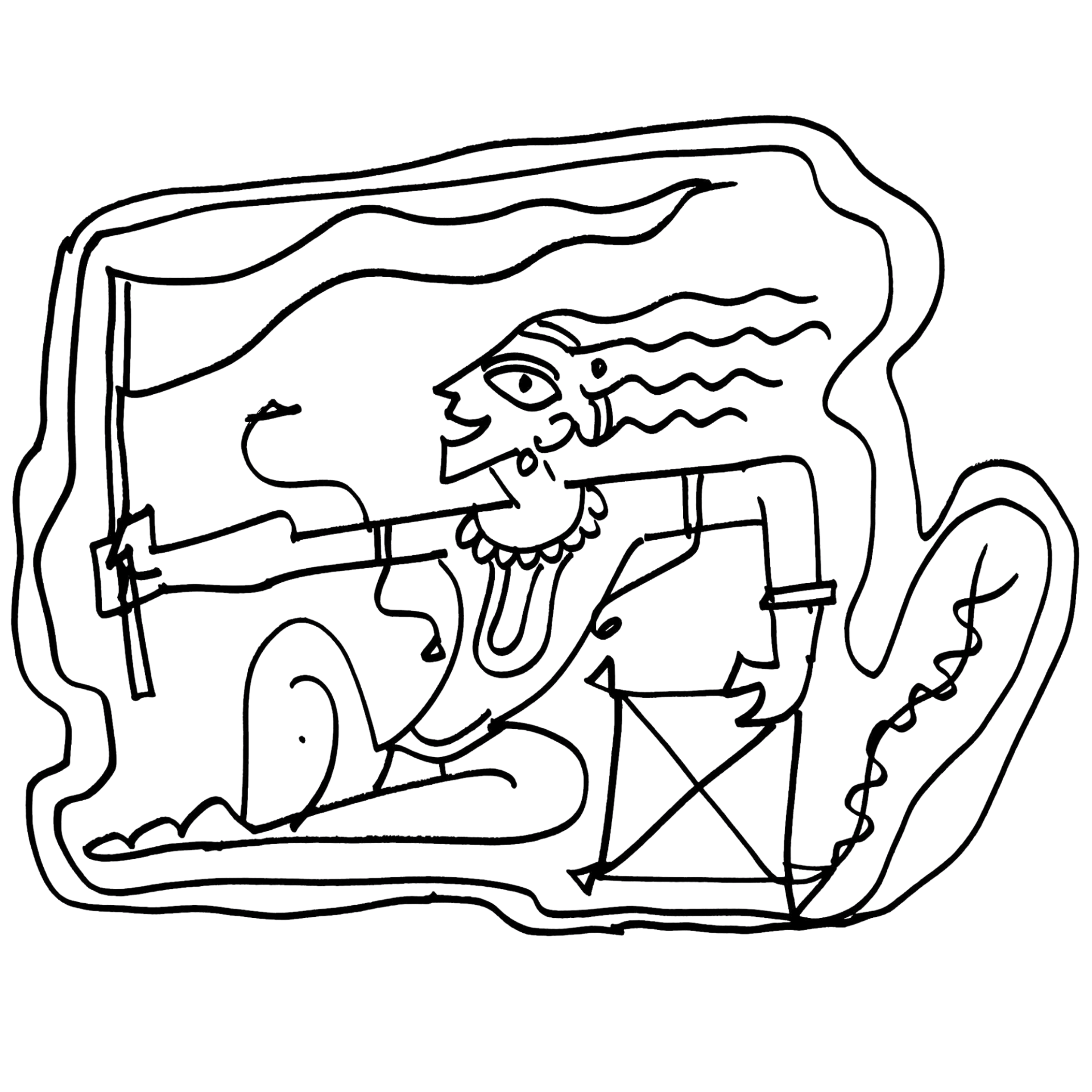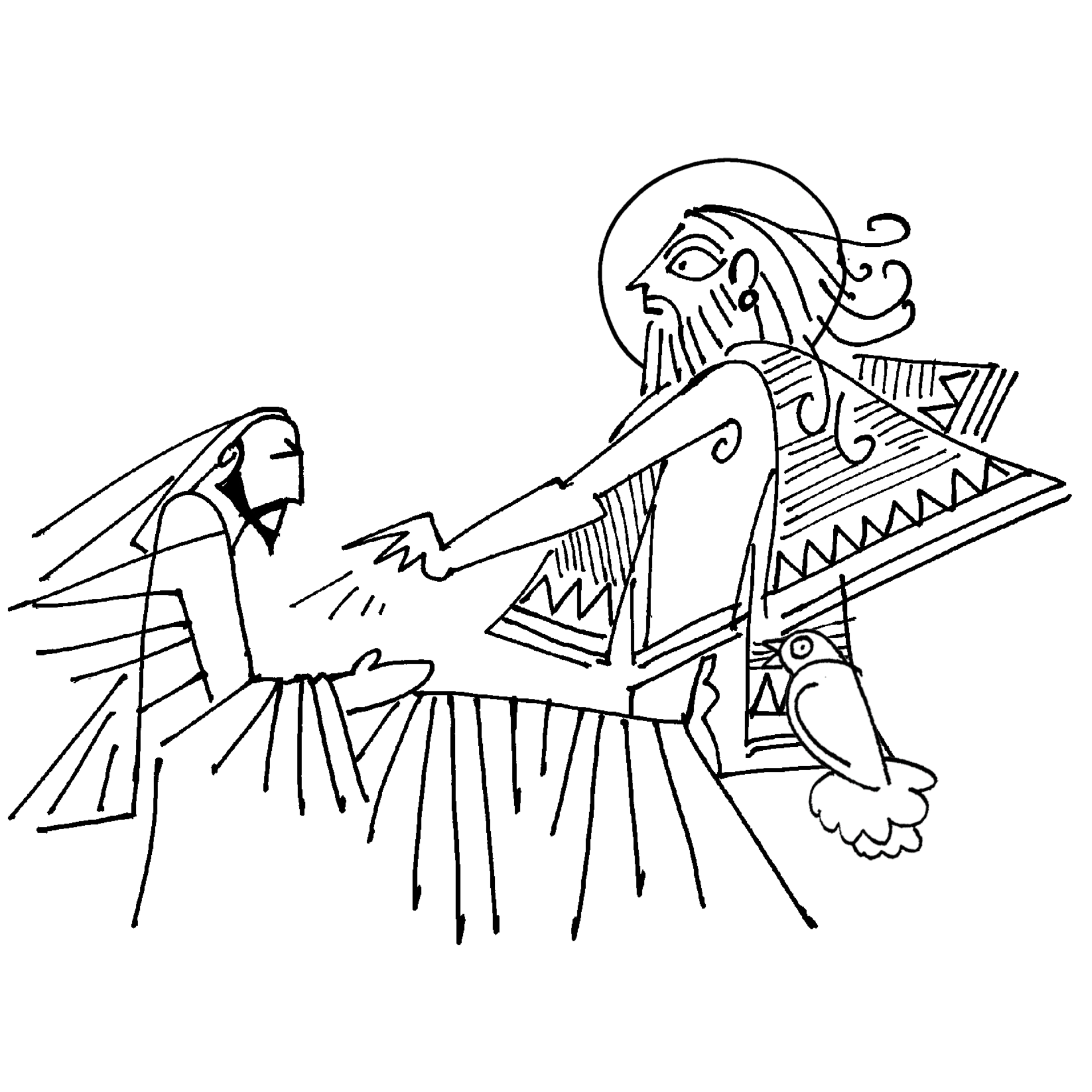
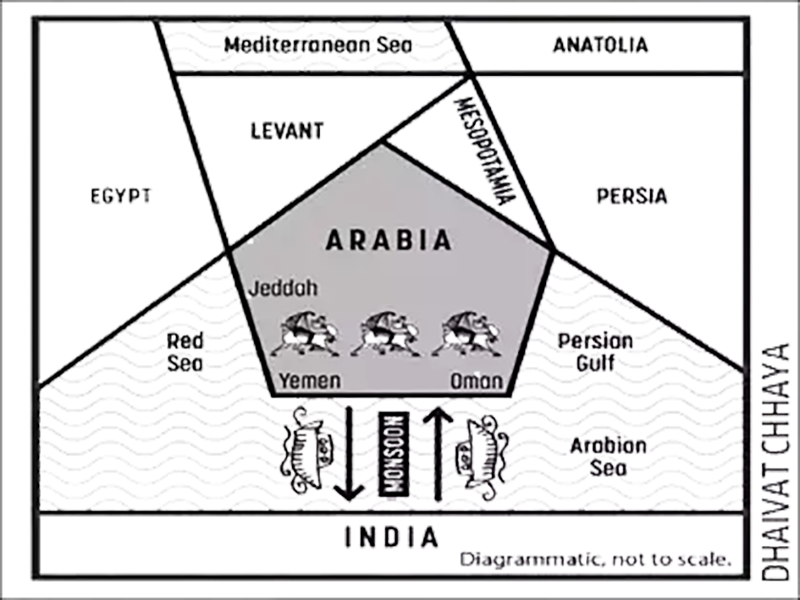
When Adam and Eve were cast out of Eden, Eve (Hawa) fell on the western coast of Arabia, at the port of Jeddah, city of the grandmother as per local lore, a reference to the mother of all humans clearly. Adam, the father of all humans, fell on Serendip, Adam’s Peak, in Sri Lanka. So says Arabic lore. How did they meet? Adam must have taken advantage of the monsoon winds.
The word monsoon comes from the Arabic word ‘mausam’, meaning season. Incidentally, the word ‘ara’ in Sanskrit means desert. This connection between Arabia and the Indian subcontinent is often overlooked. Through the Arabian Peninsula Indians were able to network with Egyptian civilisation to its West, the Levantine civilisation to its Northwest, the Mesopotamian civilisation to its Northeast and Persian civilisation to its East.
Yet, the central civilisational role of these desert and sea people has been overshadowed by scholars drawn to grand monuments. Next to the pyramids who bothers with reed boats and boats made of wooden planks sown together with coir ropes. Who cares for the men and women who crossed the harsh deserts on camels, taking luxuries to distant parts of the world, since the Bronze Age.
It is known that the Harappan cities traded with Oman nearly 4,500 years ago. Oman connected the Harappans with the Sumerian civilization. Ships from India took cotton, lapis lazuli, carnelian, bronze, wooden furniture, chickens, peacocks, dogs and even buffaloes. Peacocks were residents of Eden, as per Arabic lore. Ships from Arabia brought back bitumen for the Harappan baths, incense, dates and woollen fabrics. These Arab sea-merchants brought cowries from the Maldives, which were used as currency till the Portuguese destroyed this financial system five centuries ago.
During Roman times, ships from Egypt travelled to Yemen, and then to India. This brought in Roman gold. Off the coast of Yemen is the island of Socotra. And on the coast of Gujarat is a temple dedicated to the goddess Sikotara devi who blesses sailors making the perilous journey. Lamps in her temple served as lighthouses. Gujarat coast also has the earliest mosques. One of them (Barwada masjid at Ghoga) faces Jerusalem, suggesting it was built in the lifetime of the Prophet, before Mecca became the direction of prayer.
Stories about the Arab people come to us from what the Christians call the Old Testament. The same stories are told with a local favour in Persian lore. We find Arabic versions in the Bengali epic Nabi Bansa (the lineage of prophets), retelling the stories of the messengers of God. This was written in the 17th century by Syed Sultan.
Many Arab stories are even found in the 16th century Tamil work by Umar, the poet, called Sira Puranam (biography of the Prophet Muhammad). Although many Indian Muslims deny the existence of caste on religious grounds, at a local level, those Muslims who claim descent from Arab sea-merchants are ranked higher. These communities are found on the coasts of Kerala and Tamil Nadu. Their forefathers took advantage of the monsoon winds to connect Arabia in the West with Java in the East.
As per archaeologists and historians, camels made their appearance in Levant and Mesopotamia around 1,000 BC, almost five centuries after the introduction of the domesticated horse and donkey. Camels mentioned in the earlier Rig Veda are the two-humped camels of Central Asia. If horses came from Eurasia, these camels came from Arabia.
In Rajasthan, the ballad of Pabuji speaks of a raid to ‘Ravana’s Lanka’ to fetch camels, suggesting the camels may have reached India via a sea route. Horses from Arabia were brought on Arab ships directly to South India, when North Indian warlords refused to share the horses imported by land routes from Central Asia and Persia. The horses were paid for in advance. If a horse died en route, its tail was presented to the Indian buyer as proof of transport. This horse trade with Arabia made kings like Amoghavarsha of Rashtrakuta dynasty of Karnataka very rich in the 8th century.
Arabic culture speaks of the coastal cities and the desert nomads, those who live in stone houses, and those who live in cloth tents, the settled and the mobile, those who traded across seas and those who traded across deserts, the descendants of Cain (the herdsman) and Abel (the farmer), eternally in conflict due to different values. Arabia saw the rise of monotheistic ideas around it: tales of Zarathrusta of Persia, Abraham of Mesopotamia, Moses of Egypt, David and Solomon of Levant.
They spread the Phoenician script from the Levant, replacing the older cuneiform script. They marked the zone separating the Semitic scripts written right to left using a horizontally oriented linear design, and the Indo-Aryan Brahmi scripts written left to right using a circular design. They connected the lands that believed in one life from lands that believed in rebirth. Traders from Arabia spoke of God as judge. Traders from India spoke of God as an accountant. Both lands told stories of travelling merchants longing for wives. Arabia is so much more than the religious discourse we are bombarded with.