
Bring the wisdom of Indian mythology into your wardrobe.
Our unique designs, showcasing brilliant illustrations by Devdutt Pattanaik, bring these ancient stories to life.

Our unique designs, showcasing brilliant illustrations by Devdutt Pattanaik, bring these ancient stories to life.
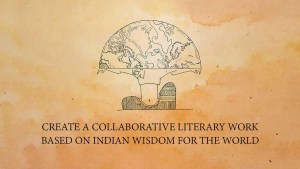

In the heart of the forest, where silence speaks and shadows tell tales, ten seekers will gather—not to find answers, but to ask better questions.
Just as Ram ventured into the wilderness with Vishwamitra, leaving behind the comforts of Ayodhya to confront the unknown, you too are invited to step into the forest—not merely of trees, but of thoughts, symbols, and stories. Here, under the guidance of Devdutt Pattanaik, mythologist and storyteller, you will embark on a journey to co-create a tapestry of mytho-fiction. The Himalayan Writing Retreat will be the venue for this coming together of talented writers.
📝 What Awaits You
Collective Creation: Ten writers will collaboratively craft a mytho-fiction narrative, each contributing over 3,000 words across four days.
Guided Exploration: Devdutt will lead sessions on the nuances of mythology, exploring definitions, structures, and storytelling traditions.
Editorial Insight: An editor from HarperCollins India will provide feedback, shaping the narrative’s journey from idea to manuscript.
Immersive Experience: Reside at the Himalayan Writing Retreat, where every meal, walk, and conversation becomes part of the creative process.
Devdutt will illustrate the stories in his distinctive style, adding a visual dimension to the collective narrative. If Harper Collins likes the final book thus created, they will publish it.
🧠 Who Should Apply
Writers under 38 years of age as of January 1, 2026, with a demonstrated history in fiction writing. Eligibility includes:
Publication of at least one short story in two respected literary magazines, or
A traditionally published book, or
Other credible evidence of published work (personal blogs or self-published platforms are not considered).
An original writing sample is required with your application.
📚 Themes of Exploration
Understanding Myth: Delve into the distinctions between myth, mythology, fiction, history, and science.
Cultural Structures: Examine the frameworks of Indian, Western, and Chinese myths.
Storytelling Traditions: Explore the Bhaav-Rasa theory intrinsic to Indian narratives.
🌄 The Setting
The Himalayan Writing Retreat offers a sanctuary where the mind can wander and the soul can reflect. Here, amidst crisp mountain air and the melodies of nature, stories find their voice. A residential haven for writers, the retreat attracts writers and poets from around the world for its various programs and events.
📍 Retreat Details
Dates: October 10–14, 2025
Location: Himalayan Writing Retreat, Village Satkhol, District Nainital, Uttarakhand
Cost: INR 10,000 + GST (This doesn’t cover the cost. Patrons and HWR bridge the gap. Travel expenses are borne by participant.)
Application Deadline: June 30, 2025
Participant Limit: 10 writers
Announcement of Selected Participants: August 15, 2025
For more information and to apply:
Questions? Call or WhatsApp: +91 73035 16665.
In the forest, one does not seek to conquer but to understand. Join us in this journey of discovery, where mythology meets fiction, and stories come alive.

As a child, Hanuman wanted to learn everything about the world. He asked his mother how he could do so and his mother pointed to the sun and said that since the sun saw everything, Hanuman should learn from the sun god, Surya. Hanuman approached the sun god and asked, “I want to learn of everything you see and observe in the world. You have more knowledge than anyone else. Can you please teach me?”
The sun god replied, “I have no time. I travel all day and rest all night. I cannot pause to teach you.”
Hanuman persisted, “Why do you have to pause? I will ride in front of your chariot each day and you can teach me while you are travelling.” In some versions, he said, “I will expand myself towards the sky so that my feet are resting on the eastern and western horizons, and I will keep looking at you all day facing your chariot.”
“But my glare will be too hard to handle and the pain and the heat will be intolerable,” reminded the sun.
Hanuman was not one to give up. “It doesn’t matter, knowledge cannot come without suffering. One must work hard.”
Impressed by his determination, Surya agreed. Hanuman spent thousands of years flying in front of the sun’s chariot, staring at the sun from sunrise to sunset, listening to everything Surya had to say. He sublimated from Hanuman the monkey to Hanuman the god of infinite wisdom. He learned Sanskrit, wrote poetry, excelled in martial skills and leadership abilities. He became one of the most knowledgeable beings.

Every time we experience negativity in the world and within ourselves, every time we encounter jealousy, rage and frustration, manifesting as violation and violence, we hear, or read, the Hanuman Chalisa. Composed over four hundred years ago by Tulsidas, its simple words in Awadhi, a dialect of Hindi and its simple metre, musically and very potently evoke the mythology, history and mystery of Hanuman, the much-loved Hindu deity, through whom Vedic wisdom reached the masses. As verse follows verse, our frightened, crumpled mind begins to expand with knowledge and insight and our faith in humanity, both within and without, is restored.

Hanuman, Anjani’s Mighty Son is perfect as a read-aloud to acquaint young readers with the qualities of valour, selflessness, loyalty and humility that Hanuman embodied.
Curated with fascinating bite-sized stories–from how young Hanuman almost ate the sun to how he helped Ram rescue Sita from Lanka–it features over forty playful artworks along with dedicated colouring pages.


Bahubali: 63 Insights Into Jainism
Many historians believe that Jainism and other hermit schools were simply a reaction to Vedic ritualism. But for most Jains, their religion has no origin: it has always been around.

Jain Dharm (Coming Soon)
Kannada Translation of Bahubali: 63 Insights Into Jainism


7 Secrets of Shiva
Smeared with ash, draped in animal hide, he sits atop the snow-capped mountain, skull in hand, withdrawn, with dogs for company, destroying the world with his indifference. He is God who the Goddess shall awaken. His name is Shiva. Locked in his stories, symbols and rituals are the secrets of our ancestors. This book attempts to unlock seven.

Shiva to Shankara: Giving Form to the Formless
Many modern scholars say Shiva’s linga is a phallic symbol. Most devotees disagree. Who is right? This book looks at the sexual metaphors associated with Shiva and uncovers the meaning beneath.In the process we discover how the symbol of Shiva is reflected in the story of Shiva’s marriage.
The question is: Why does the Goddess transform Shiva, the hermit, into Shankara, the householder? Is the story and symbol about divinity or about us? This book is the first of its kind to show the uncanny alignment between metaphysics, rituals, symbols and stories of Shiva.

Fun in Devlok: Shiva Plays Dumb Charades
Five children are having fun one evening; playing dumb charades; when Shiva appears and wants to join in! Shiva turns out to be the best at dumb charades; as well as in asking riddles. He can say so much with only his actions! He also tells the children wonderful stories with the help of the many objects he carries with him; like the rattle drum; the crescent moon and a fountain of water that rises from his head. Soon; thanks to Shiva’s playfulness; the children know much more about Shiva and the other gods—even more than their parents!

Yoga Mythology: 64 Asanas and Their Stories
The popular names of many yogic asanas – from Virbhadra-asana and Hanuman-asana to Matsyendra-asana, Kurma-asana and Ananta-asana – are based on characters and personages from Indian mythology. Who were these mythological characters, what were their stories, and how are they connected to yogic postures?


‘Ram’s story as a metaphor for human strengths and weaknesses and as a window to inner divinity’. Ram is maryada purushottam, the supreme upholder of social values, scion of the Raghu clan, jewel of the solar dynasty, seventh avatar of Vishnu. Reviled by feminists, appropriated by politicians, he remains serene in his majesty, the only Hindu deity to be worshipped as a king.

Sita: An Illustrated Retelling of Ramayana is an epic story based on the life of India’s most admired prince-Rama and his wife Sita. Since ages, the character that is most emphasized has been that of Rama, who has always been known to keep his word whatever be the circumstances. The role of Sita has been generally overlooked in the past. Sita too is a pivotal character being a single mother; she went through many ups and downs all alone. Still, she has often been portrayed as a frail and meek character.

Every time we experience negativity in the world and within ourselves, every time we encounter jealousy, rage and frustration, manifesting as violation and violence, we hear, or read, the Hanuman Chalisa. Composed over four hundred years ago by Tulsidas, its simple words in Awadhi, a dialect of Hindi and its simple metre, musically and very potently evoke the mythology, history and mystery of Hanuman, the much-loved Hindu deity, through whom Vedic wisdom reached the masses. As verse follows verse, our frightened, crumpled mind begins to expand with knowledge and insight and our faith in humanity, both within and without, is restored.

Two thousand years ago, the poet-sage Valmiki wrote the Ramayana. It is the tale of Ram, the sun-prince of Ayodhya, who is obliged to follow family rules and so makes no choices. And of Ravana, king of Lanka, who does not respect anybody’s rules or other people’s choices.
Over the centuries, hundreds have retold the tale in different languages, adding new twists and turns. But few have noticed that the tale always depends on the five choices made by Sita.
What were Sita’s five choices?

For Hindus, Vishnu is God who inspires man to discover humanity by engaging with the world. Artists have visualized him with as curly-haired, dark complexioned man with a smile on his lips and a sparkle in his eyes. Draped in yellow silk, garlanded with forest flowers, bedecked with dolphin-shaped earrings, anointed with sandal paste, he reclines on a thousand-hooded serpent that floats on the ocean of milk and rides a golden hawk bearing in his arms a conch-shell, a wheel, a mace and a lotus. Poets say that when he is awake, the world takes shape; when he is asleep, the world ceases to be. Lakshmi, the goddess of wealth, follows him wherever he goes. To him is made offerings of rich creamy butter. Sometimes, the upright Ram, he is worshipped across India as Balaji, Shreenathji, Jagannath, Ranganath and Badrinath. Locked in the stories, symbols and rituals of Vishnu is the wisdom of the ancestors, transmitted over hundreds of years. This book attempts to unlock seven secrets that are relevant even in modern times.
Hanuman, Anjani’s Mighty Son is perfect as a read-aloud to acquaint young readers with the qualities of valour, selflessness, loyalty and humility that Hanuman embodied.
Curated with fascinating bite-sized stories–from how young Hanuman almost ate the sun to how he helped Ram rescue Sita from Lanka–it features over forty playful artworks along with dedicated colouring pages.

Audible presents Ravana 360 Degrees, an Audible Original. Ravana 360 Degrees is a deep dive into the story of Ravana. By exploring him as a son, a brother, a father, a king, a husband, a devotee and an enemy, as expressed in various stories and images about him, we hope to gain a deeper insight into Hindu philosophy

Bring the wisdom of Indian mythology into your wardrobe with Anahat’s organic tees. Our unique designs, showcasing brilliant illustrations by Devdutt Pattanaik, bring these ancient stories to life.
Find your mythical match today!





We’re super excited to drop some fresh t-shirts showcasing brilliant illustrations by Devdutt Pattanaik. Dive into a blend of mythology and art that’ll make your feed pop! Trust us; you don’t want to miss out on these vibrant visuals.
Introducing the captivating illustrations of Devdutt Pattanaik on unique bold t-shirts
for men, women and kids showcasing his striking visual style.
Blending ancient wisdom with contemporary aesthetics, each original illustration is based
on his insightful interpretations of Indian mythology, and is a tribute to timeless mythological stories.
Explore the collection on the store, and find your perfect match!
Each T-shirt is Made in India with 100% organic cotton.
15% OFF FOR FIRST 50 ORDERS.
Use code WELCOME15 during checkout.


Diwali in north India celebrates the return of Ram from Ayodhya. Diwali, or rather Deepavali, in south India celebrates the defeat of Narakasura by Krishna. In South Indian traditions, Diwali celebrations take place on the 14th day, that is, on the eve of the new moon day. It involves wives bathing husbands with oil and unguents, early in the morning, mimicking Satyabhama and Krishna. Then, there is the crushing of a cucumber-like fruit (karit) to represent the destruction of Narakasura. In Goa, effigies of Narakasura are burnt, and crackers at dawn. Thus, we find the north and south traditions are very different, one favouring Ram, the other favouring Krishna.
In the western part of India, amongst traders, the Diwali celebrations happen on the new moon day. They involve the opening of a new balance sheet: the day after Diwali is when Govardhan Puja is done and 56 types of food are offered to Krishna. Two days later, Yama is visited by his sister Yami, or Yamuna. Yamuna, the river, like all rivers, is linked to Lakshmi. Yama, god of death, trapped in the world of the dead, is linked via Chitragupta, to karmic accounting. Thus, the sister, who embodies wealth, seeks welfare of her brother who ensures humanity (her husband) treats her with respect, responsibility and accountability.
Diwali new moon is also associated with the rise of Bali, king of Patala. The following day he goes back to the nether regions. This ascent and descent of Bali and asuras is linked to growth of crops and harvests. The arrival of the asura-king is marked by games of gambling played on Diwali new moon night.
In Vedic times, the negative forces were linked less with demons and more with ancestors (pitr) and ghosts (bhoot). And so, in eastern parts of India, Diwali is linked not with asuras but with the dead. The eve of Diwali is called Bhoot Chaturdashi, where 14 lamps are lit and 14 different forms of food are prepared for the ancestors in Bengal. Diwali is linked to Kali. The worship of Lakshmi happens a fortnight earlier on the full moon night of Sharad Poornima.
In the Jagannath Temple of Puri, Odisha, a huge gathering of people takes place. Here, people perform shraadh, and feed ancestors. They light lamps to show ancestors the path to return to the land of the dead (pitr-loka). The ancestors come to earth when Jagannath Rath-yatra ends. They leave when Chaturmaas (four months of monsoon) draws to a close and Vishnu is about to wake up.
Ancestor worship has been going on in India since Vedic times. The Vedic householder would make offerings, facing the east, to the gods during spring and summer seasons. However, the monsoon, and subsequent autumn and winter festivals, are linked to ancestors, ghosts and, in later times, came to be linked to asuras and demons. Thus Pitr-loka, or land of the dead, is linked with Patala, subterranean realm of asuras, and Naraka, the hell of those trapped with debts. Diwali recognises these beings and encourages generosity and charity as the only way to end debts and liberate the dead from the wheel of rebirths.
In a world, where north Indian mythology overshadows all other Hindu mythologies, from the eastern, western and southern part of India, it is good to remind ourselves of other traditions that speak of Hinduism’s diversity.

Published on 30th October, 2022, in Mid-day.
Many people asked me what is the significance of Chhat puja. They want to know a story, for example, there is a story of Ram’s return to Ayodhya on Diwali, and Lakshmi entering the house on Diwali. So there must be a story associated with Chhat Puja.
Yes, we can tell stories that this is related to the Sun, to goddess Sasthi who protects mothers, or the six Krittika stars who raised Kartikeya, that this is a festival performed by Sri Rama and Sita after the return from 14 years of exile, and by Draupadi and the Pandavas, in order to restore their fortune after they lost everything in the gambling match. Stories about kings performing these rituals in order to get children. But these stories came later. Before stories there was the ritual. The doing was more important than the story. In the oldest religions, the practice (karma kanda) is more important than the intellectual reason (gyan kanda). There may be emotion (bhakti) linked to action (kriya), but the latter is most important.
Diwali for example is about lighting lamps. Why? Some say because Ram returned to Ayodhya. Some say to show Lakshmi the path to enter our house. And others says to help our ancestors return to Pitr-loka after they pay visit to us during Pitr-Paksha before Navaratri. No one story is accepted by all. But everyone agrees, the festival is about lights.
Likewise Chhat Puja is primarily performed by housewives, the matriarch of the household. In Bihar and parts of Nepal, the larger Magadhi region, the women fast for many days, stay awake all night waiting for the sun to rise, make offerings on baskets, special baskets containing all kinds of fruits, vegetables and flowers. Special significance is attached to the sugarcane, to coconuts. If one tries to analyse the ritual, one realises this has something to do with fertility and growth, and prosperity and the health of the household where the woman plays a central role. There is no role of the Brahmin.
Occasionally, a katha may be told, a katha of how ritual when performed solved the problems of people and how those who did not perform this ritual faced many problems. Connections with Ramayana and Mahabharat seem superfluous, supplementary information, not critical.
The ritual has to do more with the body and family, and less with the mind, or soul. It’s Tantrik we can say, Tantra being about the body (tanu). The sun is important here, water is important here. The earth is important here as women approach the river by continuously lying on the ground, making their body one with the earth. Prayers are offered facing the sun, half immersed in the water. It indicates a connection with nature, with flora and fauna. An awareness of the body, a heightened sensation created by fasting and staying awake all night.
These are some of the oldest ritual practices in India. We may want to classify it as Vedic or tantric. But these are women’s festivals which may have been performed in India for thousands of years, perhaps long before Vedic culture crossed the Gandak river.
These were old practices related to life and reflect Hinduism in its most primal form, and must be respected as such without the need to explain them using Vedic or Puranic framework that were created by men.

Last year around February 14, there were a group of people who attacked shops selling Valentine’s Day trinkets denouncing them for pressuring Indian youths with Western ideas like `going on dates’ and encouraging pre-marital romance (hence sex).
We Indians – and I guess many citizens of planet Earth – are generally squeamish with the idea of romantic love, especially one that does not manifest itself between a man and a woman bound by marriage. If love has to be accepted in Indian society, it must be between an older man and a younger woman, both unmarried, and it must culminate in marriage. For other forms of love there are myths and epics, even novels and films, but no place in society.
But the problem with `love’ is that it refuses to respect the law of the land. A man can fall in love with a married woman. A woman can fall in love with a married man. A married man can fall in love with a married woman who is not is wife. And vice versa. A man can fall in love with a man. A woman with a woman. People can fall in love despite disparities in their social and economic status. Older women can fall in love with younger men. There can be love between people who are not adults. Between an adult and a child. There can be love that is not reciprocated. There can be love that cannot be expressed.
Little wonder then that in Greece, the love-god was visualized as a childlike mischief-maker called Eros. The Romans called him Cupid. An avid archer, he carried two kinds of arrows – one tipped with gold, the other with lead. Gold-tipped arrows made people fall in love; leaden ones made them hate. This explained why some people loved each other, why some people hated each other, why sometimes love went unrequited and why sometimes people of the same gender fell hopelessly in love with each other. This son of Venus, goddess of beauty and fertility, did not care for social rules, much to irritation of Apollo – the god of organizations and order, and much to delight of Dionysus – the god of creative chaos.
In India, the love-god was also an archer. His name was Manmatha, he who churns the mind. Popularly known as Kama-dev, he entered every one’s life riding a parrot, holding aloft his fish-banner, raising his sugarcane bow and drawing his bowstring of bees to shoot flowers-arrows that stirred the senses, excited the heart and filled the mind with yearnings that often refused to align themselves with the rules of good conduct.
In the Rig Veda it is said that the world came into existence because desire for creation arose in the heart of the creator. In the Atharva Veda therefore, Kama-dev is described as the one who existed even before the gods. According to Brihadaryanka Upanishad, desire of the primal father for his first creation, the daughter, led to the creation of all creatures big and small. While the `result’ was good, the incestuous nature of the `cause’ made sages and seers wary of Kama-dev’s capabilities. In the Puranas, therefore, Kama-dev is reduced to dust by the supreme-ascetic Shiva. The gods had enlisted the help of the love-god to make Shiva abandon his acetic ways, embrace a woman and father a child who would be a great warrior, a killer of demons. They had never anticipated such a violent response. In the violence response of Shiva lies the eternal conflict of all religions – that between the monastic ideal that offers spiritual bliss and the pleasure principle that offers material joys: Sex – the most tangible expression of union – was essential to rotate the cycle of life, yet yearning – the emotional component of union – was an obstacle to spiritual bliss.
For Buddha, Kama-deva was Mara, the demon of desire, the one to be conquered in one’s quest for liberation from the miseries of the material world. For Jain munis, their leaders who had conquered the senses and subjugated emotions were Maha-viras, great heroes, conquerors of the senses, greater than men of war and violence. Hindu Siddhas and Nathas were all celibate men who believed in the magical powers of retained semen. To them all women were temptations, daughters of Kama-dev, who forced them to shed seed and anchored them to earth.
If the plays of Kalidasa, Shudraka and Harsha are to be believed, there was a time in India when images of Kama-dev were worshipped in gardens during spring in festivals such as Vasant-utsava and Madan-utsava. At that time, there was no conscious effort to distinguish fertility from sensuality. Women were encouraged to bedeck themselves and walk on the streets, exciting the gods, enticing them to share their heavenly delights with mortals. During festivals, women danced and sang in orchards. Trees were said to burst into bloom on hearing the laughter of lusty women. Plants embraced by beautiful maidens were said to express their delight by producing nectar and shedding pollen. The bejewelled heavy breasted `nayika’ was auspicious. Temples were said to be incomplete unless their walls depicted beautiful and happy couples indulging in love-sports. Poets described with great delight the trumpeting of elephants in heat and the mating songs heard through the night. But with the rise of monastic ideas, this erotic and romantic mindset had to be curbed. Spring festivals were stripped of their erotic charm. Kama-dev became Ananga, the bodiless one. It was hoped that by denying his form, the ideas associated with him would not corrupt the youth.
Suddenly, nearly 2000 years after the heritage of sensual delights gave way to monastic ideals, we find that Kama-dev striking back through Valentine’s Day: a day when the deluge of advertisements and television programs force us to think of romantic potentials and possibilities.
Only the vocabulary is Western.
February 14 was first set aside to honor St. Valentine by Pope Gelasius in 496 A.D. He did so in an attempt to outlaw the pagan festival of Lupercalia. In Rome at the time, February 14 was a holiday at which Romans honored Juno, the Queen of the Roman gods, goddesses, women and marriage. The following day, February 15th, began the Feast of Lupercalia. Priests (luperci) of two colleges (Quintilii and Fabii) met at the cave where the she-wolf supposedly nursed Rome’s founding twins Romulus and Remus. Vestal Virgins offered their holy salt cakes. Priests sacrificed a dog and a goat, and smeared the animal blood on two boys who, clad only in a bit of goatskin, later led a band of revelers (luperci) whose antics included whipping bystanders with a goatskin strip (februa). Women so whipped — even barren ones — were thought to become fertile. The priests also have paired up youth of both sexes who were to stay paired up for the remainder of the year.
Another widely believed origin of Valentine’s Day is one involving Claudius the Cruel. This legend contends that Valentine was a priest who served during the third century in Rome. When Emporer Claudius II decided that single men made better soldiers than those with wives and families, he outlawed marriage for young men who were his crop of potential soldiers. Valentine defied Claudius and continued to perform marriages for young lovers in secret. When Valentine’s actions were discovered, Claudius ordered that he be put to death on the 14th day of February, about the year 270.
Some believe that Valentine actually sent the first valentine greeting himself. While in prison, it is believed that this Saint Valentine fell in love with a girl, possibly his jailer’s daughter; who visited him during his confinement. Before he was killed, he allegedly wrote her a letter, which he signed “From your Valentine.”
Still other historians say there is no link between the Roman festivals and Valentine’s Day, and that before the poet Chaucer’s time, there wasn’t any link between the day of St. Valentine and courting; but after him, the link became established. This theory suggests that Chaucer was responsible for inventing the modern traditions of Valentine’s Day. It was based on an old belief that birds begin to mate on this day, as he relates in “The Parlement of Fowles”: “For this was on seynt Valentynes day, Whan every foul cometh ther to chese his make.”
During the medieval days of chivalry, the names of English maidens and bachelors were put into the box and drawn out in pairs. Each couple exchanged gifts. The girl became the man’s valentine for that year. On his sleeve he wore her name and it was his bounded duty to attend and protect her. Hence the expression, `He wore his heart on his sleeve.’
History tells us the first modern valentines date from the early years of the fifteenth century. The Young French Duc d’Orleans was captured at the battle of Agincourt and kept a prisoner in the Tower of London for a number of years. The duke wrote a series poems to his wife from captivity. About sixty of them remain. They can be seen among the royal papers in the British Museum. Flowers as valentines appear nearly two hundred years later. A daughter of Henry IV of France gave a party in honor of St. Valentine. Each lady received a bouquet of flowers from the man chosen as her valentine.
There is no denying that Valentine’s Day has its roots in the West. There is no denying that Greeting Card and gift manufactures of the world have made it popular in recent times to exploit the commercial opportunity it offers. Granted that `going on dates’ seems to be a very MTV-planted thought in the Indian psyche. Granted that `arranged’ marriages are still very much the norm in India. But the idea of celebrating love and fertility when winter is giving way to spring is hardly alien to Indian culture. The timing of Valentine’s Day matches the timing of the ancient spring- and love-festivals such as Vasant-utsav and Madan-utsav. And it is no coincidence that festivals such as Lohri, Makara-Sankranti, Shiva-ratri and Holi are celebrated around this time.
Both Lohri and Holi are associated with bonfires, reminding us of the burning Kama-dev. Lohri is associated with harvest and fertility. It is the Pongal of the North. A time to worship the sun who enters the House of Capricorn (Makara). Capricorn a creature which is part fish and part goat in the Western tradition and part fish and part elephant in the Indian tradition is the emblem of Kama-dev. Holi is a festival charged with sexual energy as ribald jokes are cracked and men and women throw colour on each other. A fortnight before Holi, one celebrates Shiva-ratri, the night of Shiva, when the ascetic renounced his ascetic ways and agreed to marry the Goddess so that the cycle of life continues to rotate.
Today Kama-dev is no longer worshipped. But he exists. His symbols have been taken up by other gods such as the sun and moon whose rays are supposed to heat the body with passion. In the Bhakti period, Kama-dev was visualized as the son of Vishnu and Lakshmi. Like Kama-dev, Vishnu is associated with parrots, bees, Capricorn, butterflies, flowers, sugarcane, fragrance, beauty and an alluring mischievous smile. One of Vishnu’s forms is Mohini, the enchantress. As Krishna, Vishnu becomes Madan-mohan, he who enchants even Cupid. This winsome lover plays the flute and invites Radha to dance with him on the banks of the Yamuna in the bower known as Vrindavana. There romance is rediscovered. But it is a celebration outside the village, at night, in secret, reminding us all that love, howsoever true, is often at odds with the demands of society.


