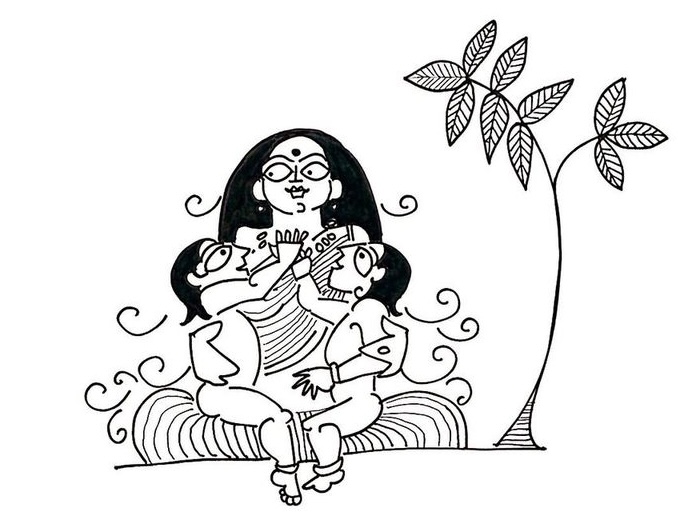
As a child, Hanuman wanted to learn everything about the world. He asked his mother how he could do so and his mother pointed to the sun and said that since the sun saw everything, Hanuman should learn from the sun god, Surya. Hanuman approached the sun god and asked, “I want to learn of everything you see and observe in the world. You have more knowledge than anyone else. Can you please teach me?”
The sun god replied, “I have no time. I travel all day and rest all night. I cannot pause to teach you.”
Hanuman persisted, “Why do you have to pause? I will ride in front of your chariot each day and you can teach me while you are travelling.” In some versions, he said, “I will expand myself towards the sky so that my feet are resting on the eastern and western horizons, and I will keep looking at you all day facing your chariot.”
“But my glare will be too hard to handle and the pain and the heat will be intolerable,” reminded the sun.
Hanuman was not one to give up. “It doesn’t matter, knowledge cannot come without suffering. One must work hard.”
Impressed by his determination, Surya agreed. Hanuman spent thousands of years flying in front of the sun’s chariot, staring at the sun from sunrise to sunset, listening to everything Surya had to say. He sublimated from Hanuman the monkey to Hanuman the god of infinite wisdom. He learned Sanskrit, wrote poetry, excelled in martial skills and leadership abilities. He became one of the most knowledgeable beings.

My Hanuman Chalissa
Every time we experience negativity in the world and within ourselves, every time we encounter jealousy, rage and frustration, manifesting as violation and violence, we hear, or read, the Hanuman Chalisa. Composed over four hundred years ago by Tulsidas, its simple words in Awadhi, a dialect of Hindi and its simple metre, musically and very potently evoke the mythology, history and mystery of Hanuman, the much-loved Hindu deity, through whom Vedic wisdom reached the masses. As verse follows verse, our frightened, crumpled mind begins to expand with knowledge and insight and our faith in humanity, both within and without, is restored.


Hanuman: Read and Colour
Hanuman, Anjani’s Mighty Son is perfect as a read-aloud to acquaint young readers with the qualities of valour, selflessness, loyalty and humility that Hanuman embodied.
Curated with fascinating bite-sized stories–from how young Hanuman almost ate the sun to how he helped Ram rescue Sita from Lanka–it features over forty playful artworks along with dedicated colouring pages.