Published on 16th July, 2017, in Mid-day.
One of the things that catch your eye in the middle of a horrifyingly crowded Mumbai local train is the sight of people sitting or standing in a corner, reading from a tiny chapbook sold in roadside shops near temples. The most popular among these is the Hanuman Chalisa. In the midst of the crushing inhumanity that is urban life, you see a glow on the reader’s face. It is the most powerful expression of personal Hinduism that one can encounter on India’s streets.
I have always wondered what the Hanuman Chalisa is and what is in it that makes it so popular. Its language – Awadhi – is an old dialect of Hindi, one of the many languages of India. Do people reading it understand what they are reading? Or does the gentle poetic rhythm calm the nervous heart, as it prepares to face the day? Or is it simply a ritual exercise, where the point is to do, not think or feel?
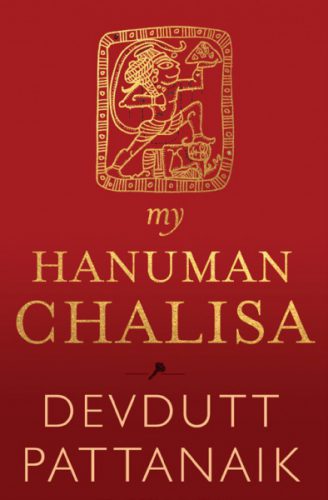
So, I decided to explore this popular religious work through which a Hindu god is made accessible to the masses. The first thing that struck me was that reading this chapbook is completely voluntary, as in all things Hindu. It is neither a commandment of a guru, nor a prescription of a priest. Its popularity is organic. Its ordinariness makes it sublime.
As I went deeper, I realised each line allows us to leap into the vast body of Hindu thought, a heritage of over 4,000 years ago, much as Hanuman leapt from his cradle to the sun, or across the sea towards Lanka, or over land towards the mountain bearing the Sanjivani herb, always returning to Ram. From the particular, we traverse the universal, and finally return to the personal.
As you go through the 43 verses in this book, you will notice how sensitively the poet has structured his work, how it creates a temple in the mind, and enshrines a deity in that temple, and how the verses take us from ideas of birth, through ideas of adventure, duty and glory, to the ideas of death and rebirth.
Chalisa essentially is a poem of 40 verses (chalis means 40 in Hindi). Hanuman Chalisa, however, has 43. The main 40 verses are chaupai, or quatrains (verses with four short, rhythmic segments). Framing these are three dohas, or couplets (verses with two long, rhythmic segments) – two at the beginning and one at the end – which serve as the entry and exit points into the ‘mind-temple’ that is created by the Chalisa.
In my work, I have always avoided the academic approach, as scholars are too busy seeking ‘the’ truth while I am interested in expanding ‘my’ truth and the truth of my readers. If you seek 100% perfection, you lose 99% of readers in cantankerous and often self-serving debates; but if you seek 90% perfection, you are able to reach out to over 90% of readers through thought- provoking elaborations that seek not to convince but to enrich. And that is good enough for me.