Published in Mythos, First City, on May 2013.
In my new book “Business Sutra: An Indian approach to Management” I refer to the critical role that the idea of goal plays in mythologies of Western origin. In Greek mythologies, there is the notion of Elysium, the heaven reserved for heroes, men and women who tower over the ordinary and the mediocre, challenge the limitations imposed by the Olympian gods, and become worthy of admiration. In biblical mythologies, there is the notion of the Promised Land, the paradise of the faithful, the land of milk and honey and freedom, reserved for those who comply with the commandments of God. Western thought, strongly influenced by Greek and biblical ideas, entered India as a major force after the British took control of the land. Willy-nilly, they valued the idea of goal, a destination that one works towards. Even secular western thought subscribes to the need for this end-point of human activity. So naturally, when the Western mind studies Hinduism they want to know: What is the goal of Hinduism?
Over the years, as Indians have subscribed to the Western template, we have sought to explain Hinduism in Western terms and this means granting Hinduism a goal, a purpose. And we have concluded that it must be mukti or moksha, liberation from the material world, a break from the cycle of rebirths. It fits in well with our notion of Hinduism being more spiritual that Western ideas which are more material, focused as they are on achievement. Buddhism, we are told, also has a goal called nirvana: blowing out the flame of individual identity. So does Jainism: it is kaivalya, omniscience, achieved through practice of non-violence.
Is this right?
Let us step back and examine this from a distance.
What separates ideas that originated in the Indian subcontinent from ideas that originated outside the Indian subcontinent, especially in Europe (Greek) and the Middle East (biblical)? It is the idea of rebirth. Like one-life, rebirth, is an idea. No one really knows what happens after death. So different cultures respond to mortality differently. Some choose to see it as a full-stop and others as a comma. These ideas shape the way we see the world.
In India, there are no full stops, and there are no boundaries. Time has neither beginning nor end. Space has neither beginning nor end. In Jain mythology, time and space are identified as chakra, the wheel, that keeps expanding and turning.
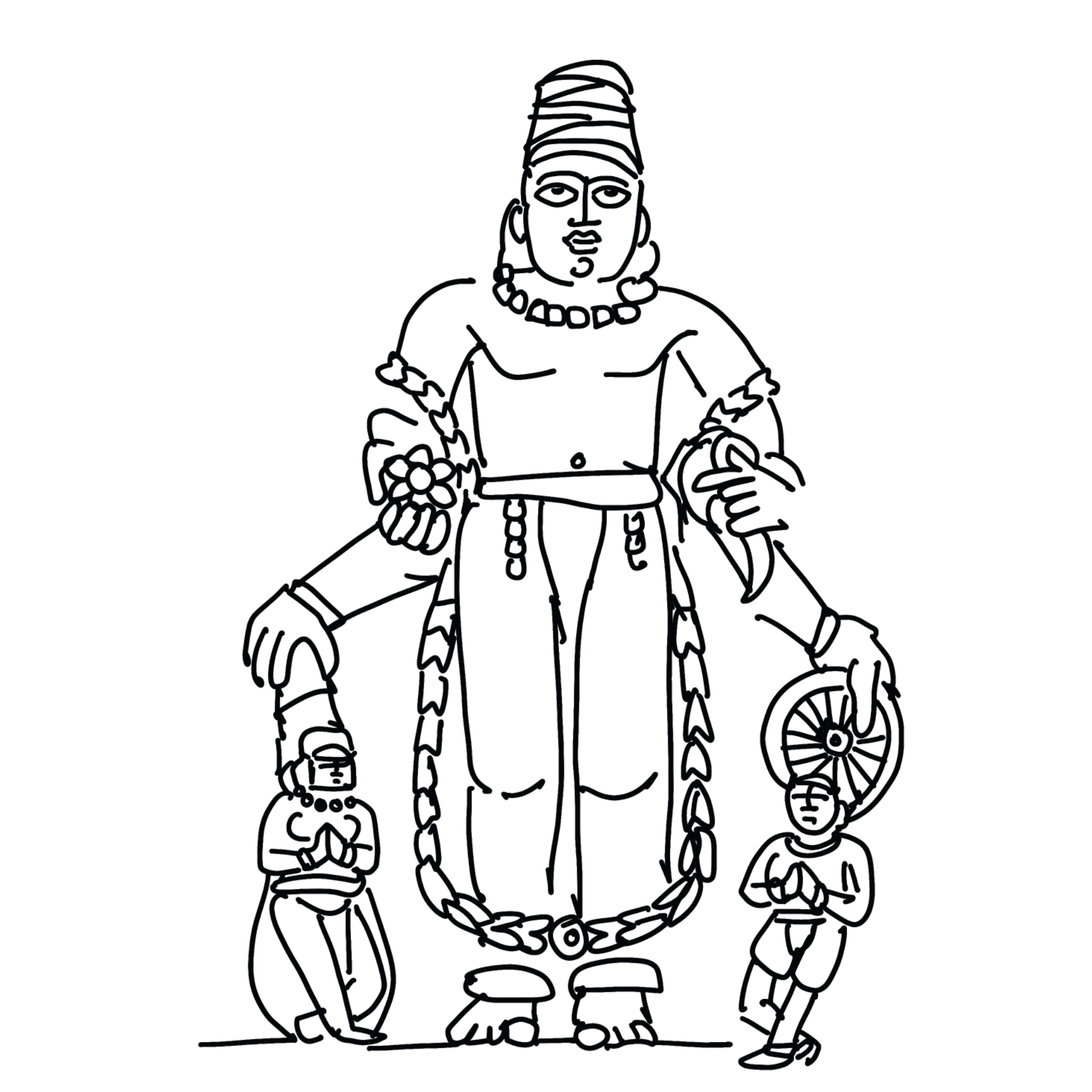
In the centre of the wheel we are told is the point where there is no expansion or movement; it is Meru, the axis mundi, the spot of silence and stillness. But can one exist without the other, the stillness of the center and the movement of the periphery? A monastic order will give primacy to the still centre, and this is what we see in Buddhism, Jainism and monastic Hinduism (popularized by Adi Shankara charya and the many saffron robed gurus and mahants of India). But society rejects this and values the movement of the periphery, the world that expands and transforms continuously. That is why Buddhism adapted itself over time and included the feminine as Tara, and Jainism framed the ascetic Tirthankara with Yaksha-Yakshi couples who sat under rich fruit bearing tree. In Hinduism, the hermit Shiva is forced to become the householder, Shankara, by the Goddess. And Vishnu is continuously taking avatars, always aware that all his achievements are temporary. He will have to descend as Ram and Krishna infinite times. Indian fairy tales do not end with a happily ever after; the story continues forever, as Vikram keeps trying to catch the elusive Vetal.
So while monastic orders speak of a fixed goal, the social orders reject this idea. In a world where everything is impermanent, where even death is a comma, moksha or mukti or kaivalya cannot be an end point. Certainly not for all. Thus in Jain mythology, Siddha-loka, that exists outside the rules of space and time, is reserved only for exalted beings like the Tirthankaras, and in every era, there are just 24 who will achieve this status. The remaining millions will continue to be reborn. Goals are predetermined endings for a very limited number of beings. In Buddhist tradition, the idea of Buddha simply disappearing in nirvana while millions continue to suffer was found to be unacceptable, which provoked the idea of Boddhisattva who stays in the world of rebirth or samsara until all are liberated. But what happens when all are liberated — the world will end. And is this end permanent? Cannot be, for as Buddha said, all is impermanent. The cycle will continue, at least for some.
The modern mind seeks a common universal answer to all things, an objective answer. But since ‘modern’ thought has roots in Europe/America, it subscribes to the Western notion of linear worldview and goals and so seeks goals everywhere, even in the exotic East. The idea of living without goals seems aimless, purposeless, meaningless. Even nature is given a purpose, with words like ‘evolution’ and culture is given a purpose with words like ‘development’. Everyone needs to go somewhere.
The sages of India would smile. Yes, goals give us a sense of purpose and milestones give us a sense of achievement. But why do we need goals and milestones? Why do we want to see heaven as the final chapter of a book or as the last room where everyone will end up eventually? Is it the human way to cope with nature, who refuses to give us a purpose, or meaning? The body will have a full stop; but does the mind? Does the mind resist the death of the body and demands freedom from this physical tyranny?
In cultures that believe in rebirth, there is an acceptance that some people need purpose, and some people do not. One view is not better than the other. But there will always be a contest as to which is better. There is no universal answer. Every guru’s view can be countered by another guru’s view. The Indian sages were never in a hurry to go anywhere. They sat and watched, and observed and smiled in wisdom, not just on icy mountain tops like Shiva, but also while seated on thrones like Ram or while riding into battle like Krishna. We can be still, silent and observant, even when we are on the journey, in search of our very own full stop.