To understand why Ganesha is worshipped as the remover of obstacles and invoked before every Hindu ceremony, we must understand—and appreciate—the role elephants have played in Indian history and imagination. Elephants are not merely large animals in India; they have shaped the way people thought about power, prosperity, and opportunity.
Archaeological evidence indicates that elephants roamed both India and China approximately 4,000 years ago. The Harappan seals, dated around 1500 BCE, depict elephants, while oracle bones from China of the same period also record elephant symbols. Yet, the fate of elephants in the two civilisations was very different. In China, elephants were treated as pests that damaged farmland. Since the king’s duty was to protect agriculture, elephants were systematically wiped out. They were totally exterminated, so they never became central to Chinese mythology or religion. Whenever elephants appear in Chinese history, it is through foreign tribute, used only in ceremony, never as part of warfare.
In India, however, elephants were revered. It is hard to imagine Indian landscapes or rituals without them. They were probably domesticated by 1000 BCE. Early Vedic ritual texts hardly mention elephants, but by about 800 BCE, kings were gifting elephants—indicating clear signs of their value. The importance of elephants in India can be understood through the monsoon. Even today, Indian cities collapse during the rains: roads flood, potholes multiply, and embankments break. In ancient times, without tarred roads, the problem was worse. The rainy months were so dangerous for travel that people observed chaturmas, a four-month retreat indoors. After the monsoon, roads disappeared under mud and overgrowth.
This is where elephants became crucial. Kings would line up elephants to walk in a row across the jungle. Their massive bodies trampled foliage, carved paths, and flattened the earth. In effect, elephants were bulldozers, tractors, and road-rollers combined. They cleared routes for traders, pilgrims, and armies. Perhaps that’s the reason why elephants came to be seen as creators of opportunities and removers of obstacles.
The sacred aura of elephants runs through Buddhist and Jain traditions, too. Buddha’s mother dreamed of a white elephant entering her womb, foretelling his birth. Jain texts describe elephants in the dreams of Tirthankara mothers. In Buddhist art, elephants flank Lakshmi, showering her with water as she sits on a lotus. Sanskrit poetry adored elephants, whether in describing the erotic sway of a cow-elephant’s walk or the unstoppable force of an aroused tusker. Elephants symbolised wealth, fertility, and power. Ganesha worship, however, is relatively late. While names like Vinayaka appear in older texts, the familiar elephant-headed deity we know today emerged around 1,500 years ago. Early Puranas, such as the Vayu Purana, do not even mention him. The oldest clear images of Ganesha come from sites like Udayagiri in Madhya Pradesh, roughly dated to the Gupta period. Over time, Ganesha evolved from a remover of obstacles to a bestower of prosperity, and finally into the embodiment of contentment. The stories of Ganesha’s birth reflect these themes. In some tales, Shiva creates him to satisfy Shakti’s maternal longing, despite Shiva’s own ascetic disdain for children. In other versions, Shakti fashions him independently, moulding a child from turmeric and sandal paste, breathing life into him. Because no man was involved in his birth, he is called Vinayaka, “one without a master”.
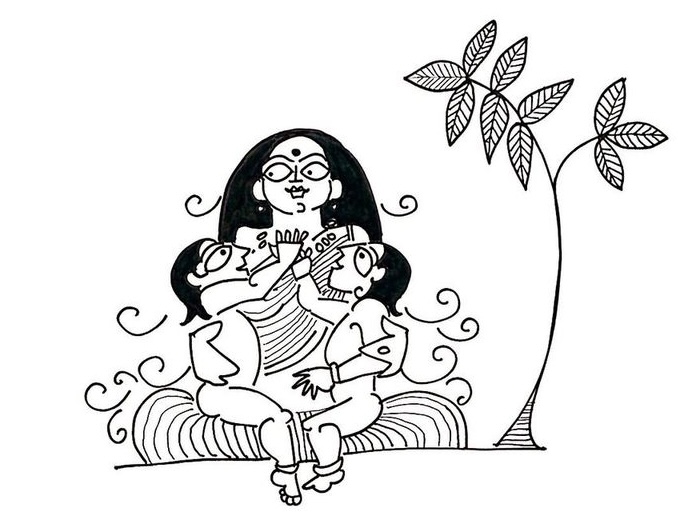
When Shiva discovers the child, jealousy and rage drive him to sever the child’s head. Shakti’s fury forces Shiva to replace the lost human head with the head of an elephant, first seen in the northern direction. This elephant head is not just an odd detail. Its symbolism runs deep. The white of the elephant head (seen mostly in Bengali images) suggests rainclouds in the sky, while Ganesha’s red body symbolises the fertile earth. He is thus a union of sky and earth, prosperity and stability, and God and Goddess. Yet the elephant’s raw force is tempered by a human body, usually depicted with a pot belly. Around this belly coils a serpent.
At Ganesh’s feet sits a rat, his vehicle, while in his hand he holds sweets. Strikingly, the snake does not eat the rat, the rat does not eat the sweets, and Ganesha himself remains calm. The image radiates contentment. No one is hungry. Everyone is satisfied, no one overreaches, no one consumes more than they need.
This is the deeper meaning of Ganesha. Contentment leads to sufficiency, and sufficiency creates surplus, and surplus can be invested in others. This creates mangala, an auspicious ecosystem, that lies at the heart of Ganesha worship.