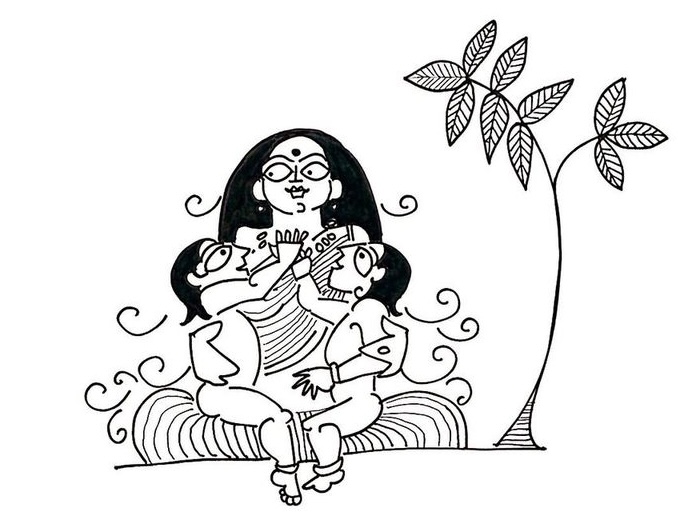
Stories shape culture. The Mangal Kavyas is one such example. They are folk narratives that emerged in Bengal between the fifteenth and eighteenth centuries. This was the period after Muslim rule had been established in Bengal, when older Buddhist institutions had declined, Brahmanical Hinduism was struggling to reorganise itself, and Islam was expanding rapidly, especially in eastern Bengal.
In this setting, the Mangal Kavyas became narrative instruments through which Hindu identity was reconstructed in western Bengal, particularly in the Rarh region west of the Bhagirathi river. Rarh was geographically distinct from the fertile alluvial plains of eastern Bengal. It was marked by lateritic soil, forests, marshes, and unstable river channels shaped by the Damodar and other rivers. Until late medieval times, it remained sparsely settled. Hunting, fishing, pastoralism, and shifting cultivation dominated.
Many inhabitants belonged to marginal castes and indigenous communities who worshipped local deities of snakes, disease, forests, fertility, and justice. These were regions neglected by Brahminical elites and actively engaged by Sufi missionaries.
Folk deities in the Mangal Kavyas
The Mangal Kavyas were a creative response. Composed in Bengali by rural Brahmans and performed orally in village settings, they did not centre on classical gods. Instead, they foregrounded folk deities such as Manasa, Chandi, and Dharma. These texts were not merely devotional. They were acts of cultural negotiation, allowing Hinduism to absorb local religious worlds rather than erase them.
The Manasa Mangal illustrates this clearly. Set in the mercantile, riverine world of Bengal, it narrates the conflict between Manasa, goddess of snakes, and Chand Sadagar, a wealthy merchant devoted exclusively to Shiva. Chand’s refusal to worship Manasa is portrayed as elite religious arrogance.
Manasa retaliates: ships sink, sons die of snakebite, and the household collapses in grief. The narrative dwells on suffering, especially that of women, culminating in Behula’s perilous river journey with her dead husband’s body to the divine realm. Only when Chand reluctantly acknowledges Manasa does prosperity return.
Social transition in Chandi Mangal and Dharma Mangal
The Chandi Mangal unfolds in forest frontiers and newly settled agrarian zones. The goddess Chandi elevates Kalakettu, a forest hunter, into kingship, granting him territory and legitimacy. His ascent is turbulent, marked by pride, violence, rebellion, and defeat. Yet the narrative is less about moral correction than about social transition.
It mirrors the historical clearing of forests, agricultural expansion, and the emergence of new political authorities in western Bengal. Chandi, not originally a Puranic deity, becomes a patron of settlement and state formation, embedding popular religious authority within evolving Hindu kingship.
The Dharma Mangal is more overtly political. The deity of Dharma, worshipped largely by ‘low’ castes, appears in early compositions such as the Shunya Purana as an opponent of Brahmanical dominance. Even Hindu gods take the form of Muslim warriors. These episodes preserve memories of resentment against Brahmanical oppression. This tone corresponds to the initial phase of Muslim rule, when lower castes perceived Islam as a social leveller.
Hindu reorganisation in western Bengal
Later Dharma Mangal texts reverse this orientation. The deity of Dharma is gradually absorbed into Hindu cosmology. His followers align against Muslims. The deity who once mocked Hindu gods becomes their ally. This marks the success of Hindu reorganisation in western Bengal. Folk religion itself is rewritten to sustain Hindu identity.
The flowering of the Mangal tradition coincided with three major developments in Rarh: the Vaishnava movement of Chaitanya in the early sixteenth century, the expansion of settled agriculture, and the consolidation of Mughal authority. Chaitanya’s devotional egalitarianism softened caste barriers and created a climate of inclusion. Ecological change allowed forest communities to shift to agriculture, forming new peasant castes seeking ritual legitimacy. The Mangal Kavyas supplied that legitimacy by sacralising their deities, occupations, and aspirations.
The Mangal Kavyas were therefore not peripheral literature. They were instruments of religious strategy shaped by ecology, geography, and social change. Through emotionally charged narratives of humiliation, suffering, negotiation, and reconciliation, they transformed folk deities into Hindu gods, and subaltern worshippers into Hindus. Western Bengal did not remain Hindu by resisting Islam, but by reinventing Hinduism itself.