Published on 27th February, 2015, in The Economic Times.
In Jain mythology, the Vasudeva or hero is much like a modern entrepreneur establishing his business aggressively while the Chakravarti or king is like an established businessman consolidating his business with patience. The Vasudeva is focused on problem solving. By contrast, the Chakravarti has perspective of the different contexts that exist in different parts of his empire.
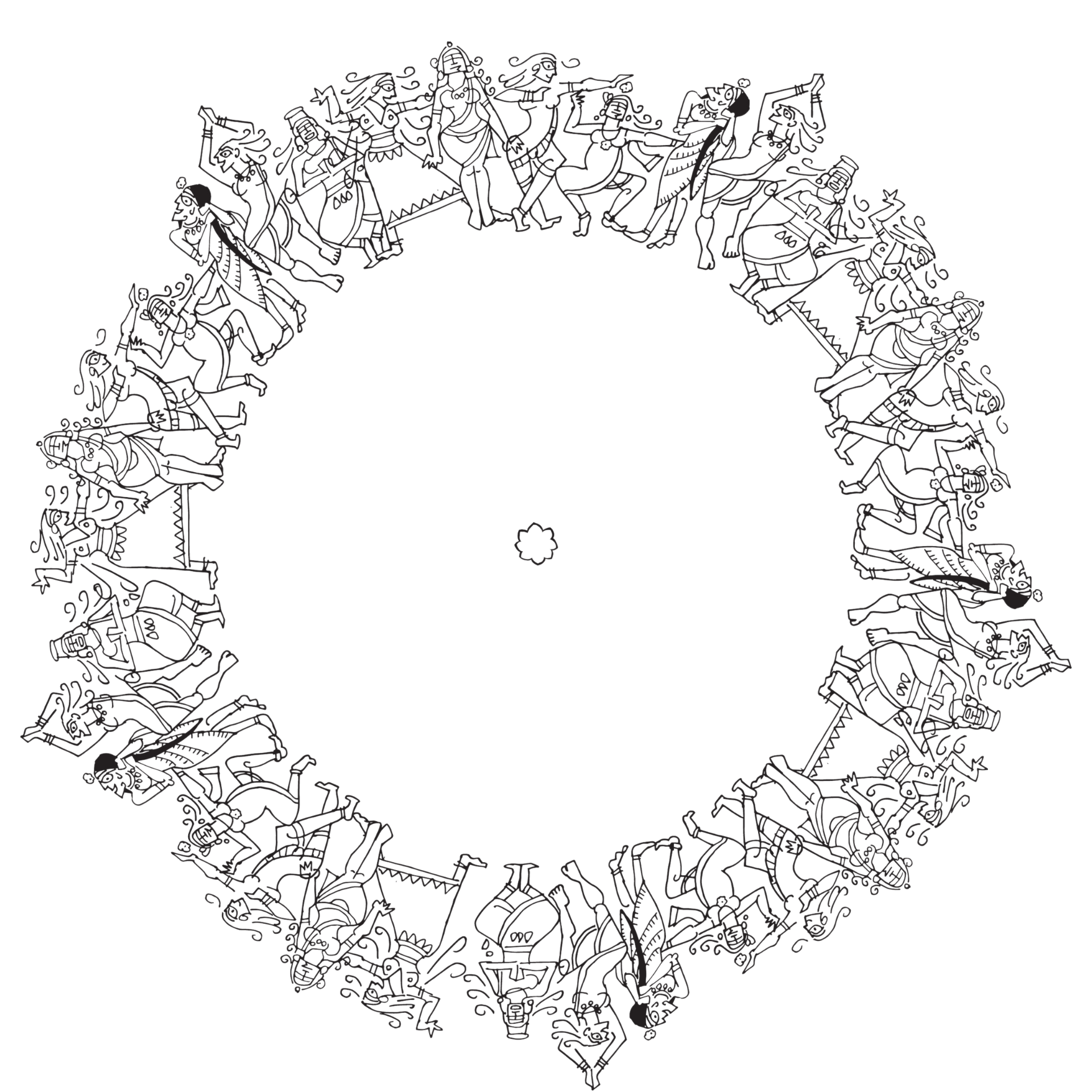
The chakra of the Chakravarti refers to the wheel of his chariot that is free to move on highways to every corner of his kingdom. The chakra is also a symbol of his kingdom with he in the centre and the spokes representing the laws through which he holds the frontier together. The rim of the wheel represents the horizon, how far his kingdom stretches: as far as his eye can see. The higher he rises, the wider is his span of control. It can even stretch beyond mountains and seas, to faraway lands, as in case of Emperor Ashoka.
In recorded history, Ashoka had the biggest empire in India. And it is significant that it is in his time that the Indian script finally emerges. Ashoka ruled in the 3rd century BCE (Before Common Era, formerly known as BC, Before Christ) and the first evidence of writing in the Indian subcontinent appears on his many stone edicts scattered across the land at this time. This seems rather strange. Before that the only Indian script comes to us in the form of the as yet un-deciphered script of the Indus Valley Civilisation. In the 1500 years in between, writing seems to have disappeared, at best reduced to a memory, known may be to an elite few such as Panini the grammarian who does refer to a script. Megasthenes notes the absence of writing in the time of Ashoka’s grandfather, Chandragupta. The Vedas were orally transmitted hence called ‘that which needs to be heard’ (shruti). In other words, though Indian literature is over 3500 years old, writing in India is less than 2500 years. Scholars composed sutras or aphorisms, for easy oral transmission and Veda had an elaborate method of memorisation and chanting for faultless transmission. Writing was never seen as important as the spoken word. So why did writing become so important in the times of Ashoka?
It clearly has something to do with controlling a vast empire, from the North West frontier to Gujarat in the West to Telangana in the South. How did the king establish his power in his absence? He needed to establish monuments, pillars with his symbol: the lion, leaving no one in doubt about who was in charge. And then, putting across edicts stating clearly his goals and expectations.
The script was Brahmi. According to legend, it was invented by Rishabha-natha, the first Jain tirthankara and passed on to his daughter, Brahmi. The Jains were nastikas: they rejected the Vedas and the way of the Brahmins. In the absence of writing, all knowledge was located in the mind of the Brahmin; this is why killing a Brahmin was forbidden as it was equal to killing a library. This made the Brahmin very powerful, too powerful. He jealously guarded his knowledge. With writing knowledge escaped human restraint. It existed outside the Brahmin’s human body, free for anyone who could read.
The language in which Ashokan edicts were written was Pali, spoken by the common man, not Sanskrit, the language of rituals. Clearly there were people in faraway lands who could read what was written, people who mattered, like local kings, their courtiers, their advisors and merchants. With writing, there was little chance of lost in translation and a sense of immortality – our word surviving even if we don’t. That is why Ashoka patronised the script as a tool to control his vast empire, and establish his authority up to the rim of his ‘wheel’.
In modern times, as businesses set up operations in different parts of the world, they need to have their own ‘script’ to establish control. The Roman Catholic Church, which has existed for over 1500 years across all continents, did it by insisting that all its clergymen speak only Latin, a decree that was changed only in the last century. The invention of the telegraph in the 19th century made it easier for Queen Victoria’s court to control her jewel in the crown, India, than it was for the directors of the East India Company.
Today, we have the Internet that allows us to connect with anyone around the world using video conferencing facilities. But increasingly people are asking: is it technology alone that enables us to get the best from our offices in other countries? In the global village, everyone seems to be dressing alike, speaking alike, and using the same modern management vocabulary with words like goals, alignment, and authenticity. Tension comes from cultural differences: the disrespectfulness of Americans, the imperiousness of Europeans, both of whom imagine they are fair and democratic, the secretive nature of the Chinese and the ambiguity of Indians.
We need someone local to take charge and yet want to oversee his actions and ensure all is well. Most European multinational companies tend to exert control through the CFO who is typically an expat with direct connections to the head office while the CEO or at least the marketing and sales guys are local. Thus a churn is created, a push based on local competence and a pull created by a more central control. Technology and communication establishes lines of communication, which is critical, reviews ensure control, but what really gets going is valuing local talent, which is unknown, and gently enriching it with central talent that is known. If we think one is better than the other, it will not work. This balance between central and peripheral is critical. We must not forget that even Ashokan edicts are customised: the ones in Pakistan and Afghanistan were written not in Brahmi script, but in the local Kharoshti, Aramaic and Greek. The ideas were, however, the king’s, everywhere.