Published on 25th February, 2018, in Mid-Day.
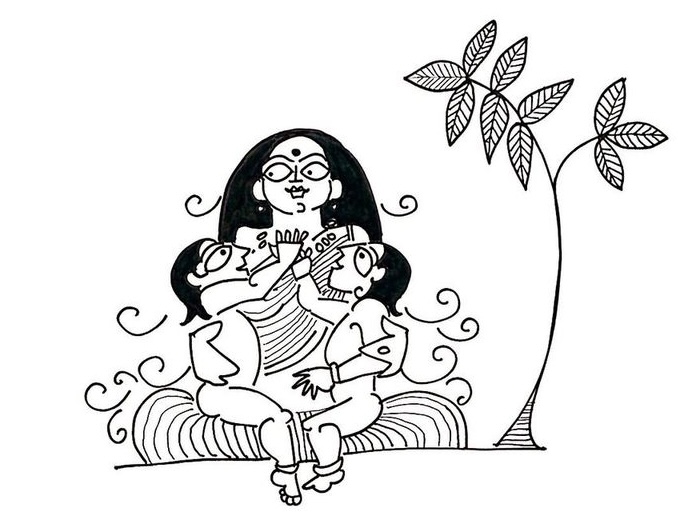
In Buddhist lore, we are told that Buddha’s mother, Maya, died seven days after his death. After attaining Buddha-hood, the Buddha went to meet his mother in heaven, and share his wisdom with her. In many retellings, in her new life in heaven, Buddha’s mother is a god with a male body, for she had earned enough merits as Buddha’s mother to gain a male body in her future life. This story, especially its retelling, where Buddha’s mother becomes a male god in her next life, reveals a Buddhist myth – that gender is fluid, women can become men, and men can become women in future lives.
But there is a twist. In the Buddhist mythic world, in order to become a Buddha, which is the goal of all living creatures, one needs a male body, and, to get a male body we need to earn merits by doing good karma or punya. Otherwise we are trapped with a female body. And with a female body, we are likely to end up in hell which is like bowl of blood, as per the Chinese Blood Bowl Sutra, the blood indicative of the blood that is shed during menstruation and childbirth, the blood that pollutes the waters of the world, the blood that entraps us in samsara from which only Buddha’s doctrine (dhamma) can take us towards nirvana, via a male body.
When Buddha descended to earth after visiting his mother, large crowds of people wanted to meet him. Amongst them was a virtuous nun called Utpalavarna, who could not make her way through the crowds. Out of compassion and awareness of her merit acquired by Buddhist practice, Buddha transformed her into a man with auspicious marks so she could make her way through the crowds, and on reaching him, regained her female body. This story is told by the 5th century Chinese monk Fahein. Again, virtue makes a woman a man.
Stories of women turning into men are rare. Upagupta, Ashoka’s teacher, turns into a woman to teach monks detachment. When a monk constantly thinks of his wife, Upagupta turns into a woman to show him the nature of transience and desire. A monk who thinks he has conquered desire, one day saves a woman from drowning and feels sexual attraction towards her only to discover ‘she’ is just Upagupta. Thus, in this story, the female form drags you down but male form elevates you.
However, in Chinese Buddhism, we discover something very different. Compassion transforms the male Buddha or rather the male Bodhisattva ‘who looks down’, known as Avatilokeshwara, into the female Kwan-yin, the one who hears the cries of devotees.
These stories of female to male transformation and male to female transformation reveal traditional Buddhist attitudes towards gender. The wise say that the male is simply metaphor for the spiritual self and female is simply metaphor for the material self. However, common people did not appreciate these sophisticated metaphors and concluded women were inferior to men because they menstruate and cannot withhold bodily fluids as men technically can.
It is up to us today to decide if these stories need to be seen literally, or metaphorically, and reflect on attitudes towards genders that have shifted over time.