Published on 11th May, 2014 in the Mid-Day.
Many people ask me the meaning of a ritual: why do young people touch feet of elders, why do Indians stand up during national anthem, why do Hindus hang leaves and flowers on the threshold of the house during festivals, why do Muslims fast during the month of Ramzan?
I give them explanations that comfort them, which is assumed to be the ‘right’ explanation. If I tell them rituals are essentially meaningless, they will reject my answer, for such an answer makes no sense to them. Thus do those who ask questions often control answers they receive.
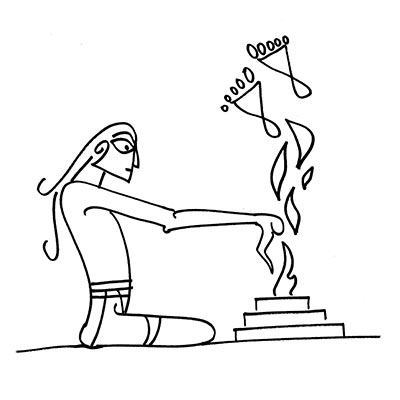
Rituals have no intrinsic meaning. But that does not mean they are not valuable. This is what many sociologists and anthropologists have been trying to explain, but few have accepted this answer.
Look at the singing of the national anthem: its value lies in performing it and not in understanding it. Whether the song makes sense or not, whether you feel like standing or not, whether you feel it communicates respect or not, you are obliged to do it unconditionally. You have no right to edit it, re-imagine it, or reinterpret it. Even the courts are clear. It has to be performed in the way laid out by the founders of the country. No questions asked.
By performing it collectively, regularly and over long periods of time, the feeling of patriotism is evoked. This is the ‘behavioral’ model of rituals, that educates us through the body while bypassing the mind. It is perhaps based on how children learn, through mimicry. That is why many ritualists will say, just do ‘puja’ and slowly ‘bhakti’ will emerge in your heart. In the same vein, many management gurus speak of developing ‘habits’ through repetition so that you develop spontaneous responses without thinking about them too much. This is also the Chinese method of teaching the body martial arts, responding to attack without bothering with thought. It is very similar to the way we toilet train dogs. The analogy of the dog may discomfort some people — but it is the outcome that matters.
Followers of this model in ancient India were the karma-margis, who were also called brahmins as they were keepers of ritual manuals called brahmanas. They chanted the Vedas meticulously and systematically (pada-patha) but did not bother with the meaning of the words chanted. They were challenged by gyan-margis, who took inspiration from the Vedic ritual and saw their ideas as the underlying meaning of the yagna. Their conversations became the Upanishads and eventually were called Vedanta. Some gyan-margis, who abandoned the Vedic path altogether were called shramanas (Jains and Buddhists).
Today when people seek meaning of particular rituals, they want the answer to fit a particular template that they have in their mind. For example, they expect all ancient stuff to be ‘scientific’. Try explaining more complex non-literal meanings using psychology or sociology, and they will turn away saying, “Gyan mat do. That’s too intellectual,” or “That is not correct, I feel.”
We have to make room for minds that cannot handle abstract concepts. That is why the old ritual karma-marga. Intellectuals and rationalists dismiss them because they assume every human being is an intellectual and a rationalist. But — looking at how we vote — we all know that is not