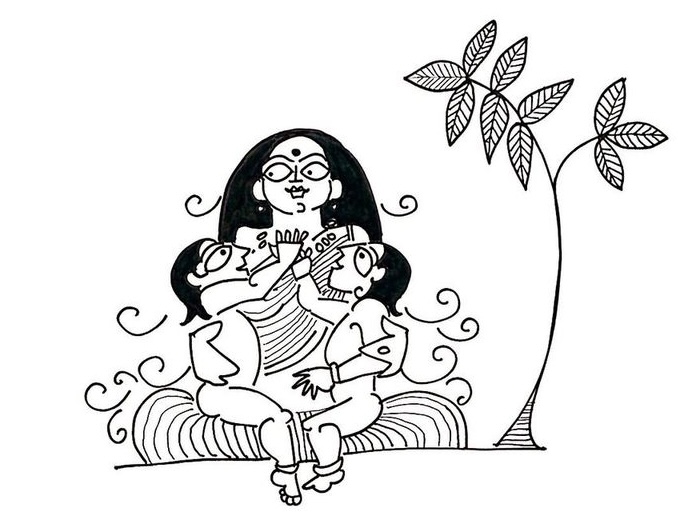
If you only consume today’s festival talk, you would think India’s calendar is a relay race between Ram and Krishna. That is a late narrowing. The older seasonal spine is goddess-centred and nature-driven. It was about paying attention to the weather, to the vegetation, to the sky, to the sun and the moon. The mind was God. Nature was the Goddess.
It all begins with Chaturmas — the four tempestuous monsoon months when Vishnu “sleeps” and Devi keeps watch. Travel halts, rivers swell, snakes surface, hills slip. In this interval of risk, rituals gather around prakriti and the household, curated largely by women.
Start with Gauri-puja (around Ganesh Chaturthi). Traditionally, idols were not plaster and paint but plants, leaves, haldi, betel — the home’s modest botanica. Gauri wears green because the land has turned green. Then comes Pitru-paksha — two quiet weeks for ancestors when consumption pauses and retail slows; the economy performs remembrance rather than acquisition.
With Sharad (autumn) Navaratri (nine nights), seeds sprout in ritual pots; women dance garba — a circle around the garbha (womb). This is not nightclub rasa; it is agriculture in motion, palms clapping near the soil to “wake the earth”.
The famous buffalo-demon is hardly a comic book villain; the buffalo is a monsoon animal, key to paddy ecologies. Folk memory remembers Devi choosing the bull (Shiva’s Nandi) over the buffalo suitor — an animal politics shaped by terrain: cows loathe slush; buffaloes love it. Myth codes environment.
Regional variety is the rule, not the exception. Kali-puja on Diwali night in Bengal, Lakshmi-puja in North and West mercantile homes, Narakasura effigy-burning in Goa and Andhra linked to Krishna or Satyabhama. Kerala largely sits Diwali out; its big markers are Vishu and Onam, tied to equinox logic. Even iconography is nuanced: Dakshina-Kali (right foot on Shiva) and Vama-Kali (left foot) encode tantric grammars of energy.
Women’s authorship is everywhere and often erased. Gangaur in spring, Vata Savitri in summer, Teej in the rains, Karwa Chauth and Chhat in autumn. Household liturgies, food codes, colours, seed-sprouting, fasting calendars — these were not priestly memos but domestic governance. Display also had civic meaning.
The old potlatch impulse — public spending by wealthy families on tanks, roads, schools, annadana — turned private wealth into visible public good. Today we outsource this to the State or to CSR decks, and the civic muscle atrophies.
We must also retire our obsession with standardisation. Hinduism is not a single liturgical document. Calendars vary (lunar nakshatra versus solar), months start on new or full moon, and precession shifted equinox alignments over centuries. Brahmins disagree — regionally, robustly, and productively. Good. Plural ritual ecologies keep culture adaptive.
Re-centring the goddess is not anti-male. It is pro-ecosystem. It reminds us that festivals are contracts with land, water, animals, and labour — especially women’s labour. When we reduce Diwali to a warrior’s homecoming, we miss Lakshmi’s audit of how we earned, spent, hoarded, and gave. When we make Navaratri a fashion parade, we forget the seed in the pot, the sprout on the windowsill, and the choreography that once honoured soil.
Bring Devi back to the centre, and suddenly the calendar reads like what it always was: a handbook for living with the monsoon. It is how children will learn to respect nature and understand how the Goddess expresses her rage through climate change.