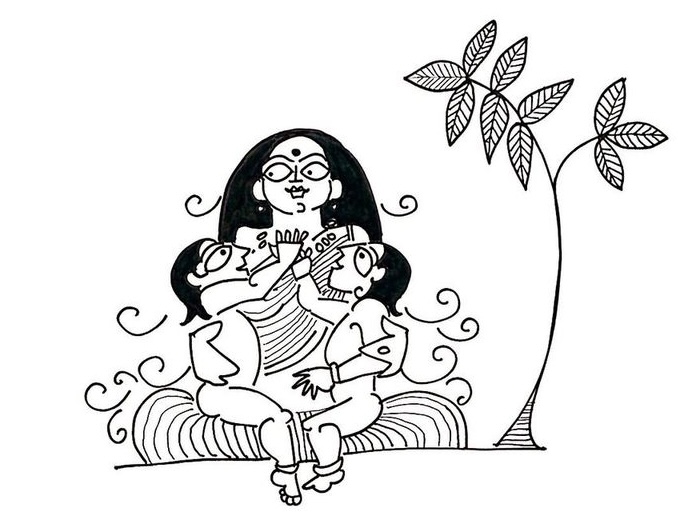
In Hindu mythology, the four months of the rainy season is when Vishnu sleeps. Who protects the world then? It is the Goddess, identified as Yogamaya. And so traditionally, women’s festivals, involving Goddesses, are found in the latter half of the rainy season after the autumn equinox.
In the Deccan region, autumn is the time when Vara-Lakshmi and Mangala-Gauri are worshipped in the form of a pot by women. In the Hindi speaking belt, it begins with the three Teej festivals (Hariyali, Kajari, Hartalika). In Maharashtra’s coastal region, people celebrate Gauri’s arrival at her parent’s house. Shortly thereafter comes Navaratri, the festival of Durga battling the buffalo-demon, said to be the days when the Goddess visits her parents. Durga and Gauri are forms of Shakti, Shiva’s wife. In South India, the Navaratri is the time when Lakshmi, Saraswati and Kali are worshipped, each for three days. When she comes to her father’s house she is fed food she likes–fish especially. Women take a lead in these festivals. The goddess is often represented by herbs. After Navaratri comes Sharad Purnima, linked to Radha in Gujarat and Lakshmi in Bengal. Then comes Diwali, linked to Lakshmi in Gujarat and Kali in Bengal. Between Dassera and Diwali, there is the women’s festival of Karwa Chauth. After Diwali, in Bihar, women celebrate Chhat puja. Then comes the marriage of Tulsi to Vishnu, when he awakens. In the Kartik Purnima that follows, Shiva shoots the arrow to bring down Tripura, three cities of the asuras.
But today Navaratri and Diwali festival is all about Ram and Krishna. Navaratri is the time when Ram defeats Ravana and greetings show him with the bow. Gauri puja is less about the Goddess and more about her son–Ganesha. Sharad Purnima is about Krishna dancing with Radha. Diwali is about Ram’s return to Ayodhya in North India. In South India, it is Krishna killing Narakasura and even defeating Indra, to bring Parijata to earth. Diwali is linked to Vishnu’s Vaman Avatar and in Krishna temples 56 sweets are offered. Many people link Diwali to Lakshmi, but few know about Kali puja and worship of ghosts on that full moon night. Old beliefs connecting wealth with ancestors (inheritance) are forgotten, overlooked, eclipsed.
Much of this has to do with nationalism and the loss of regional identity. Hindu politicians are seeking a homogenous Hinduism with homogeneous rituals and beliefs to bind India. Since 50 per cent of Hindus speak Hindi and live in North India, they ignore the traditions and beliefs of West, South and East India. Delhi manufactures a new form of Hinduism – based on beliefs of the mercantile communities who fund political parties. Thus, Navaratri which was once a time of buffalo and goat sacrifice, especially in royal Rajput, Maratha and Vijaynagar courts, becomes a time of embracing vegetarianism. It becomes less about Durga’s war and more about Ram’s war. Burning Ravana becomes the highlight on the day Durga is dissolved in water.
Gujarat, controlled by mercantile community, transforms the garba (pot) dance, meant for the Goddess, into the dandiya (stick) dance, of Krishna and the gopis. This idea spreads through Bollywood, who do not differentiate between the two dances: one performed by women for the Goddess, the other performed by men and women to experience love of Krishna and Radha.
Those who speak of protecting ancient Hindu traditions are the very people who are seeking to erode Hinduism’s feminine traditions.