
Mythologist | Author | Speaker | Illustrator

-
Articles

Of Weight and Value
Of Weight And Value: The human mind has power to create value and also strip value. Published on 11th June, 2021, in Economic Times. One of the most peculiar things about the Harappan civilization is its obsession with weights and measures. They had binary measuring systems and decimal measuring systems. They also had pans for…
-
Articles

To Burn or Bury.
Published on 21st March, 2021, in Mid-day. Hindus are constantly reminded of the cycle of life, in ritual after ritual. In Vedic times, 3,000 years ago, bricks would be gathered to build a fire altar where the gods would be invited to come and partake in a meal of soma juice. After the gods had…
-
Articles

Fluid Marriage Rites
Published on 7th March, 2021, in Mid-day. Suriya, the daughter of the sun-god, marries the twin-gods, the Ashwins, and rides with them on their chariot. So says the Rig Veda. Later, we are told, that the Ashwins do not actually marry her: they simply woo her for her real husband. In the marriage hymn, Rig…
-
Articles

The Rise of Indian Zaibatsu
The Rise of Indian Zaibatsu: How Indians are adopting more Eastern models Published on 20th February, 2021, in Economic Times. Zaibatsu means financial clique in Japanese. It refers to family-owned vertically integrated industrial and financial business conglomerates that played a key role in the economic transformation of Japan from Meiji period until the end of…
-
Articles

Sea of Spices: How Trade Gets Intertwined With Myths
Published on 26th December, 2020, in Economic Times. There was a goddess called Harsiddhi Mata who resided atop a hill, overlooking the sea in the coastal areas of Gujarat and Sindh. She would see ships sailing by. There were those who would see her temple and not venerate her. So, casting a malevolent eye, she…
-
Articles

Hinduism Beyond Vedas
Published on 20th December, 2020, in Mumbai Mirror. Hinduism is typically taught through a historical lens. We are told that there was a Harappan period 4,000 years ago, followed by Vedic Period 3,000 years ago, followed by the Puranic Age, which began 2,000 years ago, which was then followed by the Bhakti Age 1,000 years…
-
Articles

The Geography of Gods
Who Is a Hindu? The Geography of Gods. Published on 8th November, 2020, in Mumbai Mirror. Hinduism is typically taught through a historical lens. We are told that there was a Harappan period 4,000 years ago, followed by Vedic Period 3,000 years ago, followed by the Puranic Age, which began 2,000 years ago, which was…
-
Articles

Donkey’s Curse and Cross
Published on 25th October, 2020, in Mid-day. In many parts of India, especially in Maharashtra and Goa, one finds stone tablets showing a strange image of a donkey having sex with a woman. Known as “gadhe-gal” or “donkey-curse”, archaeologists believe these stones are 1,000-year-old land grants, carved in stone. They were probably carved by Shilahara…
-
Articles

Tax collection: Old View to New
Published on 18th September, 2020, in Economic Times. Ancient Greeks, like ancient Hindus, valued the idea of city-states and decentralised power. But exposure to Middle East introduced monotheism, the idea of empire, with central control, allegedly for deficient governance. This journey of history is reflected in mythology as polytheism moves towards monotheism. Nearly 6,000 years…
-
Articles
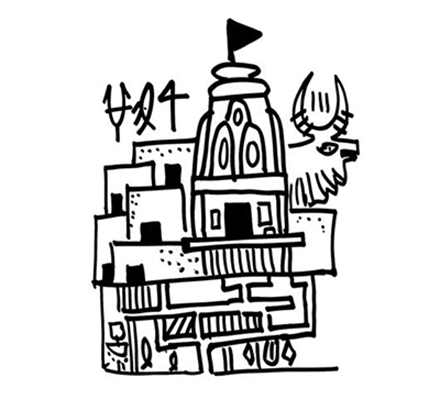
Dark secrets of the sewers of Harappa
Who is a Hindu? Dark secrets of the sewers of Harappa. Published on 13th September, 2020, in Mumbai Mirror. Indians have an uncomfortable relationship with the sanitary system. We have permitted and even justified manual scavenging. A place where the latrine is not connected to the drainage system and so humans have to come into…
-
Articles
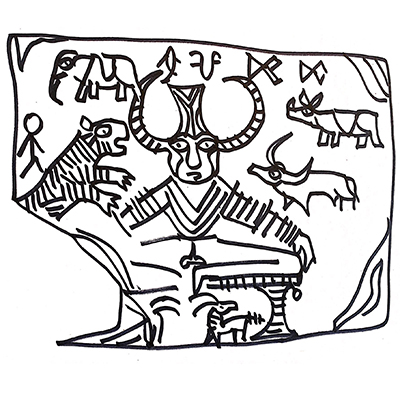
Was Harappa a Jain Civilisation?
Published on 30th August, 2020, in Mid-day. The Harappan civilisation thrived in the Indus Valley 4,500 years ago, roughly around the time the pyramids were being built in Egypt. It is famous for its grid-like cities. Here, we find a seal of a man sitting in a yogic position, surrounded by wild animals. People have…
-
Articles

Sarna, the Harappan Tree Goddess
Published on 16th August, 2020, in Mid-day. One of the things in the about-4,000-year-old Harappan seals is the value placed on trees. There is the peepal tree and the babool (acacia) tree that have been identified. The peepal tree is identified by its characteristic wide tapering leaves. The babool tree is identified by its peculiar…
-
Articles

Was Ram Born In Ayodhya?
Published on 6th August, 2020, in Mumbai Mirror. Devdutt Pattanaik, the author of The Book of Ram, answers some commonly asked questions. ♦ Was Ram actually born in Ayodhya? Hindus believe he was, just as Muslims believe Mecca is where Adam and Eve (Hawa) met after they were cast out of Eden, and Christians believe…
-
Articles

The Missing Horse Of Baghpat
WHO IS A HINDU? – The Missing Horse Of Baghpat. Published on 19th July, 2020, in Mumbai Mirror. Ram rides out of Ayodhya on a horse-driven chariot. Krishna rides out of Vrindavana and into Kurukshetra in a horse-driven chariot. As per astronomical information, found in Ramayana and Mahabharata, traditionalists believe that Ramayana occurred 7,000 years…
-
Articles
How ‘Breaking India’ Started
WHO IS A HINDU? How ‘breaking India’ started. Published on 7th June, 2020, in Mumbai Mirror. At the heart of Hindutva is the idea that Hinduism is under threat from external and internal forces and they must be countered at any cost. The proponents of Hindutva are wary of Muslims and Christians and Dalits, but…
-
Articles
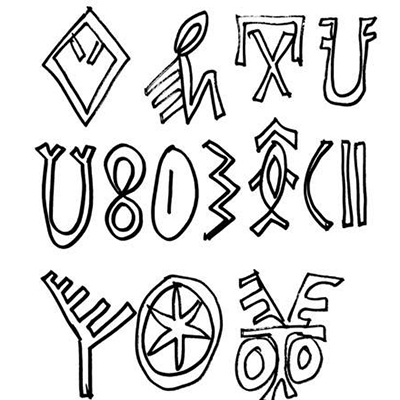
Did the Harappan know to write?
Published on 24th May, 2020, in Mid-day. Writing in India emerges only in the Mauryan period, 2,300 years ago. It is in the Ashokan edicts that we find the Brahmi script. Vedic hymns and Buddha’s lectures, before that, were orally transmitted. The Harappan civilisation, 4,000 years ago, with its sophisticated brick cities and sewage system,…