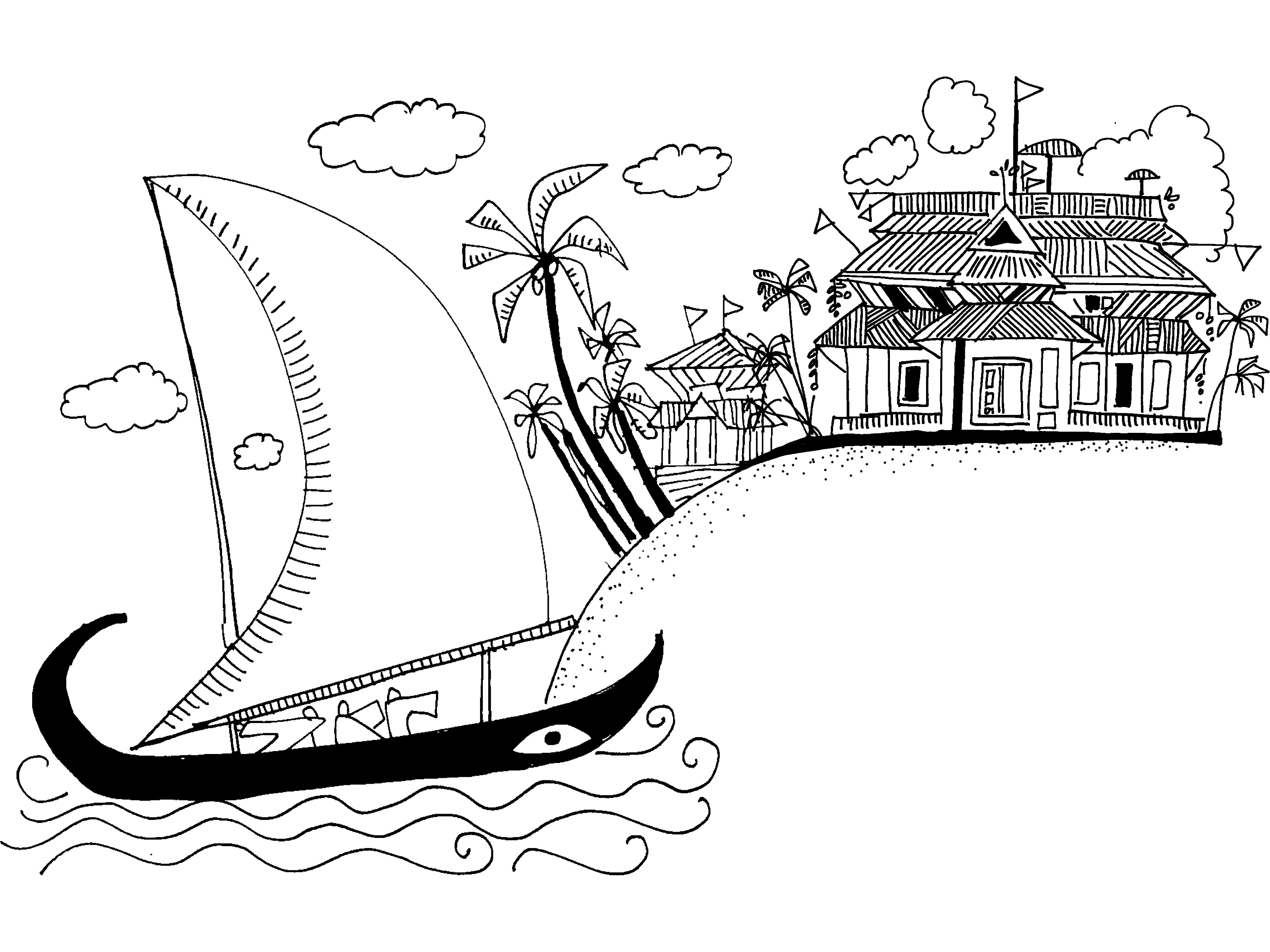
India has had relations with cultures around the subcontinent by both land and sea. By land, it was connected across the Hindu Kush to Persia (modern-day Iran) as well as Central Asia. By sea, it was connected to Persia, Arabia, and via the Red Sea to the Roman Empire. On the eastern coast, it had links with Sri Lanka, Thailand, Vietnam, Cambodia, and Burma.
There were also land routes connecting India through the mountains to Tibet. Indians took advantage of the monsoon winds which enabled ships to reach their destinations in six weeks, which over land would take six months.
Through these routes, India gave many things to the world. Trade with Mesopotamia can be traced back to Harappan times. Land routes opened up when Alexander the Great invaded the northwest Indian subcontinent in 326 BCE. Elephants were exported then in exchange for horses.
Later, during the Kushan period, links were established with Persia and Rome. After the Gupta period, significant connections developed with Southeast Asia, where India was referred to as ‘Swarna Bhoomi’ or Land of Gold.
India’s exported goods
Exported goods included plant products (such as cotton and spices), animal products (such as ivory and birds), mineral products (such as gemstones and precious metals), manufactured goods (like cloth and stirrup) as well as intellectual, literary, mathematical and scientific ideas.
The most exported goods were cotton, spices, and sugar (including sugarcane). The large-scale production and the world-wide trade in crystallised sugar have some interesting facts too. For instance, the word “Chini” likely comes from China’s association with crystallised sugar through trade, while “Misri” from its route to Egypt.
Indian fabrics were popular around the world, with multiple weaves, and vibrant colours as Indians knew the art of fixing dyes using various plant–based chemicals like indigo. Most Southeast Asian countries would give spices to merchants only if they received Indian textiles. So Indian clothes served as a form of currency too.
Animals, gems and mathematical ideas.
Animals like elephants, peacocks, and monkeys were also traded. Persian kings loved Indian peacocks, dogs, buffaloes and elephants. Chicken was probably first domesticated in India, as were the humped bull and the water buffalo.
It exported coloured semi-precious stones like carnelian from Gujarat and lapis lazuli from Afghanistan. Later, India was the only source of diamonds for centuries. The Golconda mines in the Deccan Plateau produced some of the world’s finest diamonds. In addition, steel from India was sent to West Asia as ingots, where it was turned into the famous Damascus steel.
India also gave the world the stirrup, which improved cavalry efficiency by giving riders more stability. The earliest images of stirrups came from Buddhist sites in India.
Mathematical ideas, especially numbers, also spread from India. The concept of zero as a placeholder and the decimal system of writing spread from India via Arabia to Europe. Ideas like calculus, algebra, and trigonometry have origins in India. Also from India spread bookkeeping and banking ideas such as promissory notes, popular in the Gujarat coasts and amongst Jain merchants.
Literary and cultural influence
The Indian script, in which vowels are arranged in a circular manner around consonants, spread to Southeast Asia. Sanskrit, written between 300 AD and 1300 AD, was the literary language used across regions from Afghanistan to Vietnam.
Many religious ideas spread from India as well. Buddhism, particularly Mahayana Buddhism, spread to north-east India, while Vajrayana Buddhism emerged in East India and spread to Tibet. Theravada Buddhism spread southwards, reaching Sri Lanka and from there, spreading to Southeast Asian countries.
Hinduism, and the worship of Shiva as Hara and Vishnu as Hari, reached as far as Vietnam. Chinese records mention that by 300 AD, people in Champa and Funan (present-day Vietnam and Cambodia) had Hindu dancers and Hindu scripts. Deities such as Ganesha, Saraswati, and Lakshmi have been found as far as China.
The concept of Raja-mandala (circle of kings) was an Indian idea mentioned in the Arthashastra of Chanakya, which appealed to southeast Asian kings of Cambodia. In addition, the Manusmriti, an ancient Indian law code, was popular among the kings of Thailand and Java.
The Ramayana and Mahabharata, along with the story of the Buddha, spread from India and were carved on the walls of places such as Borobudur and Prambanan in Indonesia. These stories can also be found at the My-Son temples in Vietnam, on the walls of Angkor Wat in Cambodia, in the pagoda cities of Bagan in Burma, and in Ayutthaya in Thailand. These were the gifts India gave to the world.