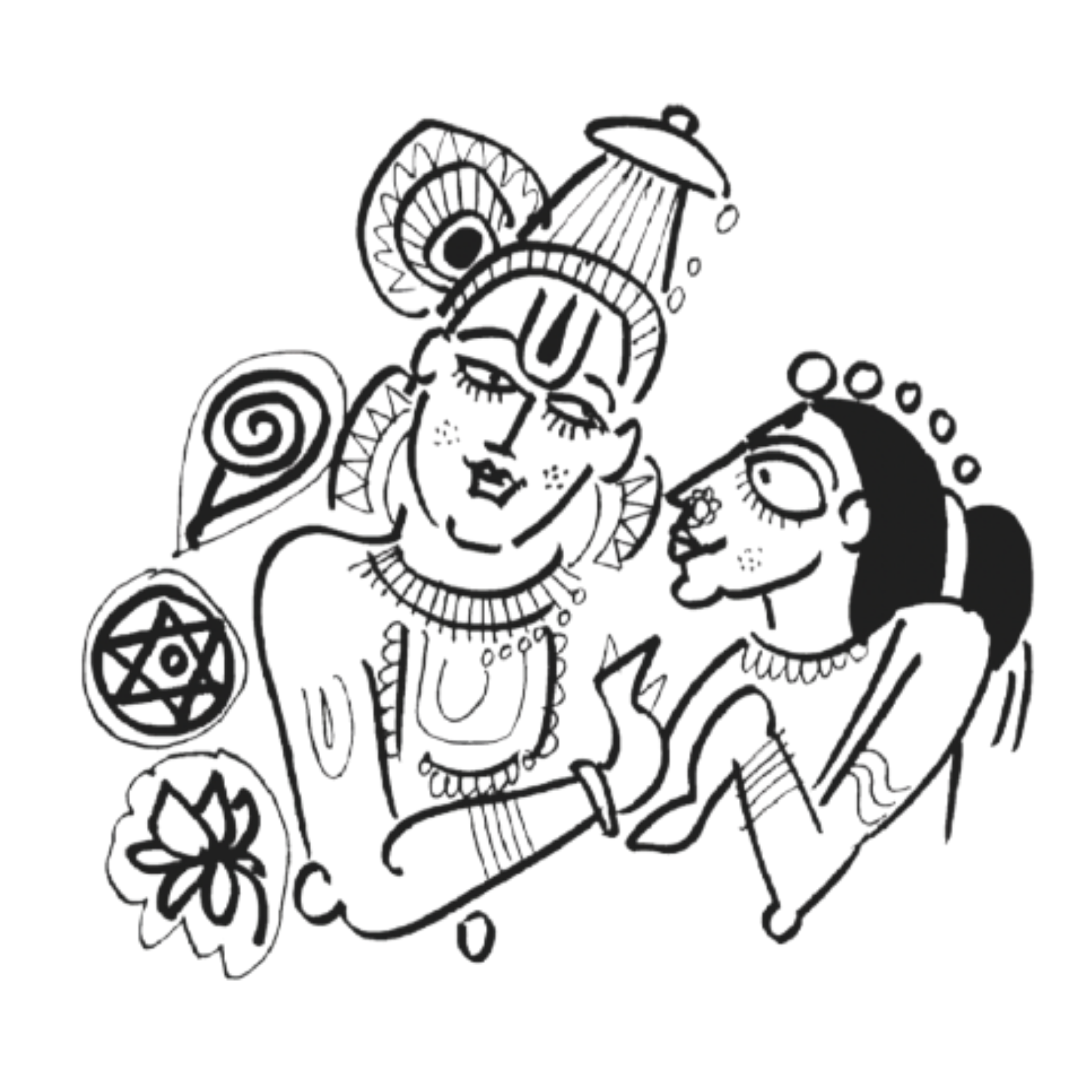
Conch-shells are conspicuous by their absence in the Veda. They are not found in the Ramayana either. But they appear in Mahabharata, used by Krishna and the Pandava brothers, in battle. The conch-shell trumpet heralds the shift of time: a great battle that witnesses the end of Dwapara Yuga and the start of Kali yuga. This conch-shell of Krishna is called Panchajanya. Later, the conch-shell is linked to Vishnu, who sits in Vaikuntha, and descends on earth taking various forms, one of which is Krishna.
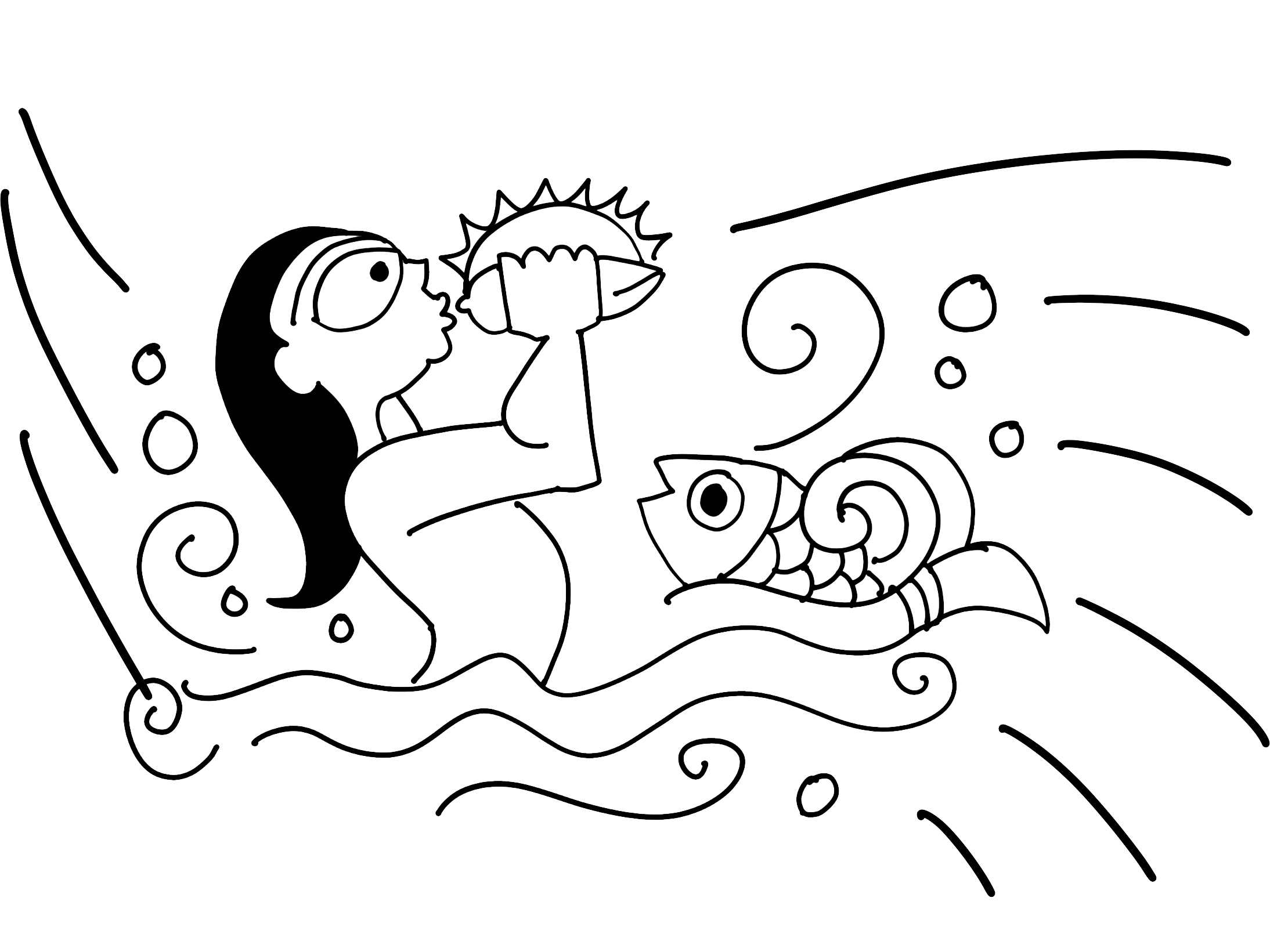
The story goes that when Brahma was sleeping, the Veda slipped out of his mouth and was stolen by a demon. Vishnu appeared either as a fish or a horse-headed being, Hayagriva, overpowered the demon and rescued the Veda. The demon had hidden in a conch-shell, under the sea. Vishnu turned that conch-shell into his trumpet and announced the recovery of the Veda, and the dawn of a new age. Thus, the conch-shell marks the triumph of Vishnu and his recovery of the Vedas. We can speculate that the horse-headed Vishnu is the original Arya while the hose-headed demon is the later horse-riding Greeks, Scythians, and Parthians who favoured Buddhism and Jainism.
This is not the only story of loss and recovery of the Veda. It is a recurring theme in Puranas. In one, Vyasa, a fisherman’s son by a Vedic sage, is asked to recover and organise the Veda. He is then told by Brahma to tell a story to communicate Vedic ideas for the benefit of those who are not allowed to hear Vedic hymns or participate in Vedic ceremonies. In another, Manu survives a great flood on a boat, where he gives shelter to the Seven sages, the keepers of Vedic mantra. When the waters recede, he establishes the age of Manu, which lasts until the next flood and the next Manu. In still another version, Shiva explains the true meaning of Veda to his wife, Uma, and to the sages. He does this by dancing. Thus, the visual form is privileged over oral tradition.
Why are these stories of recovering Veda told? Most of these stories, along with stories of Vishnu and Shiva, emerge only after 500 AD. They mark the great shift of Hinduism, from the old Vedic ways to the new temple ways. This shift in Hinduism ensured Vedic ideas survived despite the rise of monastic orders like Buddhism and Jainism. Stories of loss and recovery of the Veda is thus a metaphor for survival of an old tradition, in different ways, despite many challenges.
Stories of loss and recovery are found in every culture. The Jewish people speak of how the old temple was repeatedly destroyed and how it has managed to survive through the Jewish people. Others argue that following calamity, old ideas get corrupted and new ideas are needed. And so, in Islamic lore, we hear how God sends new ideas through a new prophet when old ideas get corrupted. Abraham’s message when corrupted was replaced by the message of Moses, then the message of David, then the message of Jesus and finally the message of Muhammad. This accounts for the difference in traditions.