Get Site Updates Via Feed | Via Email

Author, Speaker, Illustrator, Mythologist

The Snake Sacrifice

Jul 28, 2008 | Filed under Articles, Mahabharata.

First Published in Sunday Mid-day 'Devlok' on 27 July 2008

It is said that the Mahabharata should not be read inside the house because it is the tale of a household divided. But incredible as it sounds, Mahabharata is not the tale of war or violence – it is the tale of the futility of war and violence. It was first narrated by Vyas' student Vaisampayan, to calm the rage of Janamejaya, king of Hastinapur, great grandson of Arjuna, the Pandava during the Sarpa-sattra, or snake sacrifice.

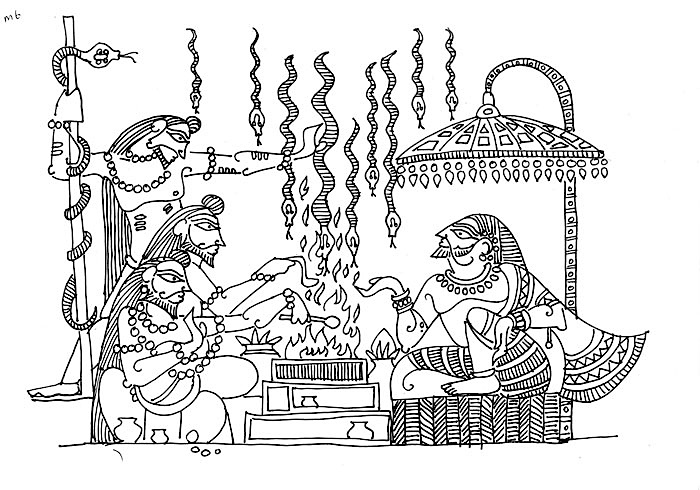
Janamejaya was angry because a serpent had killed his father, Parikshit. To punish the serpents, he decided to perform a horrific yagna that would destroy all the serpents in the land. So powerful was this ritual that it dragged the serpents from the farthest corners of earth and flung them inside the sacrificial pit where a huge fire blazed. The cry of serpents filled the air. Everyone was shocked by the cruelty of the king.

A sage called Astika, whose mother was a serpent, but whose father was a human, intervened and begged the king to stop.

‘Why? They deserve to die,’ said the king.

Astika replied, ‘Parikshit died because he was cursed for insulting a sage. He asked the sage for water not realizing the sage was meditating and hence not hearing what was being asked. In his impatience and irritation, your father put a dead snake on around the sage’s neck and so was cursed that he would die of snakebite within seven days.’

‘That explains why my father died. But it does not explain why the snake bit my father,’ said Janamejaya, refusing to stop his murderous ritual.

‘The city of Indraprastha that was built by the Pandavas was once a forest called Khandavprastha which belonged to the serpents. Your forefathers set aflame the entire forest to clear the ground for their city. One snake survived the blaze and swore to avenge the destruction of his home and his family. That snake whose name was Takshaka killed your father as punishment for the crime committed by your great grandfather, Arjuna and his brothers,’ explained Astika.

Astika realized how misplaced was his righteous indignation against the snakes. He thought he was the victim when in fact, his ancestors, were the victimizers.  ‘Tell me more,’ he begged the half-human half-serpent sage.

The sage advised him to call Vaisampayan. ‘His teacher, Vyas, has composed the epic that tells the full story of your forefathers, who belonged to the Bharata clan. You will realize how all events are created by other events. No one is truly innocent. No one is actually guilty. We are all victims of circumstances. So before you judge others, think – maybe you are not as innocent as you think.’ 

Vaisampayan narrated the Mahabharata to the Janmajeya. At the end of the narration, Janamejaya realized life is not simple as it seems. It is easy to blame people and hate people and kill people; it is difficult to forgive people and let go of anger and hatred. 

Vaisampayan revealed that Vyas called his poem not Mahabharata, which means story of the great Bharata clan, but Jaya, which means victory. There is another word for victory – Vijaya. What is the difference between Jaya and Vijaya?

Jaya means pure victory – one where there are no losers while Vijaya means victory where someone is defeated. A victory without losers is a victory over one’s own self. Thus for Vyas, the purpose of his story was not to glorify the Bharata clan, nor to describe the Vijaya of the Pandavas over the Kauravas. It is to realize the path to Jaya, conquest of one’s ego, for it is ego that makes people fight over property and makes kings like Janamejaya perform the dreaded Sarpa-Sattra.

We must remember that only six of the eighteen chapters of the epic are devoted to the war, there are six chapters before the epic describing the buildup to the war and six after that introspect on the war. Typically storytellers focus on the first twelve chapters and end with the coronation of Yudhishtira.  But there is more to the epic, stories that are not heard because people are so bedazzled by stories of war that they ignore stories of peace.

For example, in the Anushasana Parva, Bhisma tells the Pandavas the story of a fowler called Arjunaka who catches hold of a serpent that has killed the only child of a woman called Gautami. ‘Shall I kill this serpent?’ asks the fowler.

‘No,’ says the grieving Gautami, holding the lifeless body of her son, ‘It was fate that killed my son. The snake was just a medium. Why kill the medium when it cannot change my son’s fate.’

With this tale, Bhisma tries to allay the guilt of the Pandavas. Tales such as this, which are found across the Mahabharata, narrated over centuries, is what has made Indians a tolerant people. Sadly, newer narrations ignore this side of the epic and celebrates only the violence and the righteous outrage, the screaming of Draupadi is heard by all when her clothes are pulled away by the Kauravas, but no one hears her weep when all her five children are killed in the terrible 18-day war.

Get site updates
Email, Share this Page
ShareThis

10 Responses Subscribe to comments

  1. Archana Sharma

    I am fascinated by your interpretation of thestoriesof the Mahabharata. I read them whenever I come across themas in The Economic Times. I weep for Drapadi, at her humiliation annd her loss of five sons. I lost my own daughter and also feel the humiliation the women all over the world undergo everyday and and what they suffered centuries and ages before. We need Bhima-s and Krishna-s.

    [Reply to this comment]

    Jan 29, 2009 @ 5:37 pm


  2. Snehal

    I don’t find single mistake in your understanding… What you read and understand in Mahabharat is really truth and what I understand is just entertainment.

    I would like to read more articles of yours.

    Rana Snehal.

    [Reply to this comment]

    Jul 10, 2009 @ 2:34 pm


  3. Siddhant

    Where can one find these “stories that are not heard because people are so bedazzled by stories of war that they ignore stories of peace”

    Is there a book(preferably english)where the extended mahabharata stories can be read ??

    [Reply to this comment]

    Dr. Devdutt Pattanaik Reply:

    Wait till next year when Penguin publishes my Mahabharata retold :-)

    [Reply to this comment]

    Jul 13, 2009 @ 5:45 pm


  4. Shobha

    Your articles are fascinating and insightful. Have you written anything about the last conversation between Bhishma and Yudhishtra before Bhishma’s death? I have heard that in this conversation Bhisma advises Yudhistra on how to govern a country / kingdom. Could you share your thoughts on it?

    Thanks.

    [Reply to this comment]

    Dr. Devdutt Pattanaik Reply:

    For the conversation you have to await my book on Mahabharata due out later this year :-)

    [Reply to this comment]

    Jan 07, 2010 @ 6:28 am


  5. Apoorv Kothari

    The indian middle class is very peculiar owing to the strong faith and beliefs rooted in age old traditions and customs. though the stories, myths and learning get deteriorated coming down the generations but it provides such a strength of faith and belief to a common man that he remains undisturbed n manages to smile even in the toughest of times. the new generation living in the cool confines of a metro takes this feature of the middle class as their weakness and relate it to the growing backwardness or poverty. but they do not realize that these deep rooted faith are our biggest strength because something that can keep a person tolerant amid all difficulties is a great strength and not a weakness.

    Apoorv Kothari

    [Reply to this comment]

    Mar 10, 2010 @ 11:17 am


  6. Kalyani Raj

    I would like to learn more about the later 6 chapters of Mahabharata and how it can somehow be related and explained to the present day turmoil in the world viz. civil wars in Kashmir, Bengal or other parts in Asia. Can you suggest any books/articles? Thanks

    [Reply to this comment]

    Jun 13, 2010 @ 12:02 pm


  7. Chaitanya

    Dear Devdutt,

    Is it not Suka Maharshi who narrates the Mahabharata to Janamejaya? Is he called Vaisampayan?

    [Reply to this comment]

    Dr. Devdutt Pattanaik Reply:

    Vyasa’s son, Suka, narrates to Parikshit, Janamejaya’s father…..Vyasa’s student, Vaisamapayan, narrates to Janamejaya

    [Reply to this comment]

    Jul 05, 2010 @ 2:41 am

Reply