Published on 9th August, 2015, in Mid-day.
There are two kinds of prudery in this world: one that sees sex as bad, and the other which can only see sex in terms of violence. This emerged during conversations with a dear friend as she moaned the state of affairs in the world of sex education.
Those who see sex as inherently sinful, view celibacy and abstinence as indicators of purity and holiness. This is popular in Christianity, Buddhism, Jainism and Hinduism, which have thriving monastic orders. The man or woman who does not have sex is automatically assumed to be pure, noble, kind, and holy. This is the sin-school who feel sex education should be banned and people should remain pollution-free.
Then there are those who see sex as a form of violence. They can only discuss sex through the lens of abuse, rape, periods, and sexually transmitted diseases, never through the lens of foreplay, orgasm and after play. This is the abuse-school that feels sex education should not be banned, but they medicalise it, meaning link it to the use of sanitary pads and contraception and disease. The sessions are full of dire warnings about perverts and paedophiles.
In ancient India, as indicated from all literature and rituals, all forms of pleasure were celebrated. Those who shunned sex ran away to the forest to be hermits. Even there they were tormented by playful nymphs, the apsaras. Then came the Buddhist monastic order, 2,500 years ago, that saw desire as the cause of suffering. So shunning all desire, which included sex, was seen as the path to liberation. Not having sex was glamorised as it offered something greater than the temporary high of orgasm. In Buddhist scriptures, we find more laws to curtail the female bhikku than the male bhikku. In Buddhist scriptures, we find the first laws excluding the homosexual (pandaka) from the monastery.
Adi Shankara made Hindu monastic orders popular from around 1,000 years ago. We see a discomfort with marriage in the writings of Ramanuja, and Madhwa. Bhakti leaders like Shankardev of Assam and Chakradhar of Maharashtra worshipped Krishna, but shunned Radha. Female bhakti saints were either women who dressed in white, like Mira, or rejected their bodies, as in case of Akka-Mahadevi and Lal Ded. God was greater than any lover.
India had a long tradition of courtesans and dancers, free women who chose lovers. They were the pride of old republics and kingdoms and were called nagara-vadhus. Their images adored temple walls. They thrived alongside the monastic orders. Natya-shastra, which came to be known as the fifth Veda, was all about reaching God through the senses and emotions, through play and pleasure. We see this in Prakriti and Sanskrit literature. Thus two parallel paths thrived: reaching God through pleasure, or through denial of pleasure, one celebrating sex and the other shunning it.
When Muslim warlords came to India, they submitted to the Indian way of being. The sultans of Deccan and the nawabs of Lucknow became famous for patronising the cultured tawaif and the gharanas of musicians and dancers, just as the rajahs of many temple towns became famous for patronizing devadasis and ganikas.
With the arrival of British, sex became bad. The ‘nautch girls’ became ‘bad girls’. Sex was seen as sin, and those who turned sex into commerce were seen as tragic, exploited beings, who needed saving. Embarrassed by traditional comfort with pleasure, educated Indians highlighted India’s monastic tradition and distanced themselves from India’s pleasure tradition.
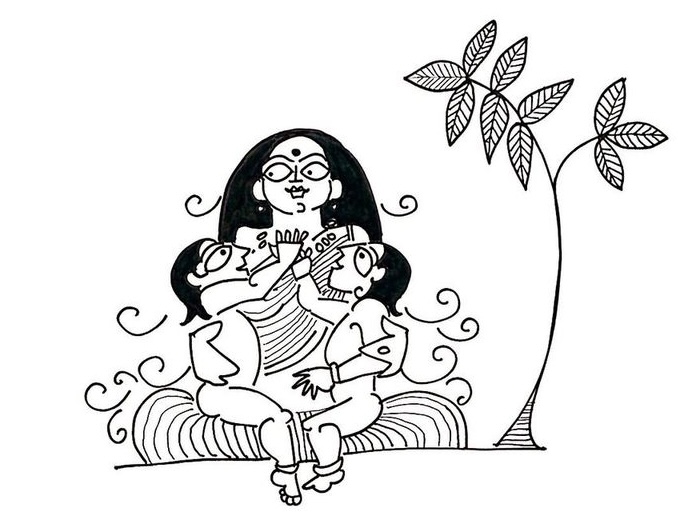
We wanted to be pure and holy. The holy man became one who condemned the dancing girl and even rejected the wife. From such hatred and exclusion, a new order was born, a masculine anxiety that permeated into patriotism and nationalism. India became Mother India, stripped of all desire other than nurturing her male child. This trend has now become the establishment. But the nymph knows what happens behind closed doors. Even the holy man blushes.