Published on 10th October, 2014, in The Economic Times.
If you add salt to pepper the outcome is always predictable. But if you get two people with complementary skills to work on a project, the output is never ever predictable. This is because people are not things. They think. They have feelings. Each one imagines himself and herself differently. They don’t listen despite reward and punishment. They plot and plan behind your back. They have private agendas that impacts output. And this impacts relationships. Relationships are never predictable. And this has been the bane of the corporate world.
Modern management, a child of industrial engineering, is based on predictability. The shareholder hates surprises. Promoters all over the world, while valuing the human constituency of their business, have always been wary of it for it for human behaviour cannot be taken for granted. This is one reason why many human activities are being replaced by technology. Machines are more predictable. Systems and databases are more reliable than human memory. Robotics is delightful, as their emotions do not have to be managed. Increasingly businesses and corporations are seeking non-human technological solutions to human problems.
A clue may lie in the avatars of Vishnu. People have long noticed that the avatars of Vishnu charts the same course as evolution. First we have the aquatic fish (matsya), then the amphibian turtle (kurma), then the terrestrial boar (varaha), then the part human predator (nara-simha), then come the human forms of Vishnu. A reminder that humans are animals. The oldest part of our brain in in fact called the reptilian brain, which simply reacts instinctively to stimuli without any thought. Then comes the limbic brain, which responds to stimuli with deep feelings, usually fear. Finally comes the neocortex brain, the human brain that can conceptualize ideas by which animal instincts and fears can be controlled, manipulated or even outgrown.
The fish reminds us of the famous Sanskrit phrase matsya nyaya or the fish law, which in English is called jungle law, where big fish eat the small fish in the sea, and that is the way it is. We cannot protest that this is unfair. This is the way of nature. It ensures survival of the fittest. This idea is embedded in our reptilian brain, our oldest and most reliable brain. It is where we regress is extreme crisis. Thus companies that are big, also have huge debts from banks. If they fail, the banks fail, and the whole financial system will collapse. So governments go out of their way to save ‘big’ companies. Small mom-&-pop stores are always chomped up on the path of progress in the name of consolidation.
The turtle withdraws into its shell when frightened while the boar attacks when provoked. That is how humans behave too when threatened. We respond from our limbic brain. we either withdraw, refusing to give organisations the benefit of our skills, or we attack, overtly or covertly, disrupting other people’s systems and plans to get our way.
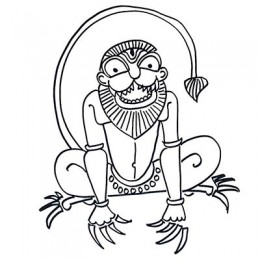
With the man-lion comes the first glimmer of the human brain, that is capable of imagination, which can discover innovative spaces, as in the story of nara-simha who is able to kill a demon by locating a space between inside and outside (threshold) and a time between day and night (twilight) and an instrument that is neither a weapon nor a tool (claws).
The animal side of our employees and bosses and vendors and customers looks at other humans as either predator (to be avoided), as prey (to be consumed) or as rival (to be subjugated), or as mate (to partner with). Our friendships often make us part of a herd that seeks to escape a common predator (the boss? the regulator?) or a pack that seeks to hunt down a common prey (the customer?).
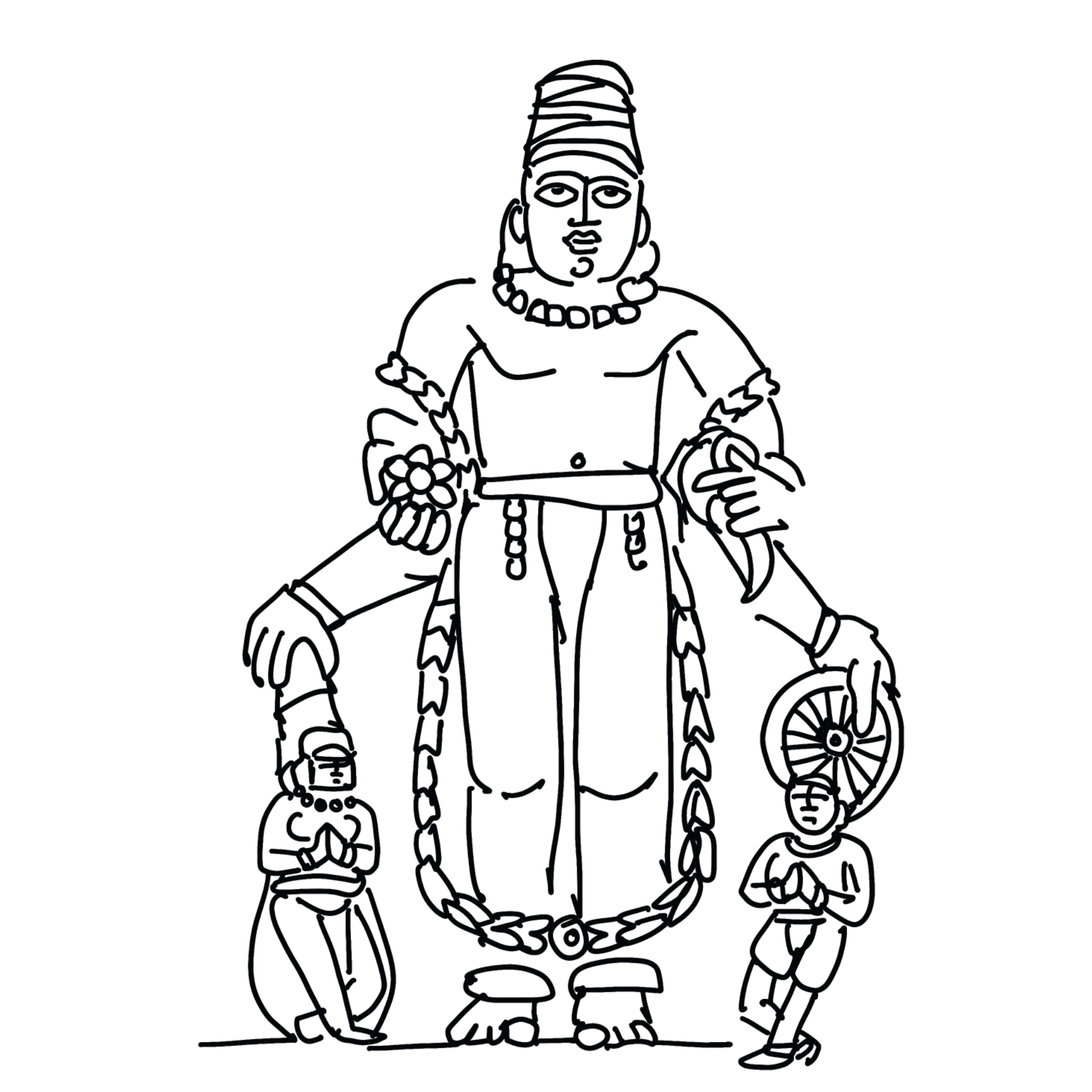
While the reptilian-limbic side makes us territorial and dominating and aggressive, the human side seeks control over the ecosystem. What is often overlooked is that the remaining avatars of Vishnu, though human, are different from each other. There is Vaman (the short priest who uses strategy to win), Parashuram (the priest who takes up arms to punish), Ram (the warrior who uses his bow to bring hope), Krishna (the cowherd and charioteer who reframes the mind), Balarama/Buddha (who withdraw from the world of action), and Kalki (the invader who breaks the old system down). All humans are not the same. Each one has a different worldview and a different purpose.
The organization never sees this. Companies never see this. Spellbound by organisational goals it only sees the skill of the people who is hired. As a result, the priest is hired without realizing that he who looks like a dwarf may turn into a giant and destroy you without really breaking a single rule. Or he may turn into an angry frustrated leader who raises his axe to discipline those refuse to be domesticated by rules. Or he may be a leader who is at peace both in the forest and in the palace, a strict rule follower, who values compliance over everything else, even justice. Or we may end up hiring a herder for our cows, or a driver for our cars, not realizing that he may have more wisdom than the wisest of men in our team.
The tragedy of modern management is that we are conditioned into hiring people for what they have (knowledge, skills, attitudes that we assume to be fixed) or what they have done (performance), rarely for who they are. We never look at the inner fish, turtle, boar or lion. We certainly do not look at the imagination that makes humans supremely unpredictable.