Atharva Veda is the collection of hymns containing spells for helping, healing and even hurting, composed by the Rishi who was generally excluded from the list of Seven Sages (Sapta Rishi): Atharva, Angirasa and Bhrigu.
For a long time, Atharva Veda was not included in the list of Veda. In Buddhist lore, Vedic lore was referred to only as ‘trayi’ or ‘the triad’. Atharva Samhita was referred to simply as Atharva-Angirasa, or the composition of Atharva and Angira sages.
A late addition
Atharva Veda was added later, around 500 BC, a time the old Vedic way lost its significance for a variety of reasons: the rise of new monastic ideas such as Buddhism and Jainism in the east; new empires such as the Maurya in the east; rise of trade routes and mercantile mindset that saw Vedic rituals as a huge waste or resources with no measurable outcome; and arrival of Greeks, Scythian and Parthian rulers from the west who introduced the idea of ‘debate’.
The old Vedic gods such as Indra and Varuna, linked to herding and nomadic lifestyle, lost their charm. Brahmins had to re-invent themselves to be useful to those in positions of power.
These involved the following changes: going beyond the Gangetic plains to the eastern, southern and western parts of India, seeking new royal patrons who were unfamiliar with Vedic lore; providing various statecraft and governance services to chieftains.
Brahmins became famous as experts (shastri) in matters related to law (niti), economics (artha), politics (danda), and governance (dharma); transformation of old royal rituals (shrauta) into domestic rites (vrata), pilgrim rites (tirtha) and royal rituals (maha-daan); telling epic stories of ancient kings who benefitted from Brahmin power. This made Ramayan and Mahabharat very popular; popularising use of spells that attract fortune, avert misfortune, block attacks, create allies, and hurt rivals.
This brought Atharva Samhita to the limelight.
Drying of Saraswati
The hymns of Atharva Samhita are as old as the hymns of the Rig Samhita. However, were compiled and organised much later. There are 20 chapters, over 700 hymns, containing 6000 verses. There were nine Atharvan branches.
Until the 20th century, scholars had access to only manuscript only of the Shaunaka Shakha. But in the 1950s, a manuscript of the Pippalada Shakha was found, in Odisha, written in Odia script, indicating this school had a profound influence in the Eastern region, which is also linked to Tantra and the cult of yogini worship.
In the Baudhayana dharma-sutra , people of Arya-varta (then North India) were told to purify themselves if they went to Odisha. This may have something to do with the rivalry of non-Atharvan and Atharvan brahmins.
The name Pippalada draws attention once again to the power of Atharva Veda. As per the 10th century Bhagavata Purana , Pippalada was grandson of Rishi Atharva, and son of rishi Dadichi.
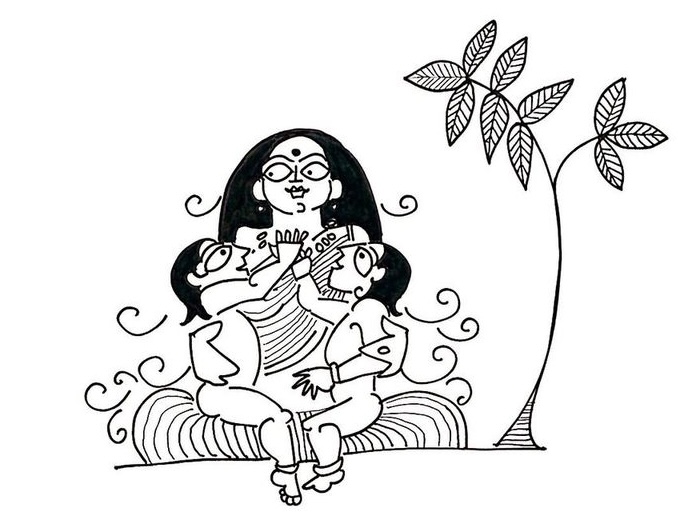
The gods had asked for Dadichi’s bones because they wanted to forge a weapon to kill Vritra, a terrible asura. Pippalada was in his mother’s womb at this time. She gave birth to him under a pipal tree. He grew up to be a great scholar, and answered the following questions on the nature of existence in the Prashna Upanishad: How did life begin? What forces keep us alive? How does life come into the body? What makes a human? What is immortal in man?
As per the 14th century Saraswati Mahatmya from Gujarat, we learn that when Pippalada learnt that the devas were responsible for his father’s death, he decided to generate heat (tapa) and destroy the heavens. The gods begged him to stop and explained the reason why they had sought the bones of his father which led to his death. This pacified Pippalada’s wrath.
The heat born of Pippalada’s rage threatened to destroy Indra’ paradise. So the devas directed the river Saraswati to carry this fire to the sea. She walked from the north to the western sea, through regions now known as Rajasthan and Gujarat. The heat was deposited at the bottom of the sea and is responsible for mists over the sea. It is said that the heat will rise up as a volcano when the world has to end. It will take the form of a horse that Kalki will ride.
The heat also caused river Saraswati to dry up. This is why there is desert in the north-western part of India, a strange desert where a lot of groundwater is also found, indicating a subterranean Saraswati, which it is believed has a tributary that joins the Ganga at Prayag, which is therefore referred to as Triveni Sangam (union of three water strands).
Since Saraswati dried up, many Brahmins had to migrate eastwards to the Ganga. These Brahmins came to be known as the Saraswat brahmins. Many of these Brahmins would consume fish as they survived on the dried river beds of Saraswati by eating fish. Fish-eating Brahmin communities are found across India, in Kashmir, in Mithila, Bengal, Odisha as well Konkan coast. Many trace their ancestry to the Saraswati river.