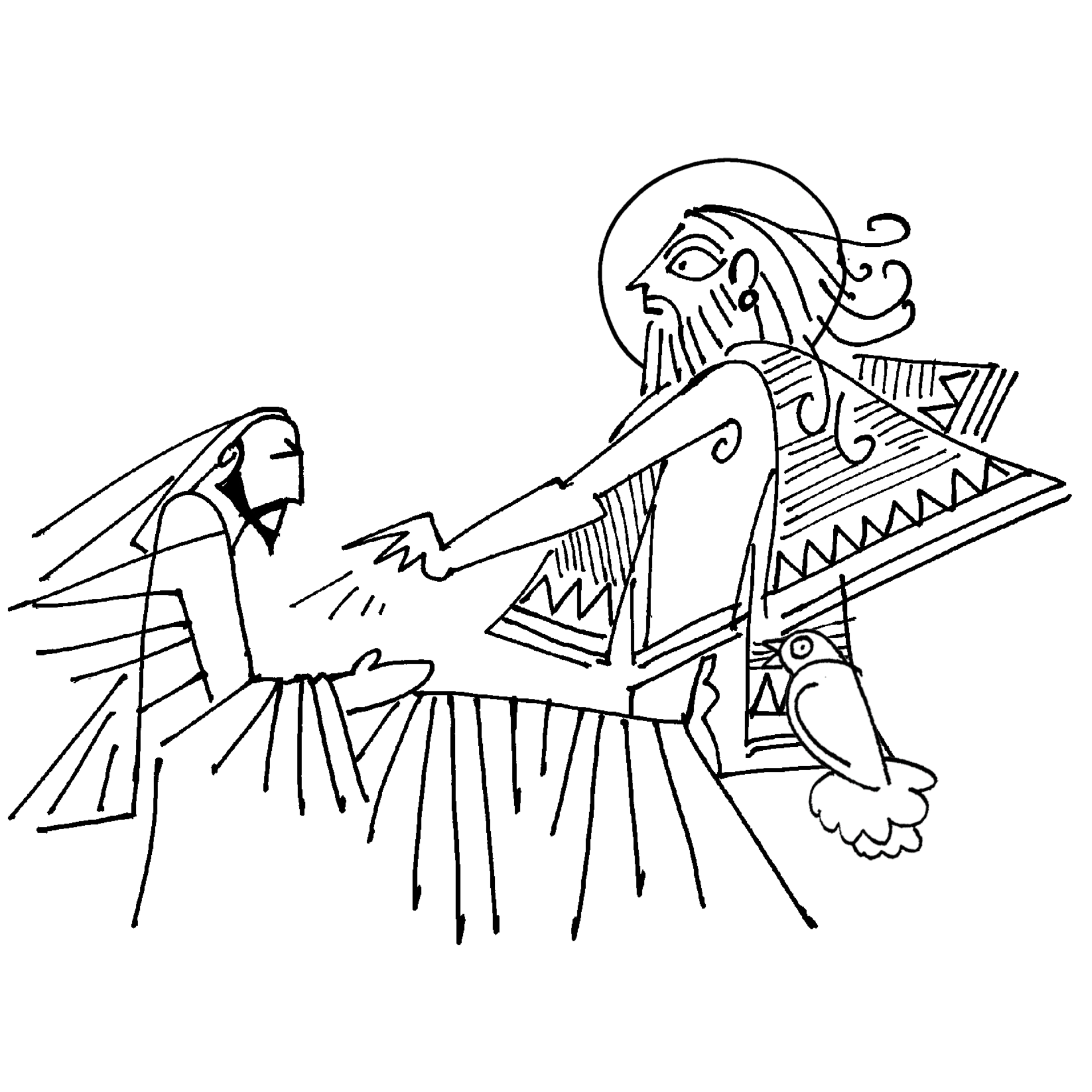
One of the most interesting stories in Islamic mythology is the journey of Prophet Muhammad on a winged four-legged steed across the sky. He undertakes this from Mecca to Jerusalem in a single night. From Jerusalem, he travels to the heavens, encounters earlier prophets, angels. He comes in the presence of God, Allah, and then returns to Mecca.
This magical journey is, of course, seen as a historical event in the Islamic world, which is what makes it a powerful mythology. It connects Mecca to Jerusalem, to heaven, to God. This is the reason why Jerusalem is important in the Islamic world, even though the centre, the navel of Islam remains in coastal Arabia, in Mecca, where every Muslim is obliged to go at least once in his lifetime. By incorporating Jerusalem into its mythology, the Islamic world clarifies that the God of the Prophet Muhammad is the same true God of Moses and of Jesus.
Jerusalem is not important in Hindu mythology. We may say that all religions are essentially the same but we clearly differentiate geographies. Many cities in India came to be associated with different Hindu gods in pilgrim texts that became popular about a thousand years ago. Today, one single city is being promoted as the holiest of the holies, a media construction of the 21st century. With the rise of democracy, the old caste models are crumbling, and it is replaced by vote banks. How do you unite a vote bank? A common city seems like a good idea.
As we march towards constructing that single city, using social media, it feels like a new Hinduism is being forged, one that erases the female principle. The unique feature of Hindu mythology is the value placed on the divine as a couple (dampatya): Uma-Maheshwara, Lakshmi-Narayana, giving equal value to the male and the female, a remarkable innovation considering monotheistic faiths are avowedly masculine. However, in response perhaps to the colonial accusation that Hindus favour female energy too much, the new political Hinduism prefers single gods like Hanuman, and presents Krishna always with Arjun, not Radha.
Religious innovations are not new to Hinduism. The idea of a temple with images is itself an innovation that is about 1,500 years old. Vedic Hinduism had no temples. In Odisha, Krishna is worshipped with his brother and sister, a phenomenon not seen anywhere else in India. Some argue the deities are amalgamations of Shiva, Vishnu and Shakti, even Buddha, to unite different denominations of the coastal state by the Chodaganga kings.
The shift from polytheism to monotheism first happened in the Fertile Crescent (modern Iraq) watered by the rivers Tigris and Euphrates. Many cities emerged here taking advantage of the agricultural revolution. Each city had its own god. In fact, there were multiple gods in multiple neighbourhoods. And the alpha communities with their alpha god dominated the pantheon. When wars were fought between cities, the victorious city ensured its god became the ruler god of the conquered cities. This continued for thousands of years with various gods negotiating powers with other cities, until the idea of one god gained popularity in Persia. Exiled Israeli tribes displaced from their homeland were so inspired by this idea that they came up with stories that we now read in the Old Testament (Jewish Bible). Some spoke of Abraham who came from Mesopotamia, and others spoke of Moses who came from Egypt. Stories of great kings like David and Solomon were added later. None of these have any archeological basis but play a powerful role in the mythology.
For the Jewish people currently waging war against Palestine, this is history. It is history also for the Palestinians and the Arabs and the Iranians. It is also history for the Western world who believe in the One True God. Around the 4th century, it inspired the Roman Emperor to use Christian monotheism to wipe out pagan dissenters. But it ended up splitting the Roman Empire itself.
All attempts to unite warring tribes with a single god have not been successful in the world. But warriors and propagandists do not care for history or archeology. They do not even listen to each other. And this failed.