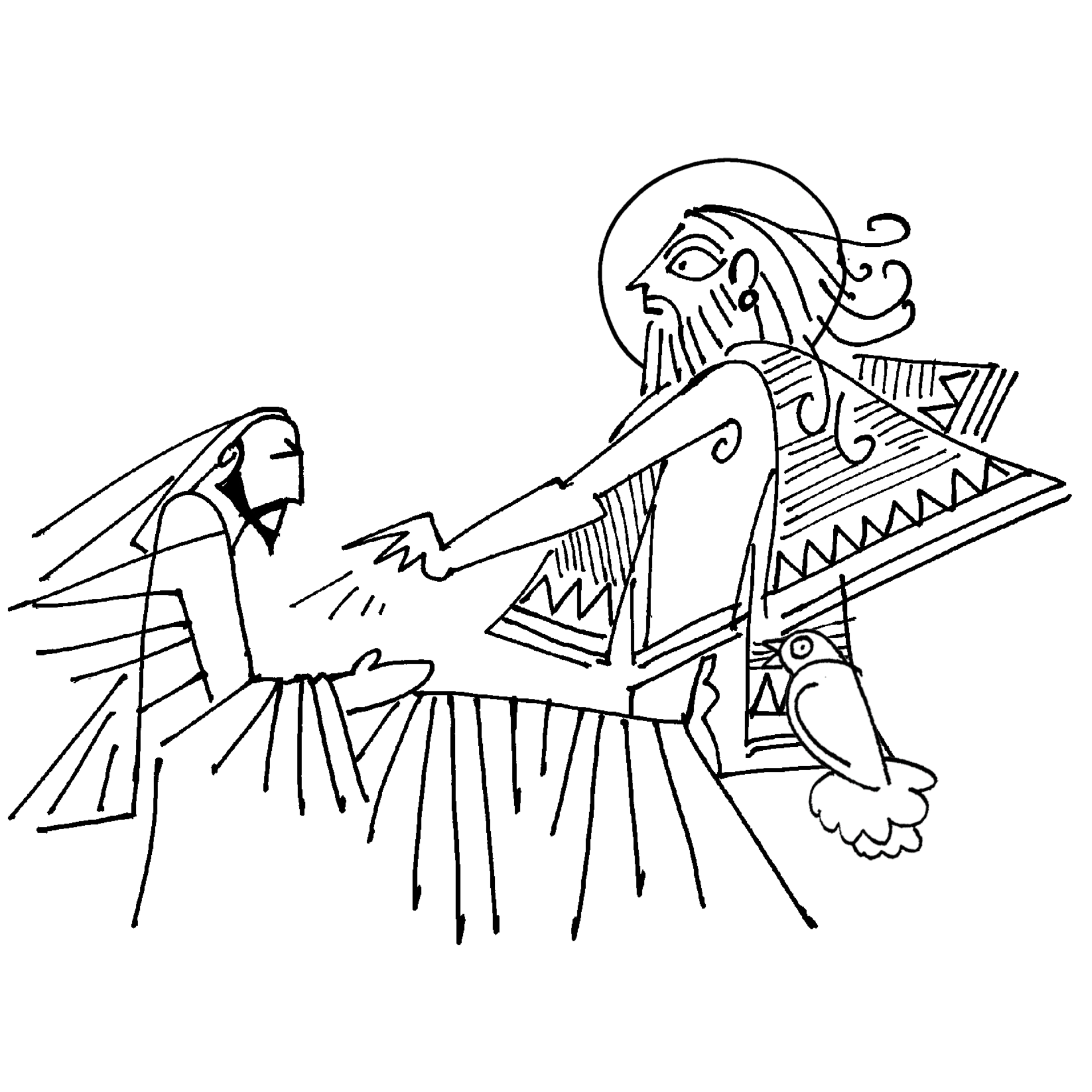
A popular theme in Hindu mythology is the dance competition between Shiva and Shakti. In Tamil temple lore, we are told Shiva raised his foot above his head but Shakti refused to do so out of modesty, thus establishing Shiva as superior to Shakti. This leads to questions if Shiva and Shakti are equal halves or is she the inferior half? Are they talking about men and women, or about mind and body?
Puranas are called the fifth Veda. They communicate Vedic ideas through stories. But when ideas become stories, non-gendered concepts like mind and matter, nature and culture, become characters and characters need to have gender. This leads to confusion between the signifier and the signified. This is most evident in stories of gods and goddesses we encounter in temple lore.
A lot depends on how the male was imagined in Hindu lore. There are different kinds of males. There is the male who thinks only about himself is the patriarch, or the hermit or the indifferent man. That is Brahma and Shiva (meditating Mahadev) and Narayana (slumbering Vishnu). Then there is the enlightened male who thinks about the other is the homemaker, and the householder. That is Shankara, who adores Uma, and Vishnu, who adores Lakshmi.
For the self-absorbed male, the male is the spiritual, superior half, above the navel, or on the side of the right arm which is used to pick up food. The female is the material, inferior half, below the navel, or on the side of the left arm used for ablutions. Here the woman bows to the man.
For the enlightened man, the male represents the soul, connected with the world through hunger and fear, wrapped in a body represented as female. Through her, new life is created. Like him, she eats and can feed. Like him, she seeks protection and can provide protection. In art, the two are right and left halves of the same body. One cannot exist without the other. Of course, the patriarch invariably will nit-pick and claim the “pure” right half of the “impure” left half.
Stories are easy to make complex ideas understandable. But they can reinforce prejudice when the shell takes attention away from the kernel. That is why mythological stories use fantastic motifs to force the human mind to appreciate its metaphorical nature.
That is why we have stories where Shankara can produce life without Uma. We are told that his semen has so much power, it can transform into a child even outside her womb. When his semen spills out, it is collected by Agni, the fire-god. But it is so hot that the fire-god gives it to the wind-god (Vayu) who gives it the river-goddess (Ganga) but the boiling water burns the forest of reeds (Sara-vana) and from the ashes emerge six babies, who are nursed by the six stars of the Pleiades (Krittika) constellation. The six babies are merged into one by Uma and is named Skanda, the spurted one. Except for science fiction writers, this is not the story of a biological man giving birth to a child that needs to be incubated in multiple bodies, both male (Agni, Vayu) and female (Ganga, Sara-vana). This is a tale to show the power of the mind (Purusha, Shiva) that manifests through the myriad forms of matter (Prakriti, Maya, Shakti).