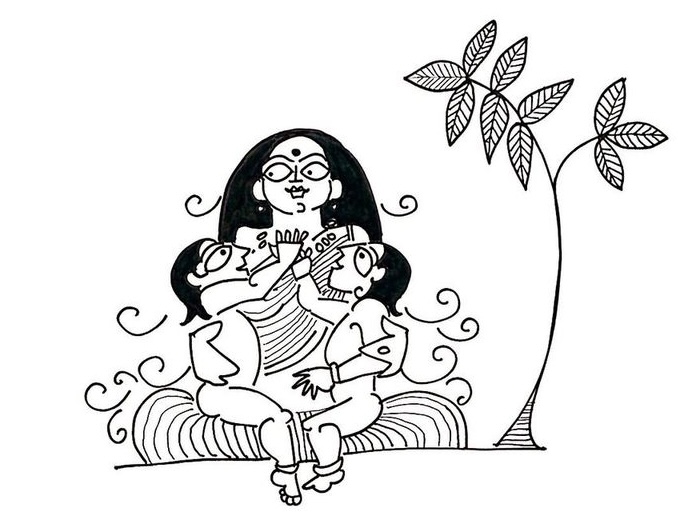
To appreciate Hindu art and stories, we need to remember that as per popular lore, the gods created the Puranas as the Fifth Veda to transmit Vedic wisdom to women and lowborn people who did not have access to the mantra and the ritual.
In Greek mythology, the Olympian gods want to control humans. So, they send Pandora with a box containing all the mysteries of the world, warning her never to open it. However, she is curious and opens the box, and that is why the world is filled with despair, suffering, disease, droughts, and epidemics. Thus, a woman is blamed for all the problems of the world.
n Biblical traditions, we hear of how God tells the first man and woman, Adam and Eve, not to eat the fruit of the Forbidden Tree. But Eve succumbs to temptation and eats the fruit, and then gets Adam to eat it too. That is why Eve is blamed for all the problems of humanity.
In both cases, women are blamed for their lower status in society. We do not find such stories in Hindu mythology. Scholars from colonial times have been trying hard to force fit Indian stories into a Western template. They seek, but cannot find, a Hindu Pandora or a Hindu Eve.
The problem with metaphors
In the Vedas, there are stories of the ‘father chasing the daughterʼ which becomes ‘Prajapati chasing Shatarupaʼ and ‘Brahma chasing Saraswatiʼ in later lore. But what does this mean? Is it to be taken literally or metaphorically? Is this description of the sky: Orion (Mrigashira) chasing Pleiades (Krittika)? Brahma or Prajapati are hardly the Hindu equivalents of Zeus or Jehovah.
Focussed on the literal and the objective, Western scholars were unable to see the metaphorical and the subjective, until Freud and Jung came onto the scene in the early 20th century. But even these great psychoanalysts were unable to identify their own Jewish and Christian prejudices in their understandings. It is a malaise still prevalent in academia.
Today both Left wing and Right wing subscribe to the Western template. If one points to Lakshmi at the feet of Vishnu as patriarchy, then the other points to Kali dancing on Shiva as an indicator of ancient Indian feminism. Are both right? Or are both wrong?
Matter and mind
To appreciate Hindu art and stories, we need to remember that as per popular lore, the gods created the Puranas as the Fifth Veda to transmit Vedic wisdom to women and lowborn people who did not have access to the mantra and the ritual. So the stories are vehicles of ideas; essentially allegories and metaphors. That is why gods and goddesses are shown with multiple limbs and heads — a reminder that what is being depicted must not be taken literally, but figuratively.
Vedic ideas revolve around the concept of food. Gods, ancestors, family, strangers, and guests are all to be fed. Food indicates hunger. Food is visible. Hunger is not. Hunger makes us chase food. Hunger makes us cling to food. The wise are content. They do not let hunger cloud their judgement. They choose to share rather than cling to food. These Vedic ideas are communicated in the Puranic stories. But in stories non-gendered ideas (hunger, contentment, and food) take the form of characters, and characters need to have genders.
Traditionally, in the Puranas, the male form indicates mental activity, while the female form indicates matter. The relationship of Shiva with Kali is the relationship of the mind (Purusha) with matter (Prakriti). Matter can be wild (Kali) or cultivated (Gauri), generating wealth (Lakshmi) or knowledge (Saraswati) or power (Durga). The Hindu male trinity of Brahma, Vishnu, and Shiva constitutes verbs (creator, preserver, and destroyer) while the Hindu female trinity of Saraswati, Lakshmi, and Shakti constitute nouns (knowledge, wealth, and power). The former is what you do. The latter is what you have.
Why the difference? Is this patriarchy at play? That is the easy answer. Men are seen as doing and women are seen as property. Or we can choose a different answer. That the artist found the male body as the best vehicle to communicate mental states. Kubera embodies hoarding, Ganesha embodies contentment. The female body was useful in indicating material forms. Why? Because arousal is best depicted using male genitalia. The female body transforms when it nurtures life, and expels it out.
The male body, like the mind, creates form outside itself. The female body, like matter, creates life inside itself. The sage who spurts semen at sight of a nymph indicates the mind that loses control of sense organs, the hermit who walks naked indicates the mind that is unthreatened and content, while the man who adorns himself with jewels indicates the mind is playful, and that seeks attention. Complementing this is the pot of food which becomes Lakshmi, the weapon of security that becomes Durga, and the instrument of music that becomes Saraswati. Food, weapons, and music can be created, shared, exchanged, and consumed.
The father chasing the daughter then is an allegory for the tension between the creator and the creation. Should the creator enjoy his own creation? Should culture hoard the goods and services it produces, or should it share this with other cultures? Should boundaries be opaque or porous? Civilisation happens when goods and services are exchanged rather than hoarded. That is why Brahmaʼs fifth head is cut when he resists giving his daughter away to Shiva. The remaining four heads then tell the world the value of giving, and receiving, rather than grabbing, and clinging.