Published on 4th October, 2013, in The Speaking Tree.
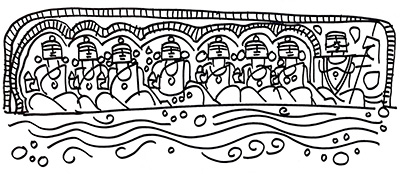
On the banks of the rivers in Maharashtra, occasionally next to a pond, one often finds a set of very similar looking rocks, usually seven, with one very distinct rock next to it, smeared with turmeric and vermillion. No one bothers much about these eight until a woman in the neighbourhood suffers either hysterical fits or miscarriages or a child has fever. Then the village remembers Sati Asara, or the seven sisters, and Mhasoba who accompanies them. It is said that when a king tried to divert the river, the goddesses were so angry that they washed the king’s camp away. Offerings are made to these angry potent goddesses to save the woman and her child.
Sati Asara is perhaps a corruption of sati and apsara, a strange phrase since sati means one who is chaste and faithful to a single husband, and apsara is identified as a divine damsel, courtesan of the gods, who is faithful to no one in particular.
This strange name goes well in line with the story of these seven sisters. Wives of the seven sages, they were accused of infidelity when they unwittingly became pregnant. Reasons vary: it happened while they were enjoying the heat of fire (Mahabharata version) or the wetness of water where Shiva meditated (Shiva Purana version). Enraged, they transformed into fiery goddesses who take their revenge on women who fail to show them due respect.
In some versions, they miscarry the child in their wombs but it survives and transforms into the warlord Aiyanar popular in folk traditions of the south. He promises to be the guardian of his mothers. This warlord is identified as Kartikeya also, after Kartika nakshatra or Pleiades constellation, who these sisters are identified with. Pleiades has only six stars; they say the seventh ran away or disappeared or remained chaste despite her tryst with fire and water. In Greek mythology, they were seven sisters ran to avoid the lustful embrace of Orion. In the Persian language, the Pleiades are referred to as Parveen.
Shrines of the six or seven sisters are found across India from the Himalayas to the Gangetic plains to the forests of Karnataka and Tamil Nadu. In other parts, they are called friends (saat saheliyan) or sisters (saat behene), or virgins (saat kanyayen) or mothers (sapta matrika). In Tantra, there is a trend of visualizing the Goddess not as an individual but as a collective and so we have concepts such as 10 mahavidyas or 64 yoginis. These women are wild and unattached and powerful and demand acknowledgment and respect.
In one story, this goddess collective is made up of the female forms of the gods who joined Durga in her march against demons. They drank the blood of the demons before it touched the ground thus preventing them from sprouting again. In still another story, they sprouted out from the nostrils of Sati when her father, Daskha, insulted her husband, Shiva. In still another story, when Shiva beheaded Vinayaka, Parvati sprouted these multiple goddesses in rage forcing Shiva to appease her by resurrecting her child.
The male accompanying the sisters is variously identified as son (Aiyanar, Vinayaka), husband (Bhairava) or brother or servant. He is sometimes called the charioteer or the doorman or the security guard. In Maharashtra he is also identified with Mhasoba, or the buffalo-god, who incidentally is the reformed buffalo-demon, Mahishasura, killed by Durga in some versions and tamed in others. The story goes that when she slit his throat she found a Shiva-linga there and realized he had some good qualities too. This transformation of an enemy and abuser into devotee or brother or servant is part of Goddess lore. We find this in Vaishno-devi where Bhairo, who attacks the Goddess, then is forgiven, enlightened and eventually granted a shrine of his own at the foothills of the Goddess. In South Indian, he is identified as Pota-Raja (Tamil) or Pota Raju (Telugu) which means the buffalo-king, who is a form of both Bhairava as well as a reformed Mahisasura. Perhaps he embodies her compassion and is a representation of her power.
The Sati Asara is sometimes associated with black magic, though the offering for this, which includes alcohol, drugs and meat is given to the demon-brother. But some say, the goddesses defy social conventions and so drink all that mainstream orthodox community shuns: blood, alcohol and meat, making them what we today call Tantrik goddesses. This side of the Goddess is increasingly denied or ignored as society gives a higher status to vegetarian practices.
In North India, on the ninth day of the Navaratri festivities, nine little girls are invited to eat in the house, and they have to be accompanied by a little boy, all less than ten years of age. This is common during the spring Navaratri but occasionally practiced even in the autumn Navaratri. The boy is referred to as ‘Bhairo’ indicating some correlation with the set of sacred rocks on the riverbank.