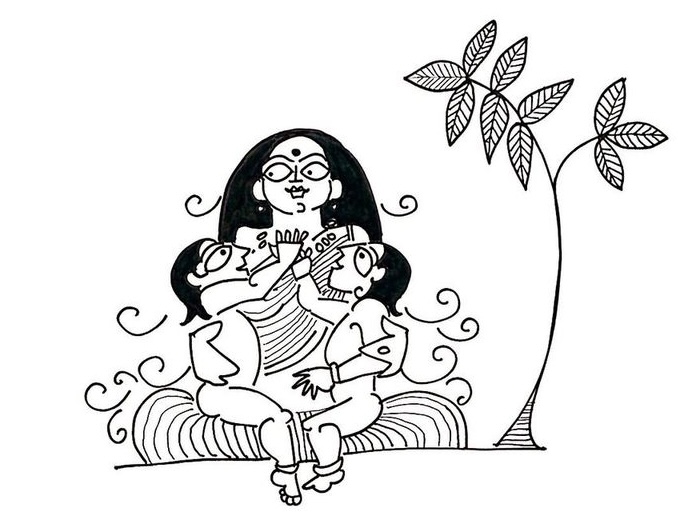
About 800 years ago, near the Mahanadi river delta, a poet called Jayadeva composed a Sanskrit poem called Gita Govinda that introduced the Brahmin world to Radha, the beloved of Krishna. It begins by describing how Krishna’s father Nanda tells Radha to take his little son back home. On the way, in the forest of dark ‘tamala’ trees, under a sky overcast with dark monsoon clouds, the child Krishna transforms into a grown-up Krishna. Radha and Krishna engage in an intimate dalliance, described in rich evocative language by the poet. The relationship is clandestine, secretive, beyond the understanding of social norms, law and customs. This poetry stands at the interface of Tantrik and Bhakti belief. Tantra celebrates sensuality. Bhakti celebrates sentimentality. Tantra is physical. Bhakti is emotional.
In this work, Krishna is identified both as the immortal infinite Vishnu as well as one of his mortal and finite avatars. His elder brother is also identified as an avatar. Also included in the list of avatars is Buddha. Vishnu takes the form of Buddha to save animals from being slaughtered in Vedic rituals. Today, many Hindus get upset when told that Vedic rituals involved animal sacrifice. Clearly, Buddhist influence on Vedic Brahmins has been profound, though always denied.
Buddhism rose around 500 BC. It was one of many ascetic movements that frowned upon Vedic ritualism. Vedic rituals were grand ceremonies meant to invoke the gods and to bring fortune to patrons. It was about all things material: success, victory, children, wives, fortune. It was about feasting. The grand ceremonies were mysterious and evoked awe in all those who saw it from afar. Its secretive nature gave it immense power. But only the rich could bear the expenses: the cost of sacrificing many animals and feeding a large community of priests who did nothing else but chant hymns. The merchants turned to the holy ascetics who wandered around speaking about withdrawing from the world. If you fed them that one meal they needed during the day, a merchant could earn merit that would grant him success in the market. What more did he need? So soon Buddhism was so popular that Brahmins lost patronage. They had to reinvent themselves. The old Vedic ways with fire rituals had to go away, replaced by temples of Hara (Shiva) and Hari (Vishnu) with rituals that offered occult power (Tantra) and sentimental gratification (Bhakti).
In Puranic lore (500 AD to 1500 AD), Buddha is seen as an avatar of Vishnu, but for totally different reasons. He becomes a teacher to get Asuras to give up the Vedic rituals. His influence is particularly strong amongst women, who become nuns and encourage their husbands and sons to become monks. This weakens Asuras and they are defeated by Devas. In one story, three flying cities of Asuras are brought down by Shiva, who earns the title of Tripurantaka. Thus Vishnu and Shiva, Hari and Hara, work together to bring down the enemy of Devas. Buddha is an instrument here.
During this time, Tantra rose in fame. Tantra was a set of rituals that could get you what you want—attract the positive, repulse the negative. Kings sought Tantrik experts who could help them keep enemies at bay. So high was the demand that Tantric rituals could be seen in Buddhist, Jain and Vedic rites. Tantrik experts were gurus. These Tantrik gurus who became royal advisors, Raja-guru, had mythological counterparts: Brihaspati of Devas and Shukra of Asuras, who are mentioned in Mahabharata also. Kings were successful if their gurus were supportive and powerful. So there was intense rivalry between the many schools of Tantra.
Shiva was the primary deity of Tantra, either with or without Shakti, the goddess. The goddess was sometimes seen as many, not one. A circle of dakinis, yoginis, matrikas, shaktis. So in Jain Tantra, one observes the Tirthankara in the middle of a circle surrounded by wisdom goddesses, the Vidyas. In Buddhist Tantra, Buddha becomes fierce Heruka surrounded by yoginis. In Shiva Tantra, Shiva is Bhairava surrounded by dancing yoginis. In Vishnu Tantra, Shiva becomes Krishna surrounded by milkmaids (gopis) and in Gita Govinda, we have the one special gopi, Radha.
If Hindu stories showed Buddha being turned into an instrument of Hara-Hari to defeat Asuras, then Buddhist Tantra told tales of how Mahakala (a form of Buddha) defeats Rudra (a form of Shiva). As more and more kings preferred the way of Hara-Hari over Buddha, many Buddhists returned to the Hindu fold. But they continued to practice vegetarianism. And so, Buddha who is used against Asuras, also stops Vedic Brahmins from sacrificing animals in Vedic rituals, and makes them adopt a vegetarian lifestyle. Brahmins who appropriated the Buddha ended up following Buddhist practices and calling it “pure” Hindu.