Stories of the folk goddesses of India are often lost in myriad oral versions. Which ones do we consider authentic? A common thread is some form of sexual violation followed by brute violence. We can say these are tales of (almost) marriage and (almost) murder. Are these to be taken literally or metaphorically?
In Jammu, a woman called Vaishnavi was meditating, hoping to marry Vishnu, when she was attacked by Bhairava. He wanted her to participate in Tantrik sex rites. She rejected his offer, but he persisted. She ran; he pursued. Finally, she turned around, transformed into a goddess in her rage, and beheaded him. As he was dying, he begged for forgiveness and the goddess said that everyone who visited her shrine would visit him. His shrine only has his head.
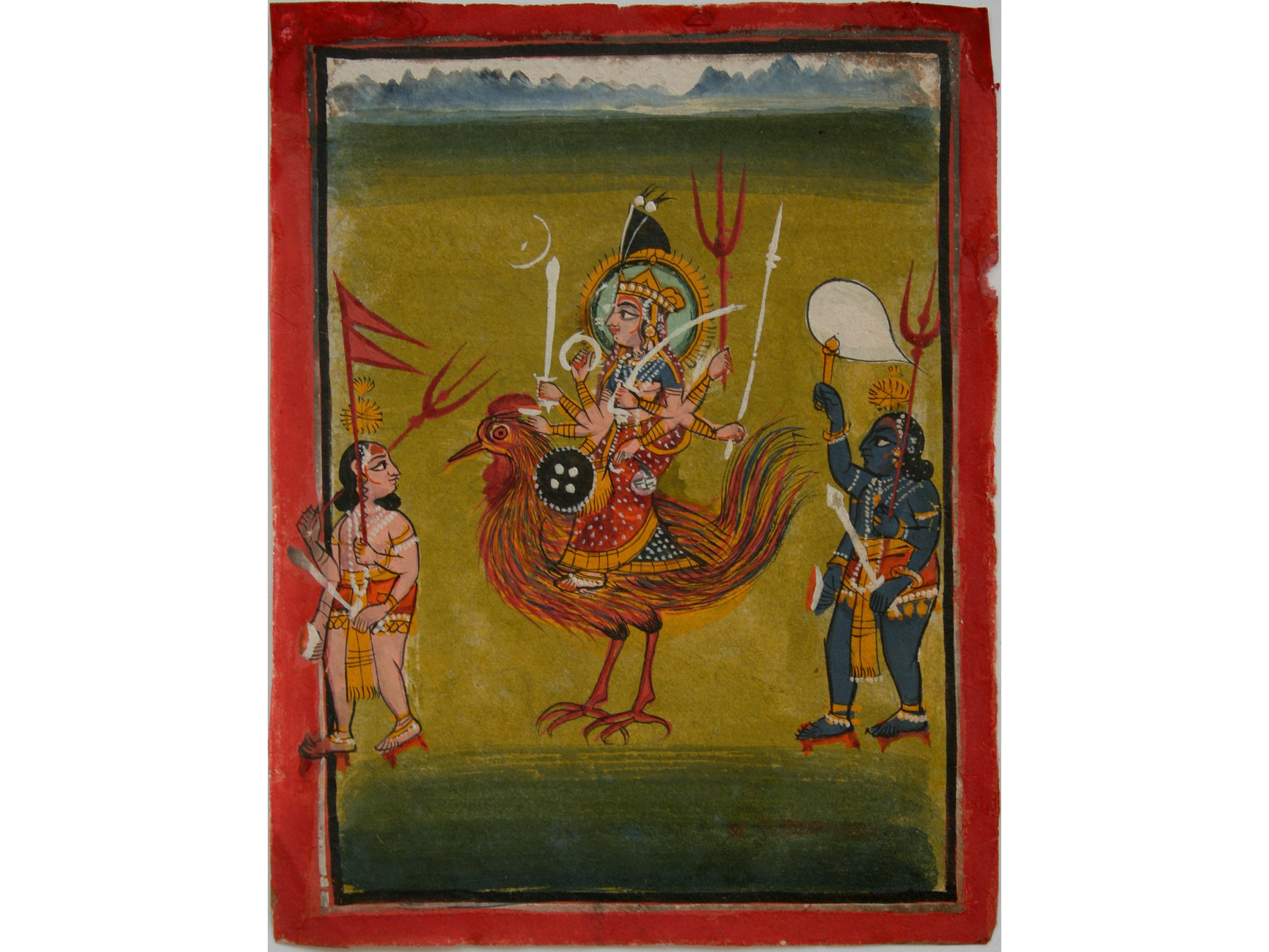
In Gujarat, a princess called Bahuchara wondered why her husband never came to her bed after their wedding. Instead, he rode out at night. She followed him one day, and found him with the help of a rooster. She discovered him masquerading as a woman. Realising he was queer, she turned into a goddess in her rage, accused him of tricking her, and castrated him. He begged her forgiveness, and she said that men like him will have to serve her as transgender priests, if they want liberation from the wheel of rebirth.
Blackface and worship
In Kerala, Ali Mappila, a Muslim merchant and sorcerer, attacked women. So, the goddess Chamundi enchanted him, got him to remove his magical protective talisman and then beheaded him. As in other tales, Ali begged for forgiveness and was told he could attain liberation if he helped the devotees of Chamundi. A shrine was built next to hers, and in certain Theyyam ritual ceremonies — which combines theatre, mime and worship — a shaman lets Ali’s spirit enter him. The performer has a blackface (to indicate African roots, perhaps), wears a fez cap (to indicate Turkish roots, perhaps), is called Ali Chamundi, and is venerated by local Muslims and Hindus.
In the Deccan regions of Vidarbha, Telangana and Karnataka, a woman discovered that her husband duped her. He was not a Brahmin, but someone who loved to eat beef and pork. Furious, she beheaded him. Every year, the husband is represented by a male buffalo calf and offered to her. The man performing the ritual is referred to as her son or brother, and identified as Potaraju (buffalo king). He is often painted black, appears demonic, whips himself, walks on fire, apologises to the goddess, and worships her.
The most Sanskritised version of this tale is the buffalo-demon Mahisha drawn to Durga, the goddess who rides a lion. She challenged him to a duel and impaled him with a trident. Images of the buffalo-killing goddess have been found in India since Kushan times, 2,000 years ago. Her images were later carved on temples and the buffalo was equated with the forces of evil and disorder. But in folk shrines, there is a memory of Mahisha, the buffalo-demon, being Mhasoba, the buffalo-god — husband, son, lover or violator.
Hidden subaltern feminist history
Sometimes, it is the woman who suffers and dies. In Sanskrit Puranic literature, Sati, the Brahmin wife of Shiva, exasperated by the disagreement between her father and her husband, killed herself in a Vedic fire pit. Her corpse broke into pieces, which fell in different parts of India now known as Shakti-pithas, or seats of the goddess of power.
In the Mahabharata, there is the tale of the seven sages in the sky who make up the Great Bear constellation in the northern sky, having seven wives. One day, six of these women were accused of being unfaithful. Furious, the women left their husbands and became the Pleiades constellations, the Krittika nakshatra. These women, sometimes six, sometimes seven, are worshipped across India as the seven wild women who cause miscarriages and fatal fevers in children unless they are acknowledged and worshipped with gifts of bridal finery.
Thus, the man who offends the goddess can be a Bhairava, a queer person, a Muslim, a low-caste man, a demon or a sage, even a Brahmin father or husband. In each case, either her consent is not taken or she is duped, she is ignored or is wrongly accused of not being chaste. Through the tales of the goddesses, communities express their fears and concerns of class/caste/gender/sexuality that could not be openly discussed. They also reveal a hidden subaltern feminist history that most elite historians deny.