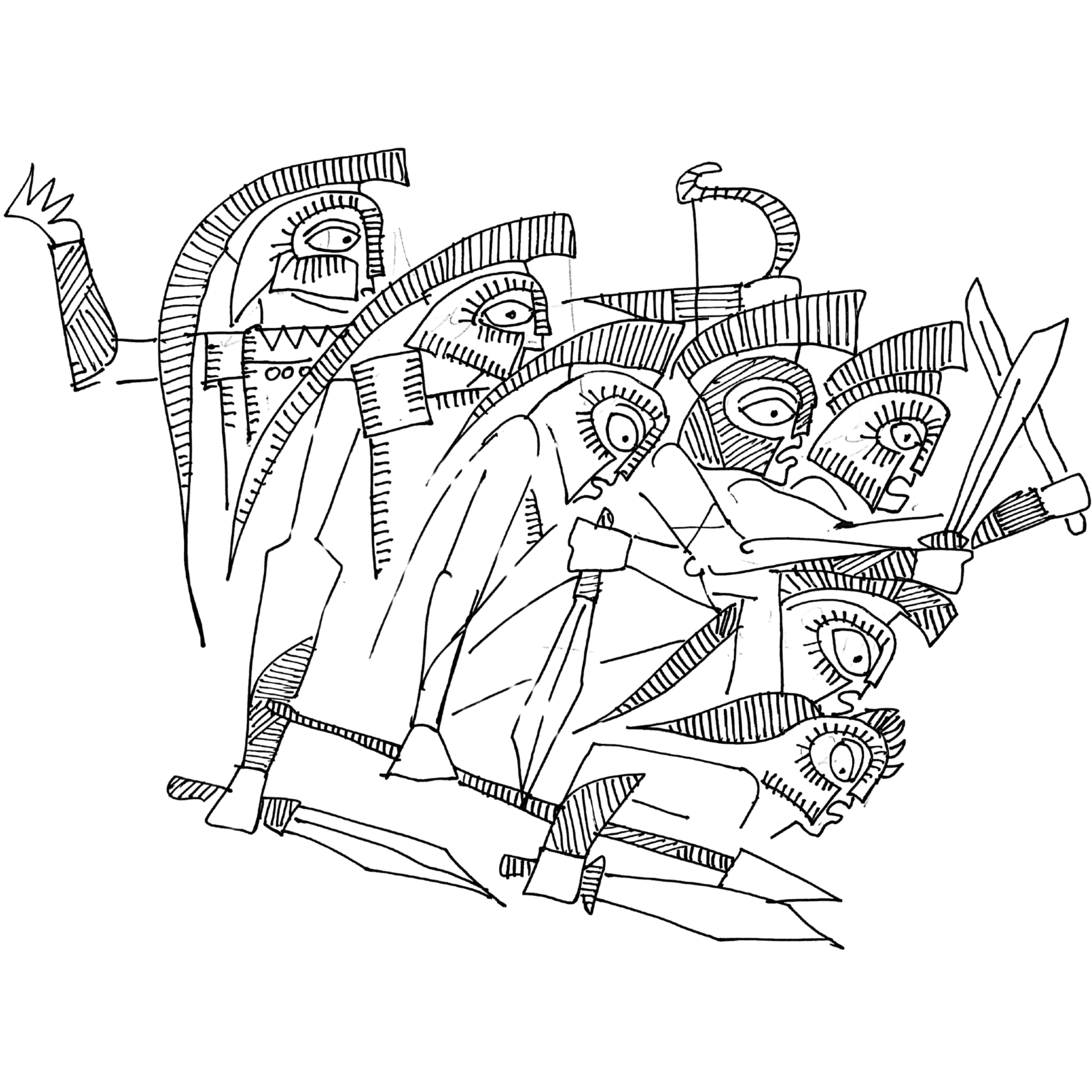
The Jewish Bible tells the story of Abraham’s nephew Lot who lived in the city of Sodom who was told by God to warn the city-dwellers i.e., the Sodomites, to change their wicked ways or face his wrath. The Sodomites disregarded the warning. So God told Lot to leave the city with his family, and not turn back. A rain of fire and sulphur destroyed the city. Lot’s wife turned around, and was turned into a pillar of salt.
What was the wickedness of the Sodomites? They wanted to have sex with Lotʼs male guests, who were actually Godʼs angels. Lot offered them his daughters instead. They refused. Was their wickedness disrespect of guests, indifference to consent, refusal of women, or homosexuality? Traditionally, it is only homosexuality. Later, Lotʼs daughters get Lot drunk and have sex with him and bear him sons. This is incest. But this does not incur Godʼs wrath.
In Islamic retellings of Jewish lore, Lot is referred to as Lut. Lutʼs wife is an unbeliever who is killed in the shower of clay stones (not fire and sulphur). There is no mention of Lotʼs daughtersʼ incestuous conduct. The Desert of Lut stands in Iran. For Muslims, this fact makes the story historical.
This story is referred to in the Quran, the conversation of God with the Prophet Muhammad via the angel Gabriel (Jibreel). For Muslims, this conversation is historical reality, not sacred metaphor. So everything said here is real, including the existence of Djinns, creatures born of smokeless fire, who share the earth with humans. To a historian, however, the Quran and the subsequent Hadith reveals a worldview that is clearly 1,400 years old, that normalises medieval desert practices of slavery, polygamy and wife-beating.
There are Christian historians who argue that the geography of the Quran is probably not around todayʼs Mecca, but more probably near Petra, Jordan, a major trade route in medieval times. They argue that Muhammadʼs tale and everything we know of early Islamic history was invented later by the Umayyad Caliphate, who was located in Damascus in Syria. The final Quranic text and early histories emerge a few generations after the Prophet, and variants of the text are all destroyed. These historians are accused by Islamists of being Islamophobic, of course. Just as historians who question the historicity of Ramayana are accused by Sanatanis of being Hinduphobic.
No matter how much we claim to be rational, history is shaped by myths. Myth of Promised Land for the Chosen People justifies the Jewish claim over Israel, especially Jerusalem. As per Jewish myth, Jerusalem is the site where Jacob (Yakub of Persian lore), founder of Israel, slept with his head on a rock, and dreamt of a ladder to paradise. Here, Solomon (Suleiman of Persian lore) built a temple in 1000 BC, which was destroyed by Babylonians in 500 BC. It is at this very site that the Prophet Muhammad arrived from Mecca, on a winged steed, in a single night, and rose to paradise, around 621 AD, shortly before the Hijrah, his migration to Medina. This is why Muslims also lay claim to Jerusalem.
We are never taught these Islamic myths in Indian schools, even though Muslims make up the largest minority in India. In the 10th century, Arab sea-merchants told the story of how Adam, after being expelled from Eden, fell in Sri Lanka, on Adamʼs peak. Adamʼs footprint is mistaken by Buddhaʼs footprint by Buddhists. Adamʼs bridge is mistaken for Ram-Setu by Hindus. Seera Puranam (Sacred Biography) is a Tamil retelling of Prophet Muhammadʼs biography, composed by Poet Umar in the 17th century. Nabi Bamsa (Lineage of Prophets) is a 16th century Bengali work by Sayyid Sultan that retells the story of Godʼs many messengers, some of whom are confused by Hindus as their gods. Tales of Sufi saints and their flying carpets and camels are found in almost all dargahs of India.
We do not teach our children that the Maratha folk god, Malhar Martand, is also known as Mallu Khan. We rarely talk about the Muslim wife of Vishnu, Bibi Nachiyar, enshrined in Srirangam and Tirupati. Few know about Muttal Ravuttan, the Muslim horseman who guards Draupadi shrines in Arcot, Tamil Nadu. Or Bon Bibi, the Muslim guardian-goddess of the Sundarbans, linked to snakes, crocodiles, and tigers.
Everyone remembers how Ramayana and Mahabharata were shown to all Indians by Doordarshan in the 1980s. Few recall how the tele-serial, on stories from the Bible, in Hindi, was taken off air because it upset Kashmiri Muslims. Mythology is not unique to Hindus. It shapes Islam, too. When we do not discuss it openly, we leave the cultural legacy of the nation in the hands of agenda-driven mytho-fiction writers claiming to be historians.