Published on 11th March, 2023, in Times of India.
Nationalists on social media argue that the Mahabharata war took place 5,000 years ago, in 3,000 BCE, based on verses from 2,000-year-old manuscripts. They believe that Krishna and Arjuna rode a chariot drawn by horses. These ‘textual’ scholars are mostly upper-caste Hindu men, who ignore hard evidence of archeology and ancient DNA from around the world. Anyone who challenges them is ‘Hinduphobic’.
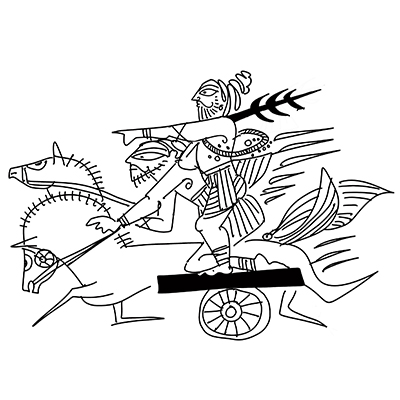
Be that as it may, the earliest clear evidence of a horse-drawn chariot is 4,000 years old, and found in burials of Sinthastha culture of southern Russia.
The horse entered India, with men who called themselves Arya, around 3,500 years ago, long after Harappan cities had ceased to be. They moved from southern Afghanistan through Punjab and Haryana towards Uttarakhand and Uttar Pradesh between 1,500 BCE and 1,000 BCE
March of horses
The Rig Veda contains the world’s oldest poetry on horses. The poets called themselves Arya. The poetry reveals a patriarchal pastoral, and rather violent, people, mostly men.
Genetic evidence indicates they began crossing the Hindu Kush mountains and entering the Indus river valley from around 1,500 BCE, and reached the Ganga river basin around 1,000 BCE. This migration happened over centuries and began around 3,000 BCE from present-day Ukraine through Russia, Kazakhstan, Tajikistan, Uzbekistan, Turkmenistan, to Afghanistan. From north of the Black Sea, they travelled eastwards to the basins of the Ural river, and then via the Inner Asian Mountain Corridor (IAMC) to the Oxus river basin before entering India.
To truly understand the Aryas, we must appreciate their pre-historic development in the following cultures:
- Yamnaya culture of Ukraine (3,000 BCE) who raised burial mounds, were the first to breed horses for food, and used copper. Burials show men holding copper clubs, inspiring tales of heroes who held clubs and hammers – like Thor and Indra. Did they ride horses? There is scanty evidence. If there was riding, it was primitive, enabling some degree of transport but not war.
- Corded Ware culture of Europe (2,500 BCE) known for pots with impressions of cords i.e. ropes, that introduced violent patriarchy to the world. These even stretched eastwards towards the Ural mountains. This culture had a peculiar burial, men lying on the right side facing west and women lying on the left side facing east. Did they ride horses without a saddle or stirrup? Scholars are divided on this.
- Sinthastha culture of southern Russia (2,000 BCE) has the credit of truly domesticating horses. They lived in circular settlements, and have the earliest horse-chariots in burials. They probably invented the horse-driven chariot. Before this, carts and wagons were pulled by oxen, donkeys and mules.
- The Inner Asian Mountain Corridor (IAMC) of Kazakhstan, a C-shaped path along mountains, going around cold deserts, connecting Altai mountains of Siberia to Hindukush of Afghanistan, suitable for pastoral life, was a major source of bronze, and so key to Bronze Age trading. This corridor took wheat, barley and tin towards China. It introduced the world to trousers, the oldest of which is found in 1,200 BCE. Invented by horse-riding sheep- herding people, it is perhaps the earliest Silk Road connecting to China.
- Oxus civilisation (1,700 BCE) of Uzbekistan traded with Harappan cities. Here we find the cities with three walls (tripura) described in the Rig Veda. This region is connected to mountains which grow Ephedra plants known as Soma in Veda and Homa in Avesta. This is where the word ‘bija’ comes from, the Rig Vedic familiarity with agriculture, worship of fire in altars and the use of the word Arya as self-identification. Here we find images of eagles holding serpents. Both the Avesta and the Veda refer to the Hindukush mountains as home of Soma and mountains that could not be crossed by eagles. But the Vedic Aryans clearly did – and never looked back.
Generations of foreign wives
Steppe pastoralists were nomads. They generally took their wives with them wherever they went. However, men who could not get wives would break away from the family, travel to new lands, with their horses, in search of new wives. This explains the spread of Indo-European languages from Eurasia westwards towards Europe and eastwards towards India.
This spread was accompanied by the spread of the Y-chromosome of men, not mitochondrial DNA of women. In other words, the men were foreigners who married local women, and this explains how the language and the stories changed over time. Some parts remained constant; but much changed.
Hence Indian culture is very different from European culture, though there is similarity in the grammar and vocabulary of Sanskrit and Latin and a common male DNA strand.
Those who left Eurasian Steppes around 3,000 BCE were not exactly the same people when they entered India around 1,500 BCE. In these 1,500 years, 60 generations had passed. Another five centuries i.e., 20 generations would pass as the men we refer to as Vedic Aryas migrated from Indus to Ganga within South Asia itself.
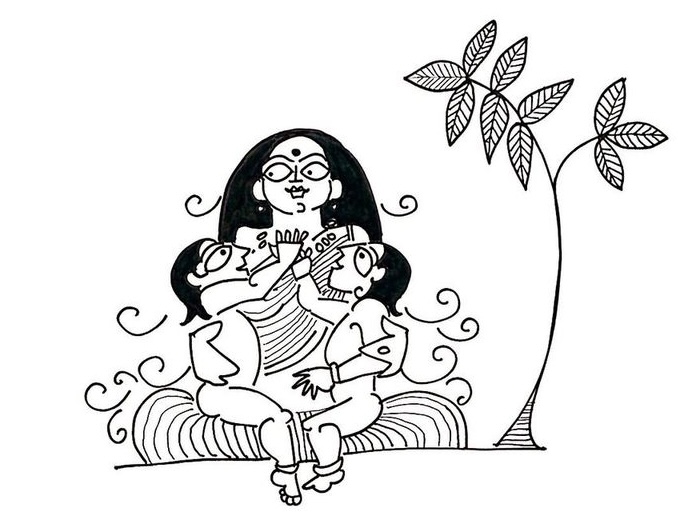
Each of these 80 generations involved marriages to local women, foreign women, women who influenced them, changed their culture dramatically with new ideas and stories and technology. But some things were clearly sacred to be transmitted only from father to son – like the Vedas. Note: The idea of endogamy or caste (jati) became widely prevalent in India less than 2,000 years ago. It did not exist when the Aryans arrived 3,500 years ago.
Steppe pastoralists were familiar with lands where nights were long and cold, closer to the Arctic, and of times when the Pleiades constellation could be seen before the rising of the Sun, in spring, i.e. 3,000 BCE.
As the Steppe nomads travelled, their mothers told them new stories about the arrangement of stars and the movement of planets. The violent hero god who inspired characters like Indra in Vedas and Thor in Europe became one who is fond of Soma, and for whom battles became less about cows and women, and more about releasing water and sunlight.
Much of this research was done by Russian scientists in the 1970s. Since this work was in Russian, until its translation two decades ago, much of this knowledge was overshadowed by the works of European and American scholars. But now this knowledge is freely available thanks to the internet.