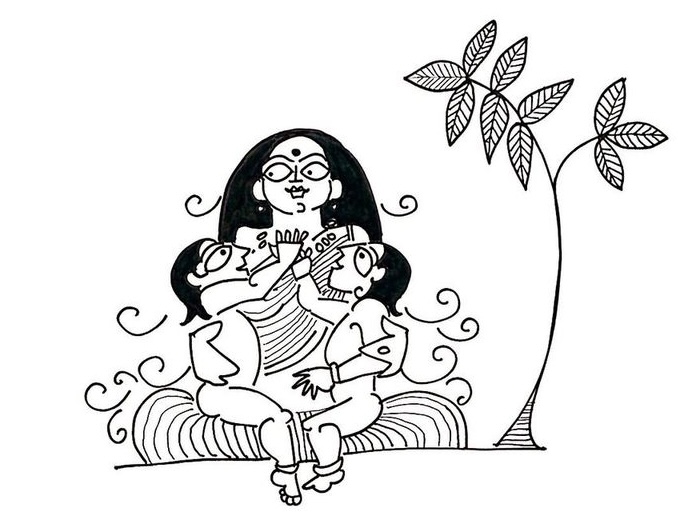
On television, Arjuna is presented as the true hero of the Mahabharata: masculine, entitled, radiant, unmatched with the bow, chosen to receive the Bhagavad Gita from Krishna himself. He eclipses his elder brother Bhima so completely that few remember it is Bhima, not Arjuna, who kills all hundred Kauravas at Kurukshetra.
A hierarchy is embedded in this relationship, one that predates the Mahabharata itself. Arjuna’s father is Indra, king of the Vedic gods. Bhima’s father is Vayu, one of the Maruts, storm-gods, denizens of the wilderness rather than the palace. Indra once struck at Diti’s womb, fearing her unborn child would replace him. The foetus split into fragments, each becoming a Marut, granted a place at Indra’s side on one condition: that its power would always serve, never rival, the throne. The same Vayu fathers Hanuman in the Ramayana, who despite his immense strength, serves Sugriva, then Rama, exactly as the Marutta served Indra.
Arjuna wields the bow, that shoots from afar. Bhima swings the club, that kills in close proximity. Arjuna is Dronacharya’s favourite student, but an insecure one, quick to fear the capabilities of Ekalavya and Karna. A thumb is cut off, an unarmed warrior shot down, and Krishna’s counsel arrives endlessly, less to win battles than to keep Arjuna’s status intact. At Kurukshetra, Arjuna’s greatness is almost always co-authored; he barely kills any one of consequence alone. Bhima needs no such co-authoring.
Long before the war, wandering in exile, Bhima kills the rakshasas entirely by himself—Bakasura, Jatasura, Kirmira, Hidimba’s brother—unglamorous kills that leave no epic couplet behind. It is he who fetches the lotus flowers that make Draupadi smile, he who gives up his own wife Hidimbi at his mother’s word, while Arjuna shares his wife with four brothers.
When Draupadi is publicly humiliated, it is Bhima who avenges her, collecting Dushasana’s blood so she can wash her unbound hair; it is Bhima who smashes Kichaka to pulp when Arjuna does nothing to stop her abuser. And still, through all of it, it is Arjuna who remains her favourite. In Nepali tradition, blood-drinking Bhima, tying Draupadi’s hair in fulfilment of his vow, is identified with Bhairava, Shiva’s fierce form, looping him back to Vayu and Hanuman: the wild god’s lineage, muscular, sincere, permanently useful, permanently subordinate.
The strangest thread, though, is what happens to Arjuna himself in the Virata Parva, the final year of hiding, when the princes are forced to live as servants, learning at last what servitude costs. Bhima, who loves eating, must cook for others before he eats. Arjuna must live the year as a eunuch, temporarily stripped of manhood, deemed fit only to enter the women’s quarters and teach the young princess how to dance. Not fight, dance. Not kill, seduce. What lesson was this meant to teach a man of his rank?
The curse had its reasons. Arjuna refused Urvashi, the celestial courtesan, on the grounds that she had once been married to his ancestor Pururavas. He did not know that the etiquette binding mortals does not bind the immortals. For that refusal, he was cursed. But it is hard not to wonder whether this, too, was Krishna’s design: a way of making a privileged man see exactly what he had spent his life declining to notice.
It began, after all, when Arjuna walked into Draupadi’s chamber while she was with Yudhishthira. For this transgression, Arjuna was exiled. He turned that exile into something closer to a grand tour, marrying princess after princess. Ulupi, the Naga princess, seduced him outright. Subhadra of Dwarka fell for him, and Krishna advised the two to elope—a betrayal that cost Draupadi her exclusive place in the household, tricked at once by her husband and her closest friend. Then came Chitrangada of Manipur, whom Tagore reimagined as a manly warrior queen who turns conventionally feminine to win Arjuna’s love, only to learn he had wanted her as the masculine warrior she already was.
Tamil folklore supplies a chapter Sanskrit lore never wrote. Alli, the Pandya queen, ruled alone and shunned all men. On Krishna’s advice, as ever, Arjuna disguised himself as a woman to enter her court, and by night Krishna turned him into a serpent so he could slip into her bed and take her. Tellingly, the story splits by teller: women’s versions dwell on the trickery done to her, while men’s versions call it the taming of a shrew.
Put together, Arjuna’s year as eunuch stops looking arbitrary. It is a mirror held up to a man used to being seen, served, and excused—a man asked, for once, to live as those who are never seen but who always serve. The male gaze is turned back on him: unthreatening, unmanned, fit only to teach women how to dance and to feel, briefly, what it is to be looked at rather than to look. A subject India’s storytellers were quietly working through centuries before any department of gender studies gave it a name.