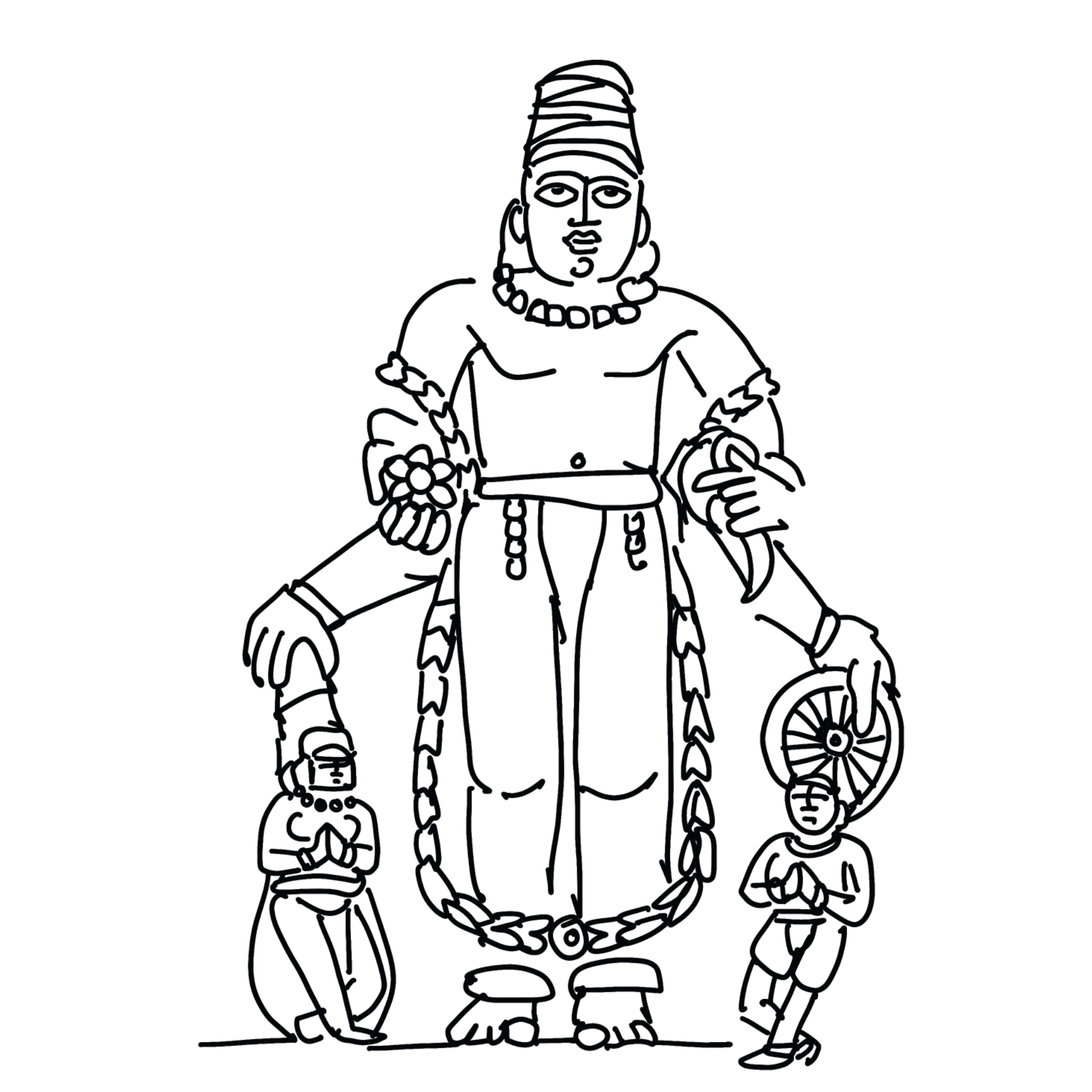
Bhima is the strongest man of earth as per the great Hindu epic, the Mahabharata. In folklore, he is considered Bhairava, a fierce form of Shiva, because he disembowels Dushasana and drinks his blood and uses his blood to wash Draupadi’s hair. In this folk imagery, Draupadi becomes the goddess and Bhima, her guardian. No one shall look upon her with eyes of desire.
As per the epic, Arjuna wins Draupadi as a trophy in an archery competition. His mother, Kunti, asks him to share his wife with his two elder and two younger brothers. Each brother stays with Draupadi for one year, before she moves to the other brother. So, they get turns once in five years. Of these husbands, Draupadi loves Arjuna the most. But when she is in distress, no one comes to rescue other than Bhima. Bhima is willing to defy even Yudhishtira’s word to make her happy. He is the one who takes the oath to break Duryodhan’s thigh and drink Dushasana’s blood to avenge Draupadi’s humiliation. He is the one who crushes Kichaka to pulp when he sexually harasses her in Virata’s palace–an act that leads to the Pandavas being exposed during their year in hiding. It is he who travels to the edge of the earth to fetch golden lotuses for his beloved wife.
Draupadi is worshipped as a goddess in northern Tamil Nadu. Bhima is worshipped as a guardian god in parts of Nepal. He is depicted either holding the mace or disembowelling Dushasana in many temples. His worship has been around for at least since 1500 BCE ie, 500 years ago, as per records. He is popular in the Newar community, who dominate the valley. Scholars have found Bhima worship also as far as Indonesia, where he serves as doorkeeper and guardian god. There is one unique iconography of Bhima that one finds in Nepal in traditional households where he is shown wrestling simultaneously a tiger, a lion and elephant, a horse and a serpent, declaring his great strength. This contributes to his popularity.
Bhima has a rakshasa wife called Hidimbi. And from that union is born the mighty Ghatotkacha. Ghatotkacha married a Naga woman and from that union was born Barbareek, whose head is worshipped as Khatu Shyamji in Rajasthan. These folk mythologies connect Bhima to the masses to many tribal communities across India. He is also popular as Hanuman’s brother as both share a common father–Vayu, the wind-god.
In Vedic mythology, Rudra is linked to the storm-gods known as Maruttas, which is why Hanuman is called Maruti. Thus, there is a link between wind, storm, Shiva, Hanuman and Bhima. Bhima carried Bhairava to Indraprastha on his shoulder, withstanding the loud shouts of Bhairava. So, Bhairava agreed to protect the Pandava capital and still stands in a temple near Purana Qila of Delhi, where he is offered alcohol.
What is often overlooked about Bhima is that while he loved food, he was also a great cook. So, not only was he a warrior, but he was also a cook. In this way, the very masculine warrior aspect is balanced by the feminine, nourishing aspect, making him a complete god in many parts of India.