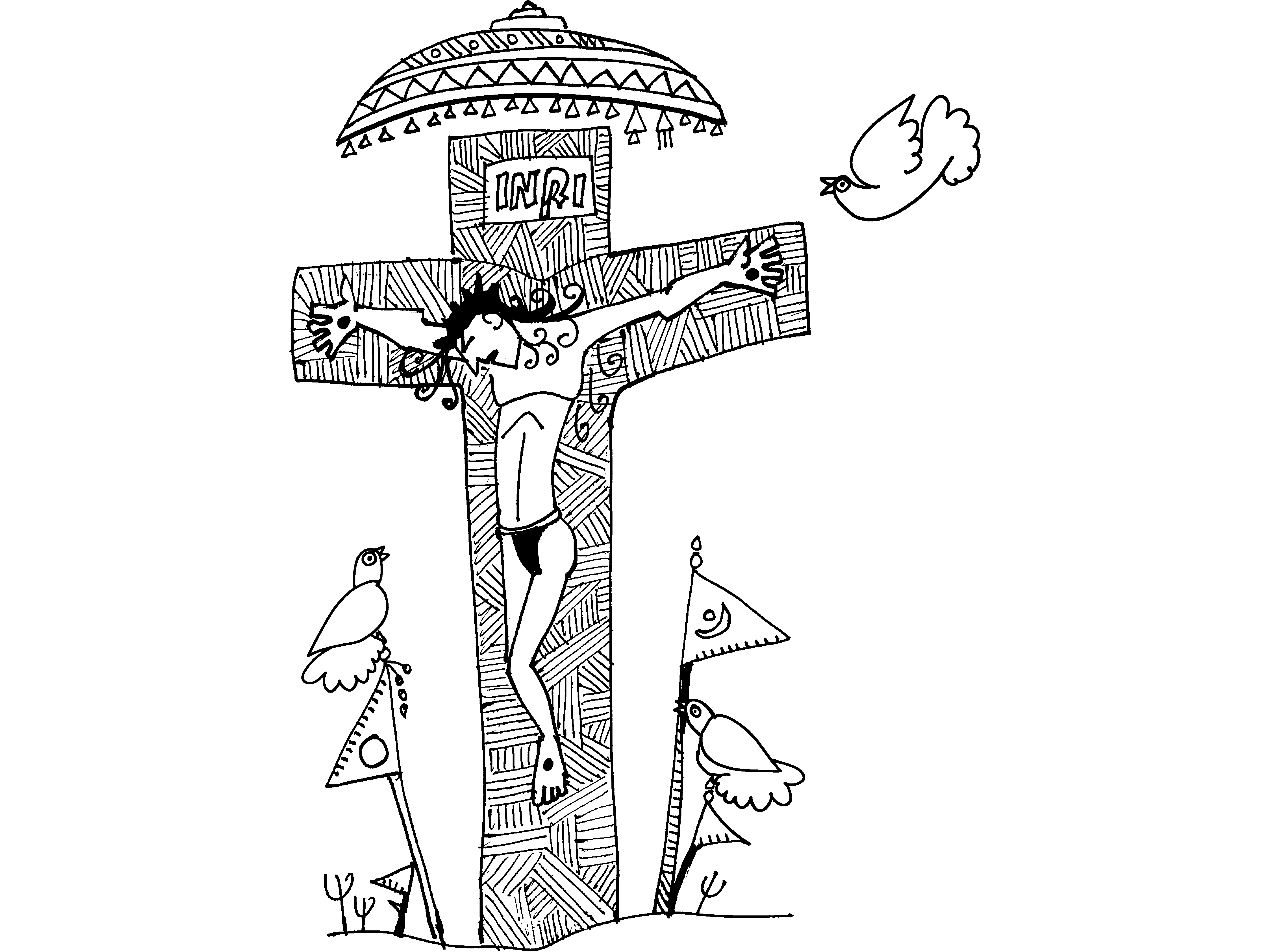
A Pope – in Latin, Papa – is dead. Another will be chosen. And in all the commentary about the papacy, there will be one thing missing: the defining role that power politics and the rise and fall of empires had in giving papacy the extraordinary role it has in Catholicism.
When we think of the Pope, we never think about the Roman Empire. We think of an avuncular religious leader, not a shrewd political leader. This is because of the way we are taught history. In history textbooks, religion starts with a leader. Judaism starts with Moses, Buddhism with Gautam, Jainism with Mahavir, Christianity with Jesus, Islam with Muhammad.
When the founder dies, he is replaced by an institution. The leader of the institution carries forward the work of the founder. In the case of a Pope, things are a bit different. In him, the Catholics see a direct connection with God through Jesus Christ, son of God, who is God, who chose Peter as the apostle to be the ‘rock’ on which the Church would stand.
Beyond the complex verbal and theological jugglery, for Catholics, the Pope and church are almost synonymous with the idea of Jesus Christ and God. By attending church, by obeying the Pope, they will be saved when the world will come to an end.
The Pope’s hand is guided by the divine and so the church adapts to history, changing with the times, creating new rules. For example, its views on marriage, divorce and sexuality today are different from those a hundred years ago. And they are fiercely debated. This is unlike Islam, where finality is recorded in the lifetime of the Prophet Muhammad, 1400 years ago.
Faith aside, the rise of Christianity is closely linked to declining fortunes of the Roman Empire. A city-state, Rome, established in 500 BC, began expanding from 300 BC, controlling vast stretches of the Mediterranean region. Its oligarchs established a complex extraction economy. They were inspired by Greek city-states.
Greek city-states were controlled not by a monarch, but by a democratic council made of free men, who owned land, slaves and women. Rome too began as a republic controlled by oligarchs. Its democratic council was made of senators who had vast estates and slaves and trading interests. Their power came by conquering more lands and bringing the wealth to Rome.
Rome had a law: be democratic at peacetime and have a dictator at wartime. About 2000 years ago, an ambitious senator, Julius Caesar, wanted war all the time so he could be dictator, like the Egyptian pharaoh, the Persian Shehan-shah, whom even Alexander admired.
Julius Caesar was assassinated in 44 BC in Rome. Jesus Christ was crucified in 33 AD in Jerusalem, Palestine, a Roman province. In 70 AD, the second temple of Solomon was destroyed by Romans, to crush the resistance of the Jewish people.
Shortly thereafter the Christian Bible (New Testament) was compiled which spoke of how Jesus resurrected himself three days after his crucifixion (an idea celebrated on Easter Sunday) to tell all that he will once again revive the broken temple of God, through his body and in the Church; Peter, the ‘fisher of men’, would establish that Church.
Peter establishes that church in Rome. As per Christian myth, after being visited by the resurrected Christ, Peter travelled to Rome to spread the good word of Christ’s triumph over death and offer to save humans from the Original Sin of breaking God’s law in Eden during Genesis. Romans crucified him. His cross is shown upside down in art to remind all that he is not Christ. The church claims there is an unbroken chain of Popes since the time of Peter.
When the Roman Empire faced collapse, around 300 AD, its emperor Constantine converted to Christianity. The Christian church suddenly became the spiritual centre of the Roman Empire. Around 500 AD, another Roman emperor consolidated his power by insisting that the Roman empire was Christian. He ordered the wiping out of all pagan faiths. This was the first time religion and politics merged. Intolerance was legitimised.
This idea was adopted by Arabs, whose empire rose in 700 AD. They were taking advantage of the Roman and Persian empires that were weakened by wars around 600 AD. The Arab empire, first located in Medina, then Damascus, then Baghdad, told the world that Jesus was not the son of God. Muhammad was the final prophet. They changed the world forever. But it would not have been possible without the rise of the Roman church and Pope.
When we speak of the Western world today, we mean the Holy Roman Empire, headquartered at Rome. This city fell to ‘barbarians’ around 500 AD. By 700 AD, the Pope successfully converted the barbarians who had defeated the Rome king. Thus Christendom survived.
The Eastern Roman Empire, is the Eastern world we speak of today, headquartered at Byzantium, which was conquered by Muslims around 1400 AD. The church in Rome competed with the church located in the ‘New Rome’ of Byzantium. The two split. The Byzantium half became the Orthodox (true) church. The Roman church insisted it was Catholic, ie, universal.
You cannot understand what a Pope is all about unless you understand the politics of papacy.