June 26, 2024

First published June 25, 2024

My Gita

We never actually hear what Krishna told Arjuna. We simply overhear what Sanjaya transmitted faithfully to the blind king Dhritarashtra in the comforts of the palace, having witnessed all that occurred on the distant battlefield, thanks to his telepathic sight. The Gita we overhear is essentially that which is narrated by a man with no authority but infinite sight (Sanjaya) to a man with no sight but full authority (Dhritarashtra). This peculiar structure of the narrative draws attention to the vast gap between what is told (gyana) and what is heard (vi-gyana).

Krishna and Sanjaya may speak exactly the same words, but while Krishna knows what he is talking about, Sanjaya does not. Krishna is the source, while Sanjaya is merely a transmitter. Likewise, what Sanjaya hears is different from what Arjuna hears and what Dhritarashtra hears. Sanjaya hears the words, but does not bother with the meaning. Arjuna is a seeker and so he decodes what he hears to find a solution to his problem. Dhritarashtra is not interested in what Krishna has to say. While Arjuna asks many questions and clarifications, ensuring the ‘discourse’ is a ‘conversation’, Dhritarashtra remains silent throughout. In fact, Dhritarashtra is fearful of Krishna who is fighting against his children, the Kauravas. So he judges Krishna’s words, accepting what serves him, dismissing what does not.

My Gita

In a world that seems spellbound by argument over dialogue, vi-vaad over sam-vaad, Devdutt highlights how Krishna nudges Arjuna to understand rather than judge his relationships. This becomes relevant today when we are increasingly indulging and isolating the self (self-improvement, self-actualization, self-realization—even selfies!).We forget that we live in an ecosystem of others, where we can nourish each other with food, love and meaning, even when we fight.
So let My Gita inform your Gita.

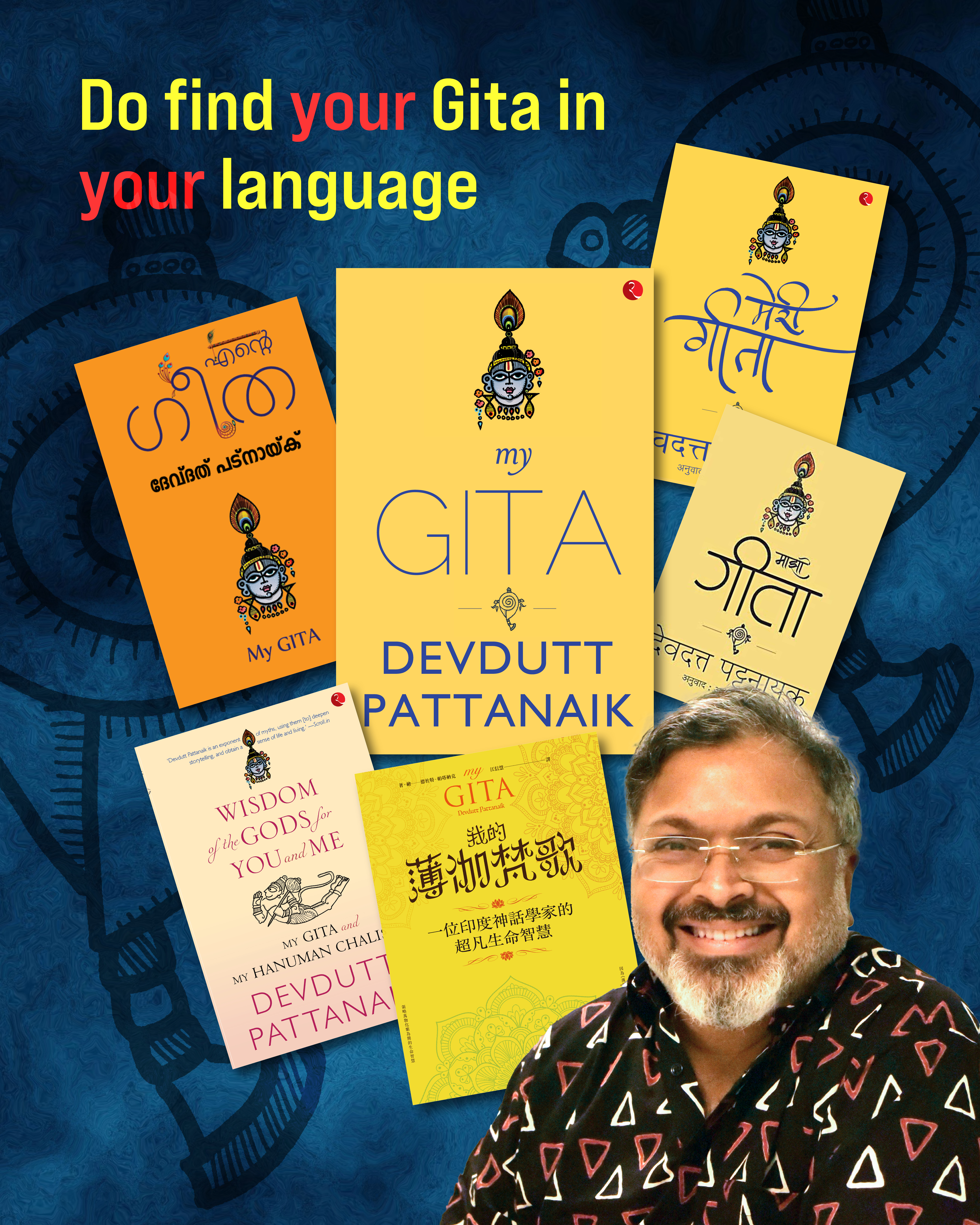
Meri Gita

Hindi translation of My Gita

Mazi Gita

Marathi translation of My Gita

Ente Gita

Malayalam translation of My Gita

我的薄伽梵歌

Complex Chinese translation of My Gita


Recent Books

  • flowers of india book

    Flower of India: Ways of Seeing the Lotus

    In Flower of India, bestselling author and renowned mythologist Devdutt Pattanaik examines the lotus as one of the most pervasive and resonant symbols of the Indian subcontinent. Through its many avatars—as plant, resource, metaphor, design, and sacred form—he traces how the lotus has shaped India’s cultural imagination across history, religion, art, and everyday life. Concise…

  • astra shastra

    Astra Shastra: Weapons of the Hindu Gods

    Well-known mythologist Devdutt Pattanaik introduces young readers to the wonderful weapons of Hindu gods with his unique art and easy-to-read text…

  • Escape the Bakasura Trap : Let Contentment Fuel Your Growth

    This book re-discovers this path, first revealed by Hanuman in the Mahabharata. Insightful and inspiring, Escape the Bakasura Trap is another classic from one of our great mythologists and thinkers…

  • लंकेश: रावण संग एक रोमांचक यात्रा

    यह पुस्तक भारत के सबसे विख्यात महाकाव्य रामायण और इस कारण भारत के सबसे बड़े खलनायक, रावण, को विस्तार से जानने की राह खोलती है।…

Recent Posts

  • The Global Resurrection of Islam

    The Global Resurrection of Islam

    Earlier, Islam was sustained by rulers. In the modern era, it is sustained by communities. Authority shifted from courts and empires to classrooms, print networks, voluntary organisations, and individual conscience…

  • Why Lord Ram Was Painted Green

    Why Lord Ram Was Painted Green

    In Nayaka art, Ram is painted green, the colour of tender leaves that emerge from the earth after rains. Green is not the colour of fear or dominance. It is the colour of renewal, fertility and calm strength. This Ram is not alone. …

  • Ashoka and the Unifier of China

    Ashoka and the Unifier of China

    Over 2200 years ago, two rulers on opposite ends of Asia confronted a similar problem: how to hold together vast, diverse territories emerging from long periods of conflict. Qin Shi Huang in China and Ashoka in India both inherited states forged through conquest. Yet the solutions they offered to the problem of unity could not…