
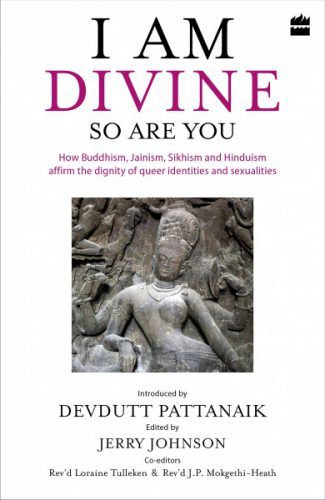
Published on 7th September, 2018, on Quartz India.
The following are ideas based on karmic faiths that can be used to affirm the dignity of queer people:
1. There is no concept of judgement day in any karmic faith. God is no judge. There is no such thing as eternal damnation for anyone, which includes queer people.
2. Nature/God is infinite (ananta). Infinity has no boundaries (rekha), no divisions (khanda). It is fluid like a river. It includes the queer. The human mind is finite and limited and so cannot understand everything. We have to accept even that which makes no sense to us, with love for and faith in the infinite.
3. Our body, our personality and our sexuality are outcomes of their karmic burden. They are therefore natural. Wisdom lies in accepting them as such rather than fighting them.
4. Knowledge helps us accommodate the queer in society. Every society has to change its rules as per the needs of geography (sthana), history (kala) and people (patra). In the past, women were seen as inferior to men, Dalits as inferior to Brahmins, and queers as inferior to straight people. But this is considered unacceptable in modern times. We have to change with the times.
5. We have to think in practical terms:
- How to include the queer in our family?
- Who will take care of the queer when he/she is old?
- How will the queer take care of old parents when they grow old?
- How will the queer take the family name forward?
6. Problems with the queer are the same problems we face with young men and women who are increasingly choosing career over family, singlehood over marriage, divorce over staying together, and preferring to have only one child. Old religious practices are being abandoned and new ways are emerging as boys and girls marry across religions, languages, castes and communities. This adjustment is no different from adjusting with queer people.
7. Queer people can get married, for marriage is between souls (atma) that have no gender. We give too much value to the body (sharira) that can be male, female or queer.
8. No matter what our body (male, female, queer), no matter what our social status (rich/poor, educated/ uneducated, married/unmarried, business/service), every human being has to cope with loneliness, sense of invalidation, and feelings of frustration and abandonment. This is universal for all creatures. Wisdom lies in helping people cope with this.
9. God is within us (jiva-atma) and others (para-atma). Through the other (para-atma) we can realise the infinite divine (param-atma). Hence the Upanishadic maxims: there is divinity within me (aham brahmasmi) and in you as well (tat tvam asi). To discover love and appreciation for the world as it is, not the way we want it to be, is wisdom. Discover God–that is wisdom and love–within you by being more generous and accepting of the queer in you and around you.
10. Everything in the eternal faiths (sanatana dharma) has a way out (upaay), nothing is fixed, provided we have open hearts, expanded minds, and are willing to “adjust.”
Excerpted with the permission of HarperCollins India from I am Divine. So Are You, introduced by Devdutt Pattanaik and edited by Jerry Jhonson.