Published on 2nd April, 2023, in Mid-day.
In Ramayan, Sita is ploughed out from the earth. She is called the daughter of the earth. Earth is her biological mother but she has no biological father. Janaka, King of Mithila, is her foster father. In the Mahabharat, Draupadi is born of fire after the priests throw a magical potion into the flames. She was born fully formed and adopted by Draupad, King of Panchal. But she has no defined mother. The two great heroines of Hindu epics have ambiguous origins. Both Sita and Draupadi are forms of Lakshmi. Lakshmi is born of the ocean. Ocean is male and so Varuna, god of sea, is Lakshmi’s father. Who is Lakshmi’s mother? She has none. One can rationalise and say they were foundlings adopted by kings. Or we can believe the supernatural and say they were children outside the natural biological process.
In Hindu mythology, all beings are classified as swaymbhu (self-created), ayonija (born by bypassing the womb) and yonija (born from the womb). Gods like Brahma, Vishnu and Shiva are swayambhu, self-created. They have no father or mother. They do not need children as they will not die and hence, do not need children to facilitate rebirth. This is the argument given by Shiva when Parvati asks for a child. Finally, he realises that while fatherhood does not matter to him, motherhood matters to his wife. So he fathers children.
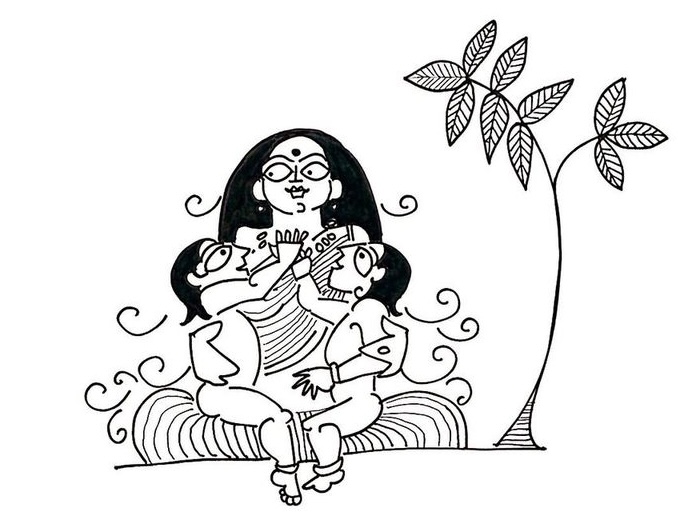
But Shiva’s children are ayonija—born outside the womb. This makes them immortal, distinguishing them from Vishnu’s avatars such as Ram and Krishna who are born through a womb, so yonija, hence mortal. Kartikeya is born when Shiva spills semen outside Parvati’s body and it is incubated by fire (Agni), wind (Vayu), water (Ganga), and reeds (Sara). He is nursed by stars of the Krittika or Pleiades constellation. In other words, one father, many mothers, but no womb. Agni and Vayu, though male gods, are called mothers of Kartikeya. Ganesha is born outside the womb when Parvati uses the rubbings of turmeric anointing her body to mould herself a son. Shiva then replaces this boy’s head with an elephant and declares himself Ganesha’s father.
When the Vedic gods Mitra and Varuna see the apsara Urvashi they spurt out semen which falls into pots and thus are born the Rishis Vasistha and Agastya. Likewise Drona is born when his father spurts semen into a pot at the sight of an aspara. Uparichara gives his semen to a bird to send to his wife; this falls into the sea and is swallowed by a fish; thus is born Satyavati. Why these complex stories of birth? Is it because the ‘womb’ is of a low-caste woman and so an unfit wife or mother. Or are these just magical stories to be accepted at face value. Or maybe they indicate ancient technology for test tube babies.
Mahabharat speaks of Bhagashvana who had children when he had a male body and children when he had a female body. There is Yuvanashva who becomes pregnant when he accidentally drinks a magic potion meant for his wife. Ramayana speaks of how Vali and Sugriva are conceived when Surya and Indra fall in love with the same woman. Only this woman is actually a man who acquires female biology. Depending on which version of stories we read she is either Aruna, the dawn-god, or Riksha, the king of the land of monkeys, Kishkinda. In Krittivasa Ramayana, we even have a tale of two queens giving birth to a ‘bone-less’ child called Bhagirath. If mythology is history, then these must be facts, right?