In the 18th-19th Century, to make sense of Indian culture, the British consulted Brahmins, who they thought were the ‘clergy of Hinduism’, who led them to the ‘Bible of Hinduism’. Thus began the quest to define Hinduism through the Vedas. While older Vedas had many gods and rituals, later Vedanta seemed to be more philosophical and monotheistic. When Sanskrit was seen to be similar to Latin, the British were now able to claim that they were in India to rescue long-lost Aryan cousins, who had been waylaid by idolatry.
Later, the British discovered something no Brahmin told them — Buddhism whose story was told in Pali canons, which the Brahmins shunned. The British thus uncovered a big historical secret: The Buddhist legacy of India. How for centuries Brahmins and Buddhist fought for patronage. Their rivalry was equated with the rivalry of the snake and the mongoose.
So now, the British argued that they had overpowered Muslims who had overpowered Brahmins who had overpowered Buddhists who had overpowered Vedic rituals. The British weaponised Buddhism to keep the Brahmin lobby in check. Buddhists were the egalitarian counter to Brahmin casteism.
Such colonial imaginations of the past serve political interest. They can be seen in all cultures, even today, expressed in social media, where anyone with a smartphone can establish himself or herself as a scholar. Popularity has become the only citation needed.
The current narrative is ‘Hindus are in danger’ and everyone is pointing towards Bangladesh. But the Hindu of the narrative is expected to be vegetarian, and respect cows and caste. This is a Brahmanical definition of Hinduism. Not even a Vedic one — where there are rituals where all kinds of animals were slaughtered, even cattle, and Vedic concept of caste (varna-system) was very different from the later purity based jati-system.
Now, historians and geneticists have revealed that purity-based caste (jati-system) emerged in India only 2,000 years ago, roughly the time when the dominant economic practice shifted from trading to agriculture. It was encoded in Dharma-shatra literature, which became dominant around this time, and which only gave lip service to the older Vedic rituals.
Indians have always resisted homogenisation. Much of this has got to do with India’s geography, mountains, ravines, and plateaus separating people. No Indian king ever controlled all of India, despite popular lore. India was connected by trade routes, and pilgrim trails, mapped by merchants, Buddhists, Jains, and later Brahmins. We are told that Brahmins triumphed over all other faiths by the Gupta period. But a closer examination reveals they had to make many changes to the old Vedic way to survive.
First, in areas where Buddhists and Jains were powerful, such as the South, Brahmins had to become vegetarian, to get merchants on their side. In exchange, the merchants were made ‘dvija’ — a word meaning ‘twice born’ and worthy of hearing the Vedas, a word that appears only in later Dharma-shastra literature.
In the Aravalli region, stretching from Rajasthan to Gujarat, the trade routes were controlled by Jains. The only way Brahmins could make inroads was by equating vegetarianism with purity and giving higher status to traders. Vedic ritualism was infamous for animal sacrifice. Buddhist and Jain scriptures consistently mock Vedic Brahmins for killing innocent beasts. But today Brahmins reject this past. They insist Vedic animals were actually made of flour, or substituted by fruits and vegetables. Thus, the past has been successfully whitewashed.
Second, as Brahmins shed their Vedic rituals, they began working with temples of local kings. Dharma-shastra which introduces the idea of ‘dvija’ has a low opinion of temple-based Brahmins. Even the famous Shankaracharya in the 8th century did not like temples. He shunned Vedic rituals and temple rituals and focussed on abstract philosophy and monastic lifestyle. This was very Buddhist which is why other Brahmins accused him of being a Buddhist in Vedic clothing.
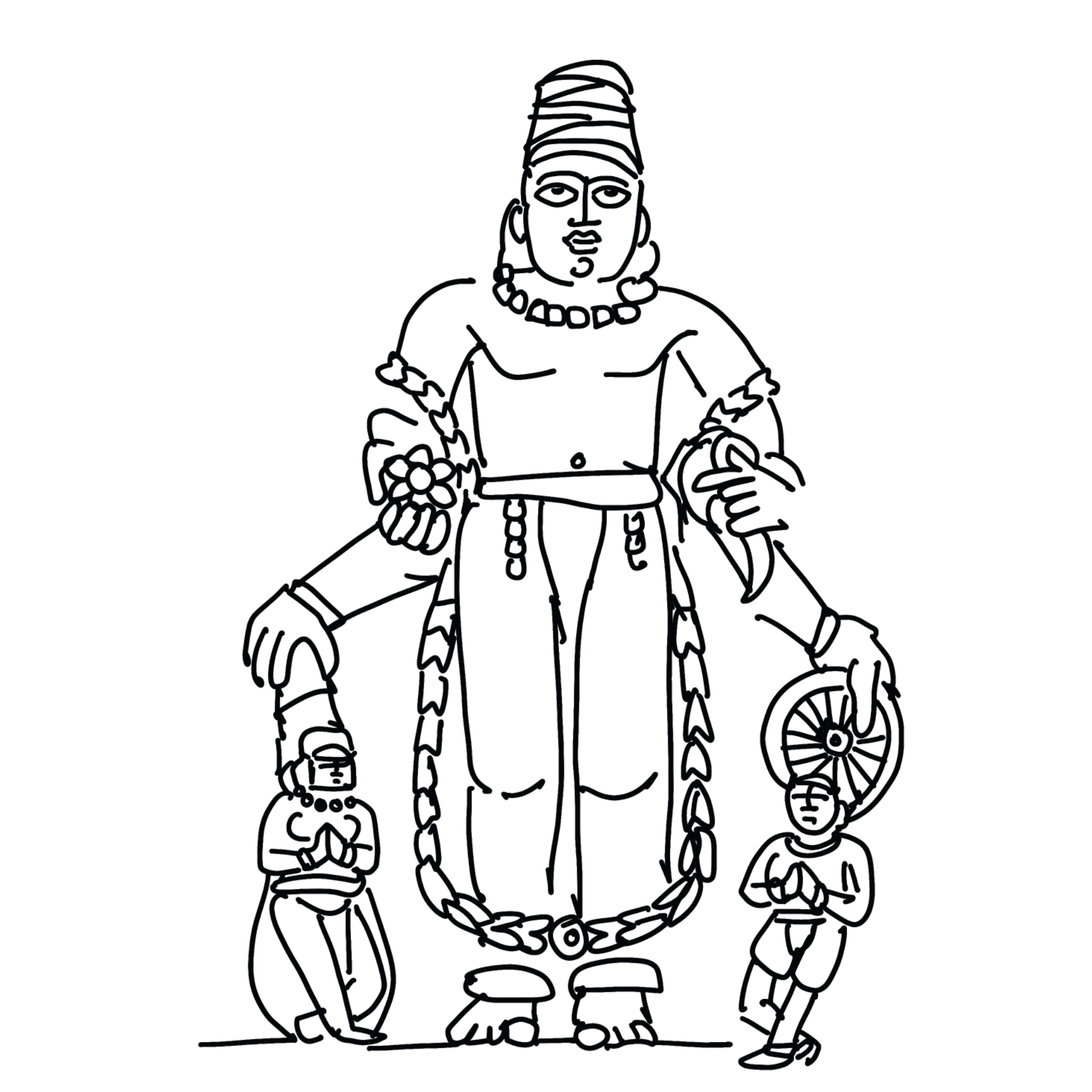
With Ramanuja in the 11th Century, temple-based Hinduism became respectable. Both these Vedantic gurus opposed Buddhism and Jainsim, but like Buddhist and Jain monks promoted vegetarianism, and monasteries attached to shrines. But unlike Buddhists, the gods in the shrines enjoyed material life. Singing, dancing, food, and fine clothes. This made the kings happy. The kings were made Kshatriyas by Brahmins using new rituals called ‘Mahadana’. If you gave Brahmins land and gold, they could make any chieftain a Kshatriya. In fact, the Brahmins said that there were no Kshatriyas in South India, the land they had migrated to. In North India, Parashurama had killed all Kshatriyas. So essentially, it was Brahmins who gave birth to the ‘dvija’ in exchange for patronage.
Post-Vedic temple-based monastic and vegetarian Brahmanism owes a lot to Buddhism and Jainism for its survival. Perhaps that is why many Brahmin texts saw Buddha as the ninth avatar of Vishnu, and equated Shiva Bhairava with the Buddhist Kala. The bull, the lion, the snake, the eagle — all symbols of Jain Tirthankaras — were also linked to Hindu gods. Old Vedic gods and rituals were seen as belonging to an earlier age, before Kali Yuga, before the Mahabharata war.