Bhakti in India before the arrival of Sufis, in the 12th century AD, always involved the worship of an idol (saguna-archa-murti) enshrined in a temple. This is evident in the Tamil poetry of Alwars and Nayamnars, composed in the 8-9th centuries AD. Sikhism was a new form of bhakti that arose 500 years ago in Punjab, where God was formless (nir-guna).
One is often told that Sikhism has no mythology. That is because in the 19th century, God (singular with capital G) was seen as real; gods (plural without capital G) were considered imaginary. Today, all things based on faith, rather than scepticism, are considered myths. Myth manifests not just as stories but also symbols and rituals. Sikhism is full of rich mythic symbolism.
The Sikh faith is based on the idea of a formless God, devotion to whom is expressed in poetry that have been compiled in a book, known as Guru Granth Sahib. The poets are not just Sikh gurus but also Hindu Sants and Muslim Sufis. This holy book is treated with great respect–carried in palanquins, placed on pedestals, with the chowrie (yak-tail fly whisk) waved over it, reminding one of Hindu ways of treating a sacred icon in a temple. Many Sikhs do not like it when the Guru Granth Sahib is referred to as a “book” much like how many Hindus get offended when the image inside a temple is referred to as an “idol”.
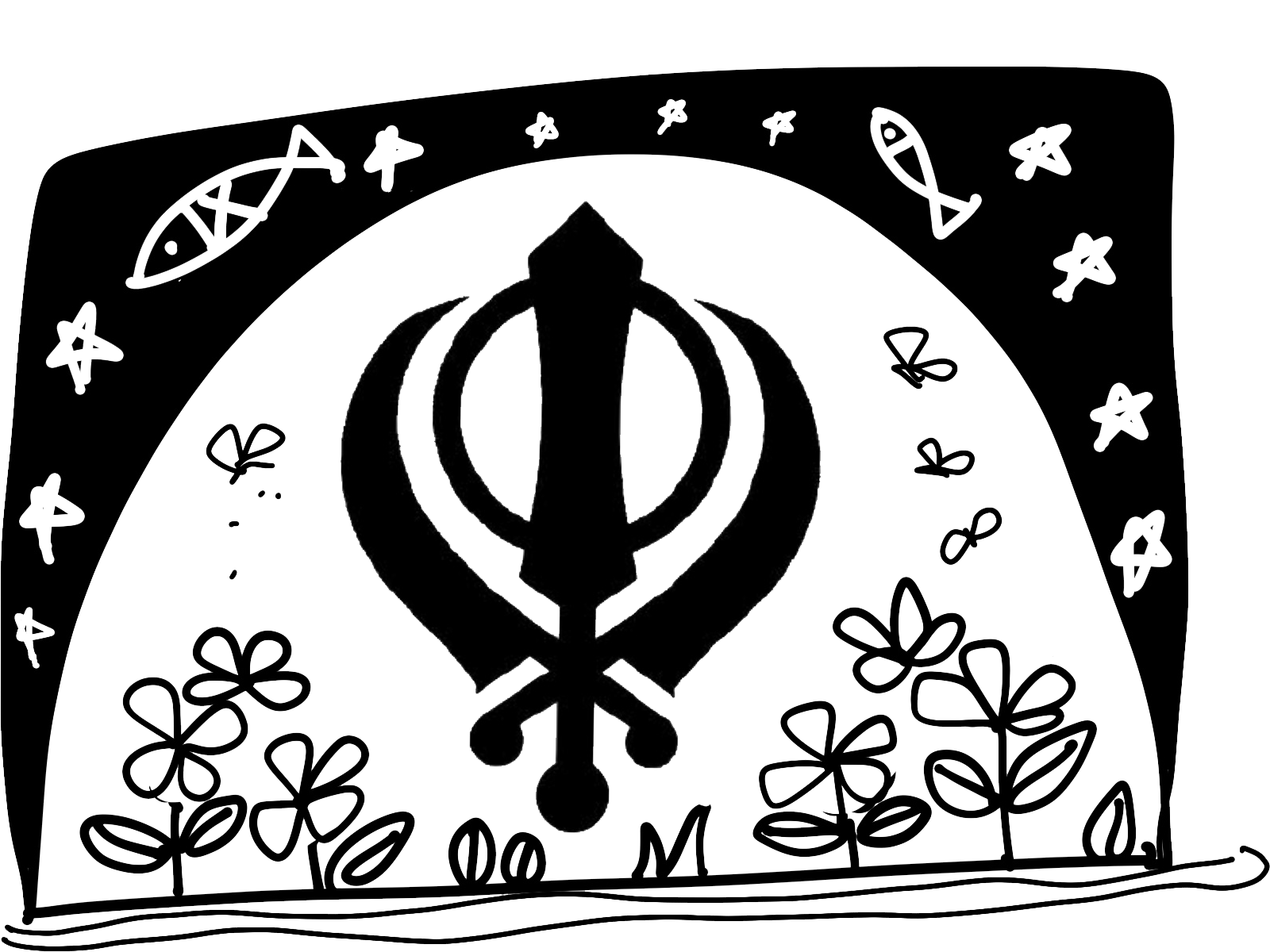
The poetry of Guru Granth Sahib is not prescriptive. Unlike Judaism, Christianity and Islam, the God of Sikhism is not seen as a Judge who puts forths laws that humans have to obey. This makes Sikhism very different from the Abrahamic faiths. In fact, confrontation between the Sikhs and the Mughals led to the rise of the Miri-Piri concept. Miri (from the Persian word Emir, for governor) represented the political side of Sikhism while Piri (from the Persian word Pir, for saint) represented the spiritual side. These were represented by the double-edged sword (khanda) that can be seen on the Sikh flag (Nishan-Sahib).
Recently, the colour of the Sikh flag was standardised. The saffron colour (kesri), inspired by tigers, often used by militant Sikhs and Hindus has been officially sidelined. Preference was given to traditional mustard yellow (basanti) and dark blue (surmai) colours, the former representing the musical arm of prayer-singing saints (sant), and the latter representing the military arm (sipahi). The yellow represents the fertility of fields and the inspiration of poets. The blue represents the sky that shelters everyone, probably the blue-black seer fish of the sea that has no master and probably lamp-black used to remove evil eye.
Theory of a faith is often challenged by lived reality. For example, not a single poem in the Guru Grant Sahib comments on homosexuality. The focus of the poetry is on equality and love for the divine. But this does not stop many Sikh leaders from aligning with the homophobic policies seen amongst conservative Abrahamic faiths. Why do religions that speak of love seek refuge in the path of law? Law grants you control and makes you feel authoritative. Love grants you the capacity to be vulnerable and make room for the vulnerable. Miri always prefers law. The Piri always chooses love. Yellow is about empowering with love, blue about enforcing the law.