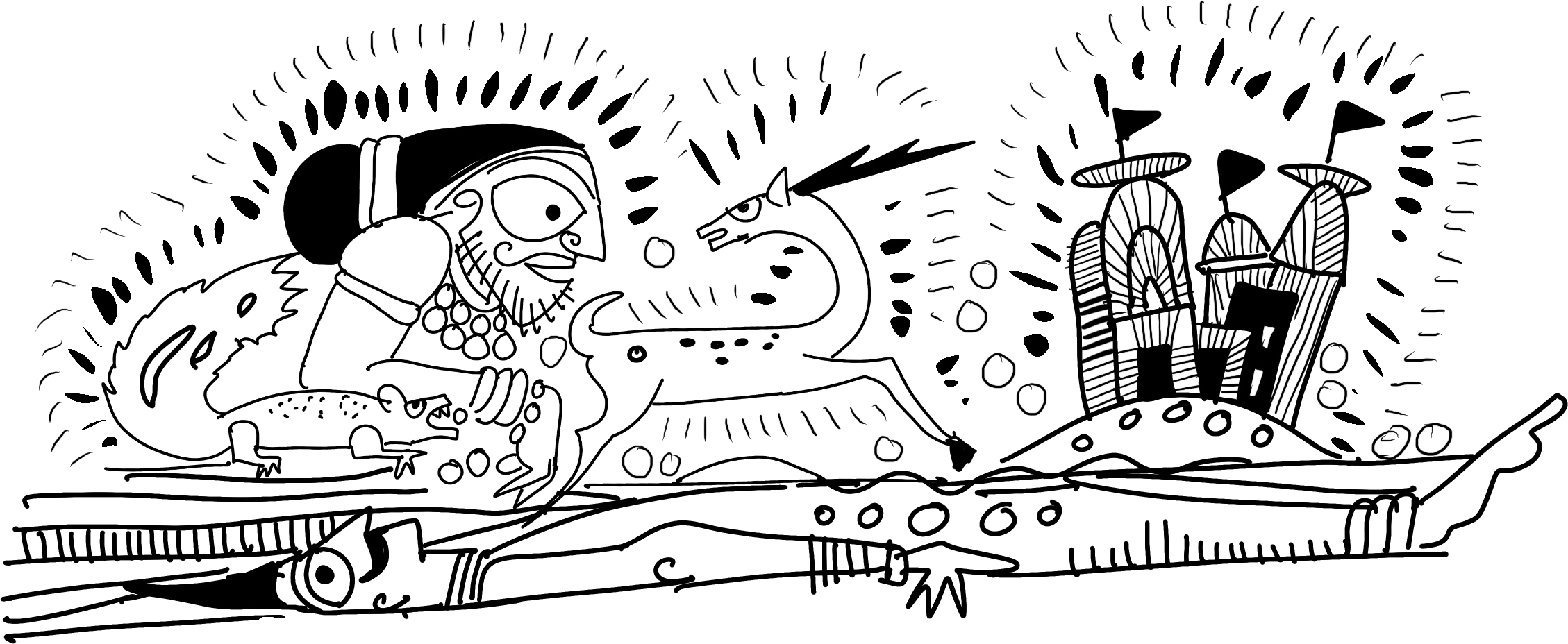
We have heard of the golden city of Lanka. Where did Ravan get his gold from? Was Ramayana the story of Aryans in search of gold?
Gold is, after all, a recurring theme in the epic. A golden plough is used by Janaka in the field where he finds Sita. Sita loves the golden deer that she forces Ram to chase. When abducted, Sita drops her golden jewellery, leaving a trail of gold for Ram to follow.
And, of course, Hanuman discovers that Ravan’s island-city is made of gold. It was built by Ravan’s brother Kubera, the king of treasures, master of metal and gems.
We assume metal was easily available in ancient India. But the truth is metal was a precious commodity in ancient times, and a major trade commodity that led to the vast trading networks of the Bronze Age from Egypt through Persia to Indus river valleys.
In the ancient world dominated by Mesopotamia, copper came from the west (Turkey) and tin from the east (Central Asia), which allowed the smelting of bronze. Harappan cities had mostly copper vessels and few bronze vessels. Arsenic was mostly used rather than tin, indicating that the latter was a rare commodity. The discovery of tin in Central Asia probably sparked the rise of the Oxus civilisation, which perhaps eclipsed Harappan cities by 2000 BCE.
In Rig Veda, dated to 1500 BCE, there is a reference to ‘ayas’ (metal), which means copper. But Atharva Veda, dated to 1000 BCE, refers to ‘Krishna ayas’ indicating iron. Many tribes in ancient India had figured out how to extract iron. Aryans thus brought horses from Eurasia, but sought the iron of tribes in the east, in the Gangetic plains.
With an iron axe, it was possible to clear dense forests. With an iron plough, it was easier to establish fields. This led to the rise of cities in the Gangetic plains by 500 BCE. The top trade commodities at this time were cotton, iron (sourced from eastern India), gold and silver (obtained from Central Asia and beyond).
In the east, in later times, we hear of asuras like Gaya, who was so great that in his rule no one died. So, the gods tricked him to lie on the ground and performed yagna on his body. His bones turned into metal. Gaya’s path links Bihar to Odisha
The rise of Magadha
The availability of iron, and later steel, in Bihar, and elephants, enabled the rise of India’s first empire — the Magadha empire. Gold and silver, much sought by all, was not available locally. Its quest led to the search for the famous city of yakshas and rakshasas.
Originating in Jharkhand and flowing through Odisha is a river called Subarnarekha (a streak of gold). When the river water is filtered, you get gold. This is the oldest source of gold in India. South of the Subarnarekha flows the Mahanadi, which originates in Chhattisgarh. On its banks is the city of Subarnapur (golden city) where people worship Lankeswari.
This region is known for its Sal trees, a tree that as per the oldest manuscripts of Valmiki Ramayan was found in Ravan’s Lanka. No Sal tree grows in south India, certainly not in Sri Lanka. So, could western Odisha, or the jungles of Jharkhand and Chhattisgarh, full of tribal communities, be the original Lanka, city of gold, where Ram encountered vanars and rakshasas?
The local tribes are convinced that they descended from Ravan’s ancestor, Paulatsya, and in Chhattisgarh we find many statues of Ravan raised by local communities. This was the land of gold. Was it sought by Aryans of the Gangetic plains? Did it inspire the Ramayana? It certainly inspired Ashoka, the Mauryan, to invade Kalinga 2,300 years ago.
The famous Kalinga war was for the metal of Odisha and access to its seaports. Local seafarers travelled to Southeast Asia, from where they got back more gold. Hence, Southeast Asia came to be known as Suvarnadvipa (golden islands).
Nearly 2,500 years ago, the Greeks spoke of giant ants who dug up gold in the Indian portions of the Persian empire. They probably referred to a creature known as Himalayan marmots known to dig the earth to make burrows for hibernation. They kicked up gold dust and so were revered as the ‘mongoose of Kubera’ and the ‘golden mongoose’ who visits Yudhishtira’s yagna-shala in the Mahabharata.
About 2,000 years ago, in the western ports of India, in Karnataka and Kerala, gold was imported from Rome in exchange for pepper and cotton. The gold imported was rarely used as currency but mostly as ornaments.
Gold coins started being used in India mainly from the Gupta period, 1,500 years ago, when there was surplus gold thanks to a peak in trade with Rome. But when the Roman empire collapsed, and trade stopped, gold imports collapsed.
Royal status symbol
There was no surplus gold, and so gold coin usage declined in India, though gold continued to be used as ornaments. Surplus gold, hence gold coins, returned in the Islamic age, 800 years ago, when the warlords from Central Asia re-established the old Silk Roads with Persia and Europe.
In India, royalty wears gold but labourers prefer silver. Gold heats in the sun and so is worn by the elite who do not step out in the sun. Silver does not heat in the sun. It is seen as a lunar metal, hence of lower status, much like the lunar kings of ancient times. But where was silver found? In Northwest India, which explains why it is said that Kubera, god of treasures, who was kicked out of Lanka in the south, made a home in Alanka or Alaka of the north.
Sri Lanka was famous not for gold but for copper. Tamraparni is the old name of Sri Lanka. Tampralipti is an ancient port in Bengal. Ships sailed along the eastern coast of India, bringing gold from Southeast Asia and copper from Sri Lanka. The Andhra region was ruled by the Satavahana kings, whose coins had images of ships; these have been found in Bengal indicating the maritime trade.
We have heard of the famous Chola bronze statues made by the Chola kings 1,000 years ago. Where did the copper for these bronze statues come from? Not from India, but from Sri Lanka. This is why Chola kings invaded and controlled much of Sri Lanka.
In Chola times, the Tamil Ramayana was written by Kamban. It was the earliest work in a regional language. It speaks of Ram as an avatar of Vishnu whose actions are mysterious and unquestionable. The feudal language is a reflection of the imperial power of the Chola kings who controlled the eastern coast of India. Such was their impact that even today, the eastern coast of India is referred to as Coromandel (Chola-mandala).
For the Chola kings, the island of Sri Lanka across a narrow stretch of sea, full of Buddhists and copper, seemed like the mythical city of Ravan, full of demons and gold. Lanka, which means island, became Sri Lanka, the island of great fortune, from which copper came with which grand statues of Hindu gods could be made. People gradually forgot the original Lanka, further north, in Odisha.