Published on 25th November, 2018, in Mumbai Mirror.
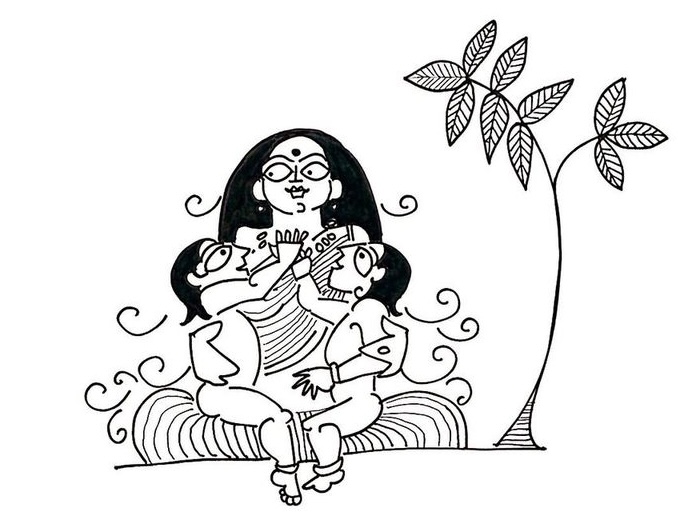
About 1,200 years ago, there was a learned couple in the region we now know as Mithila in Bihar. Mandana Mishra and his wife Ubhaya Bharati. They were highly educated and followed the Vedic way of life. They were householders, who performed the rites and rituals designed to establish a household and make gods, sages and ancestors happy. They lived in harmony with nature and culture. They followed the Mimansa school of thought, an enquiry of the soul. The best way to identify their house was to look for parrots, kept outside in cages, discussing issues on ontological and epistemological realities associated with the Vedas.
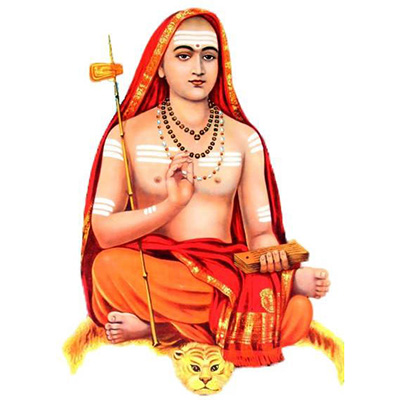
The great Hindu philosopher from Kerala, Adi Shankaracharya, was directed by another scholar, Kumaril Bhatt, to go and visit this very special couple. When Mishra first saw Shankaracharya, he became upset. Shankaracharya was a hermit and as per Vedic rules of household, the face of a hermit is inauspicious on certain days. Later, however, he reconciled to Shankaracharya’s presence.
In the deliberations that followed, Bharati was made moderator. It is said that both men were exceptionally brilliant, but the garland around Mishra’s neck started to wither, for his body was starting to get agitated and angry. Though he was as intelligent as Shankaracharya, Mishra had not internalised wisdom. Therefore, he was not as calm as him. This led Bharati to declare Shankaracharya as the victor over her husband. Shankaracharya was impressed by her fairness.
But she asked him how he could claim to have complete knowledge of the world, contained in the Vedas, if he was a bachelor and had never experienced sexual pleasure. Until he understood kamashastra, or the sensual arts, he could not consider himself to be fully immersed in Vedic wisdom. This created a dilemma. Shankaracharya had taken a vow of celibacy. How could he experience and gain knowledge of the kamashastra? Bharati smiled and said that was his problem.
We are told that Shankaracharya then trained himself in the tantric secrets, enabling him to leave his body and enter the body of a dead king called Amaru in Kashmir. Through the reanimated body of Amaru, he experienced sexual pleasure. On returning to his original body, he met Bharati and explained how he understood kamashastra. Bharati then happily declared Shankaracharya the greatest Vedic scholar.
This story is from Shankaracharya’s many biographies, composed 500 years after Shankaracharya died. It is quite possible that these are based on local folklore and may not have historical authenticity. However, this particular story draws attention to very interesting ideas. We have tensions between the householder arm of Vedic Hinduism and the hermit arm of Vedic Hinduism. There is also tension between the Vedic way of thinking, valuing the mind, and the tantric way of thinking, valuing the body and the occult arts. We are made to realise that Shankaracharya was an expert, both in the occult and the metaphysical aspects of Hinduism, making him the winner.
In a modern take of the story, following his defeat, Mishra becomes an ascetic called Sureshwara and spreads Shankaracharya’s Advaita Vedanta around the world. He abandons the householder’s life and becomes a hermit. From this point, we stop hearing anything about Bharati.
Why did Bharati, a scholar herself, give permission to her husband to turn into a hermit? Was becoming a hermit superior to being a husband? By making the hermit superior to the husband, the woman’s position is made inferior. In the monastic and occult traditions of India, the female position is always inferior and female biology is considered inferior to the male’s. We see this being reinforced by folklore that emerges from the monastic traditions of medieval India.
It is ironical that Shankaracharya is said to have established Sharada Devi as his personal deity. This goddess holds a parrot in her hand, which is a symbol of Kamadeva, the god of love, desire and sexuality. She also holds a pot in her hand as well as a book, making her an amalgamation of Saraswati, Laxmi and Gauri, goddesses of wisdom, wealth and the household, respectively. Though Shankaracharya was a hermit, he was made to appreciate both the woman and the householder’s life. He even broke the rules of ascetic order when he returned to his village to perform his mother’s cremation, indicating the value he placed on motherhood and womanhood. However, his followers chose to reject the feminine completely.
But Hinduism has undergone many transformations and we are now in a phase where women are questioning their side-lined position. Shankaracharya is said to have written a very famous collection of erotic verses called Amaru-shataka, but we prefer to study Shankaracharya as a metaphysician rather than an expert in the erotic arts. It is time for us to take notice of Ubhaya Bharati who taught Shankaracharya that wisdom cannot exist without including the household, the body and the woman.