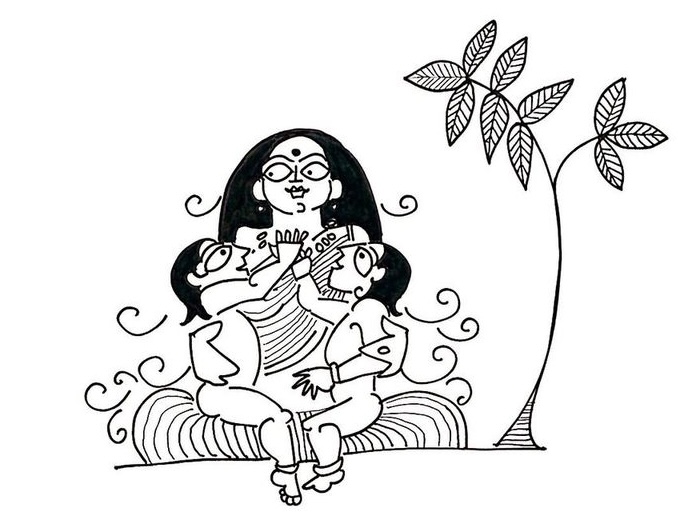
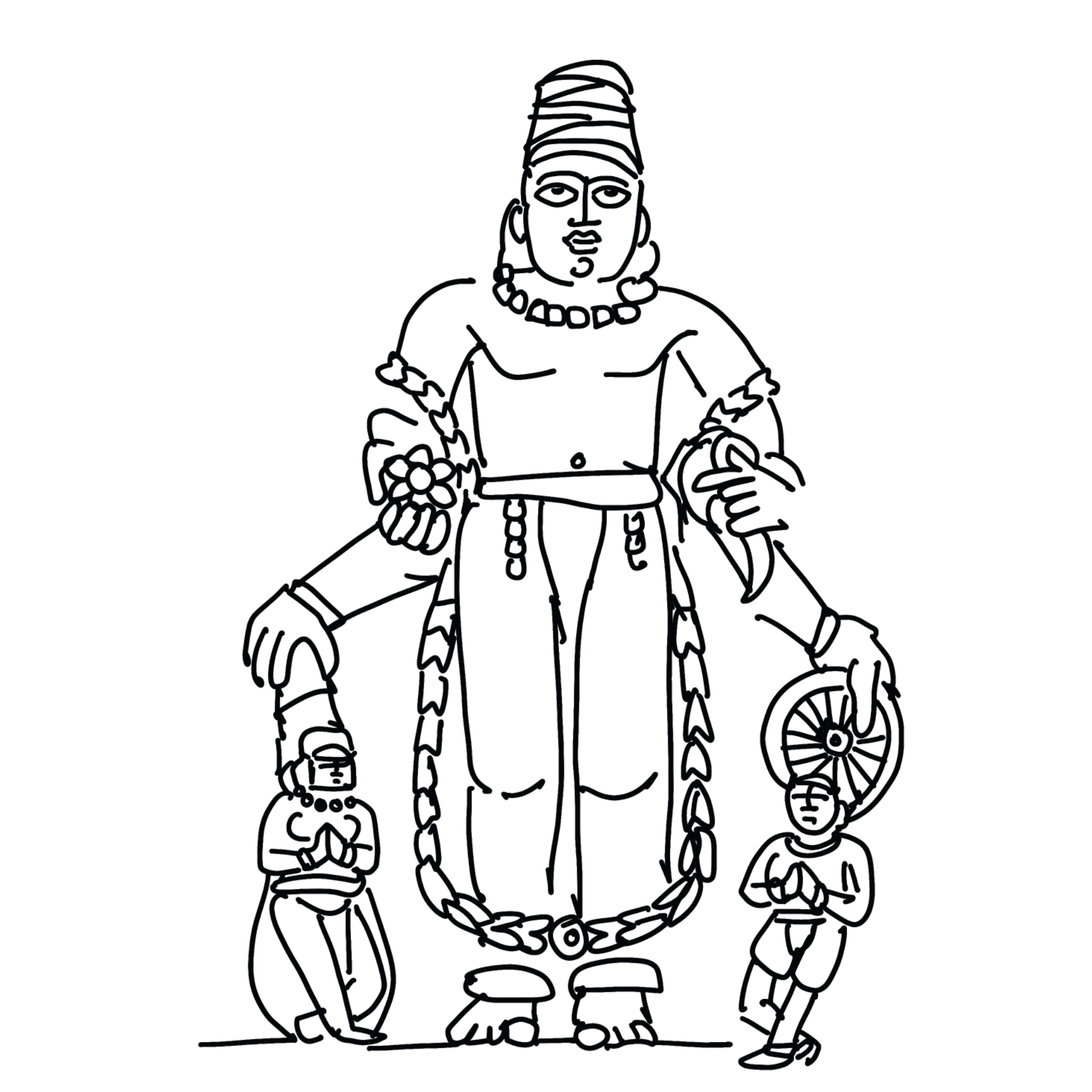
Indradyumna was told to leave paradise because no one on earth remembered him. He could return only if he found at least a beneficiary of his good deeds. When Indradyumna returned to earth, he realised a thousand years had passed. His family did not exist. His lineage was forgotten. So were the palaces he built. Even stories of his marvellous feats composed by bards were not remembered. The oldest bird did not remember him. The oldest tree did not remember him. But one old turtle remembered him, saying he was a resident of Indradyumna’s lake. Indradyumna did not remember ever building a lake. The turtle narrated the story his grandfather had heard from his grandfather.
Indradyumna’s lake came into being when water collected in a depression on the ground. This depression was created by the dust kicked by the hundreds of cows that Indradyumna had donated in his lifetime. The lake became home to reeds and frogs and snakes and fish and turtles. They all referred to the lake as Indradyumna’s lake, one even Indradyumna did not know he had built. Thus informed of the direct and indirect powers of generosity, Indradyumna was able to reclaim his place in paradise amongst the immortal gods.
The idea of mortality bothers humans, not plants and animals. We have stories of immortal beings. Hindu mythology speaks of the nectar of immortality. Chinese mythology speaks of the peaches of immortality. In Sumerian mythology, we find the story of Gilgamesh who is told he can get the herb of immortality provided he stays awake for seven days. He tries but falls asleep to realise that immortality is as impossible as living without sleep.
When animals die, they do not bury the dead because they do not give their life meaning. They feel sad, but the idea of ceremonially disposing of the dead is unique to humans. Humans give their lives a meaning, their relationships meaning, and so dead bodies become vehicles of meaning. ‘He was a king, a soldier, a martyr, a hero, a villain, a friend, a relative.’
So humans invented burial rites. The way the body is buried, the way the body is cremated and the way tombs are built reveal how we imagine the afterlife. Ancient Greeks placed coins in the mouth of the dead to pay the ferryman Chiron to take them across the river Styx. Ancient Egyptians mummified bodies because the dead without preserved bodies could not exist in the afterlife. Favourite pets were mummified too. Christians often bury the dead facing the east so that they can see Jesus Christ on the Day of the Raptures. Muslims often bury the dead with their head turned towards Mecca. In Hindu death rituals, rice cakes are offered to feed the dead who await rebirth in the land of their ancestors. Food and hunger haunt us even in our imagination of the afterlife.
Humans have invented a smart way to outsmart death. We have split ourselves: a mortal part (who we are) and an immortal part (what we have). We can die but our possessions can outlive us. Thus through our property, we can be immortal. Ram dies but Ayodhya outlives him. Pandavas die but Hastinapur outlives them. In life as in death, we are seen for what we have, rather than for who we are. We know Shah Jahan existed because he built the Taj Mahal. We know there were pharaohs in Egypt because 4500 years ago they built pyramids. Kalidasa is remembered because we still recite his poetry. Shakespeare is remembered as his plays still inspire. We see the king’s sword, not the king. The sword outlives the king. We see the merchant’s wealth, not the merchant. Wealth outlives the merchant.
Family, too, is a human invention, another what we have, another creation of imagination, to whom the property of the deceased can be transmitted using inheritance rules. At one time, only the elite were allowed to marry as they had property to pass on. If you had no property or skill or knowledge, that you could call your own, why did you need a legitimate wife to bear you a legitimate child? Slaves were meant to breed like animals and provide more farmhands. Men had legitimate wives, recognised by society, to bear heirs, and concubines for pleasure. Children born of concubines did not inherit property. Legitimate wives were not allowed to remarry for fear she would take away the legitimate children and the family property. Same-sex couples were not allowed to marry so that the court could give away their property to the ‘family’ not the ‘lover’. Childless men were given legal means to procure heirs. The impotent man, the sterile man, could adopt sons. They could inherit estates and titles only if society let them.
Our biological children can be family, our adopted children can be family. By passing on our property to those we deem to be family, we ensure continuity. Thus we trick ourselves into immortality.