Published on 9th October, 2022, in Mid-day.
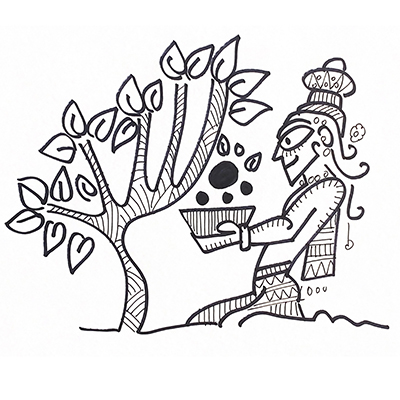
In Hindu, Jain and Buddhist mythology, paradise or swarga, is described as a place where the wish-fulfilling tree, Kalpataru, grows; where the wish-fulfilling cow, Kamadhenu, lives; and where Chintamani, the wish-fulfilling jewel is found. In other words, it is a place of infinite plant, animal and mineral resources, where all needs and wants and dreams are satisfied.
The residents of Swarga are the devas; Indra is their king. These devas are invoked in the Rig Veda through hymns of flattery. This is done with the hope that they will share some of their vast fortune with humans. But the devas are not worshipped in a single Hindu temple. There is no temple to Indra. Why? It’s clear that possessing this wish-fulfilling tree or cow or jewel does not make you a god worthy of worship.
Every tree in nature has a purpose. However, humans only value trees that bring us some economic benefit. Those that provide us with wood and spices, with food or clothing. Valuable trees like mango and banana and coconut become important and worthy of worship. Plants that bring shade and last long, like pipal and banyan, are worshipped. Plants that have no value, are not even pretty to the eye, are not put in the gardens, orchards or fields. Weeds are disregarded and kept outside settlements. But gods like Shiva and Hanuman, who live in the wilderness seem to value these wild useless plants. Datura and the calotropis, though poisonous weeds, are used in their worship.
No single plant can satisfy all our desires. No single animal or human or mineral can satisfy all our needs. We need many. Managing many is difficult. So we fantasise about that one thing which satisfies all our needs. This is the quest for the job that will give us what the Japanese call “ikigai” – makes us happy, makes us money, makes us famous. But if we get that tree that satisfies our needs and wants, will we be happy? Or will we want more? And more?
How will we cope with boredom that creeps in? To get rid of boredom we seek innovative ideas to entertain us from the wish-fulfilling tree/cow/jewel. Therefore, one often hears of rich and powerful people indulging in crazy practices. You hear stories of rich people torturing servants, abusing children, getting pleasure in useless fetishes, travelling to exotic inaccessible places, indulging in practices that are forbidden in society, in order to feel they are rich and can do what others cannot afford. But does all the comfort and luxury take away boredom? The mind wants more.
In Indian mythologies, a greater heaven is not where all wishes are fulfilled, it is a heaven where you have outgrown hunger and desires fully. It is a state of being where you do not feel the need for Kalpataru or Kamadhenu or Chintamani. You are happy with what you have. Such a person is content everywhere. He is content in the forest, he is content in the desert, he is content in the city. This idea manifests as the Buddha-kshetra heaven of Adi Buddha and Siddha loka of Jain Tirthankaras, the heaven of contentment. This idea is embodied in Shiva, who lives on the mountain of stone covered with ice, and Vishnu, who is surrounded by the ocean of milk. These content beings are enshrined in temples, not the needy Indra.