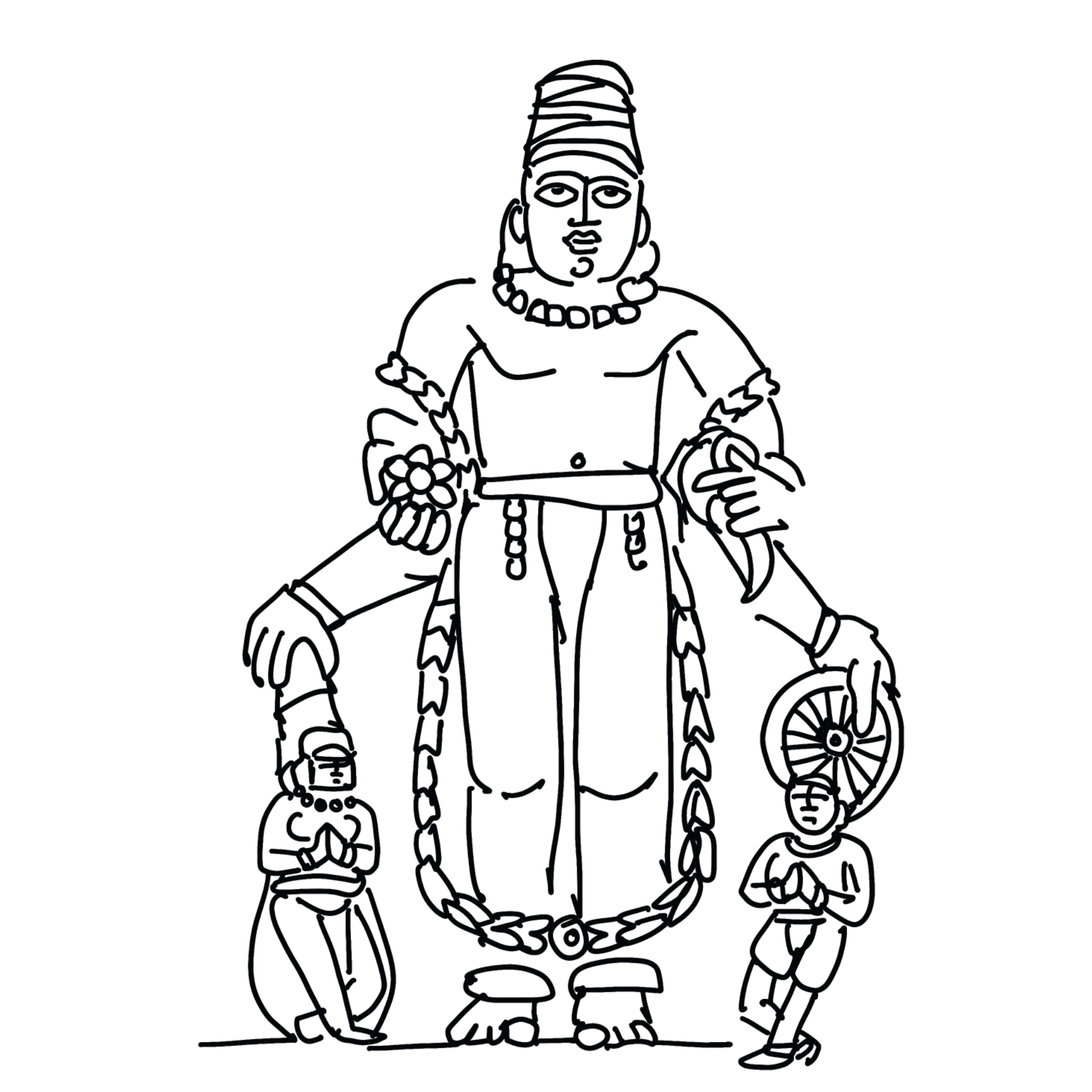
Mythology uses fantastic concepts to explain human emotions and human cognition. Ideas like god and equality do not exist in nature. These are human concepts. How do we explain them visually? We can see horses. We can see mango trees. So, we can draw horses, and mango trees. But how do we draw something no one has seen? Mythology is about the unseen world of ideas: concepts. It uses fantastic images to explain ideas that do not exist in nature. The supernatural is essentially artificial ideas; man-made ideas.
To explain the workings of nature, the early man came up with the idea of gods. Gods in trees that produce flowers and fruits. Gods of the forest and the rivers who protect birds, bees, beasts, and fish. To ensure an alignment to rules, Middle Eastern tribes came up with tales of a god in the sky who demands obedience and threatens the disobedient with floods. In India, they spoke of rebirth to explain the diversity, unpredictability, and inequalities of life. These ideas were communicated through fantastic stories and unreal imagery.
For example, the Jataka tales inform us about 550 previous births of Buddha, some as plants, some as animals, and some as humans. Mahabharata and Ramayana tell stories of two earth-bound mortal forms of Vishnu: Krishna and Ram. In his previous birth Krishna was Ram. Krishna’s elder brother Balaram was Ram’s younger brother Lakshman. Even Hindu rituals reinforce the idea of rebirth. For example, the rituals Naba-kalebara in Puri temple show Jagannatha, the presiding deity, losing his old body and regaining a new body in an elaborate ceremony.
The idea of Jesus being born of a virgin woman is taken literally today by many; but it was meant to evoke the idea of a supernatural being, a son of God, who walks the earth, and resurrects himself after he is killed. The idea of Muhammad flying to heaven from Jerusalem is also taken literally, when the story is meant to reaffirm Muhammad’s status as Prophet. European scholars who take the myths of Jesus and Muhammad literally also take Hindu myths literally. They fail to see the metaphors. No Hindu believes in the actual existence of the ocean of milk, or the crescent moon on Shiva’s head, or Ganga descending from the skies. These were concepts communicated visually using meaning-rich symbols. They were meant to be decoded. Like figures of speech in poetry.
Modern people tend to be contemptuous of tradition and feel they are more rational than their predecessors. But if we accept rebirth as a concept, we need to understand what purpose this narrative tool serves. Rebirth brings forth three interesting ideas not found in cultures that believe in a single life.
First, it explains the diversity of the world. How would one explain why someone is born to rich parents and some to poor parents? Why does fortune favour only some? If everyone comes from the same source or seed, this seems unfair, even cruel. Rebirth makes all diversity our own responsibility. All of us have a different balance sheet. Those who come with debts end up suffering. Those who come with credit have pleasure. Karma helps explain this diversity. Rebirth explains karma. The karma theory is found in societies which do not like homogeneity. Wherever you like homogeneity, you will find one god, one book, one way of living.
Second, in mythologies that believe in one life, life has a climax — a judgement day, apocalypse, war to end all wars, happily ever after, or a Greek tragedy. In societies that believe in many lives, there is no such climax. No victory or defeat. Winners in this life become losers in the next. The rich in previous lives are poor in this life. Everything is a cycle. Every action has a consequence. There is no one judgement day. No one is in heaven or hell. No final destination. Just a merry-go-round up into paradise and then down out of it.
Third, if you live life only once, the value of that life is a sum total of your achievements, and whatever you have gathered. So, the arithmetic of your actions, achievements, and possessions are calculated at the end of your life to conclude if that life has been successful or not. But if you live infinite lives, the denominator is infinity, so the value no matter what you do or achieve or attain remains zero.
Your value comes from what you give others. A mango plant is not valuable because it produces mangoes. It is valuable because we like eating mangoes. The Sun does not intrinsically have value. It has value to the plant that uses it to produce fruit and flowers. The idea of intrinsic value does not exist. It comes from the other. Those who eat in this life will be eaten in the next life. Those who consume value in this life will be consumed by others in the next life. It induces in people a sense of responsibility and accountability. There is no one watching us or judging us. But we can witness our lives and work towards repaying debts and writing off loans.