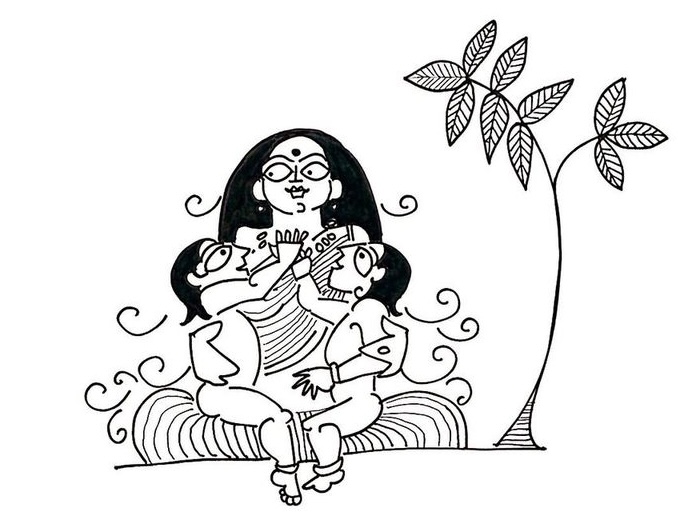
When BAPS Swaminarayan Akshardham opened in Delhi in 2005, it was hailed as a triumph of Hindu civilisation. The sandstone shikhara, the hand-carved pillars, the bronze elephants: all sourced from the iconographic repertoire of classical India. And then, surrounding this monument to Hindu authenticity, were lawns. Trimmed, mowed, geometrically edged lawns. Sacred waters from 151 rivers of Bharatavarsha contained in a rectangular reflecting pool. A lotus garden shaped, from above, like a lotus — because a real lotus pond with muck and frogs and seasonal flooding would be unacceptable to the aesthetic that actually governs these spaces.
That aesthetic has two parents, and neither of them is the Vedas.
The first is the Mughal charbagh. The defining grammar of Mughal garden design — quadripartite symmetry, axial water channels, walled enclosure, geometric order imposed on landscape — was a Persian-Islamic cosmological statement: the four rivers of Quranic paradise, the garden as earthly representation of divine perfection. BAPS does not reproduce the charbagh literally, but it inherits its fundamental premise: that a sacred precinct must be ordered, symmetrical, visually legible, and immaculate. The Narayan Sarovar is not a temple tank in any traditional sense. It is a reflecting pool, performing precisely the function that water channels performed in Humayun’s Tomb garden — producing a mirror image of the monument and heightening its grandeur through axial reflection.
The second parent is the British colonial park. The Mughal gardens were orchards, full of fruit bearing and flower bearing trees, creating a heady scent through the seasons. The English landscape garden arrived in India through the tree-less maidan, the cantonment garden. These spaces institutionalised a particular idea of what a well-governed landscape looks like: clipped, weed-free, patrolled by gardeners with shears. After independence, this aesthetic migrated into the idiom of Indian institutional respectability. The Birla temple lawn announces, in the same register as a Raj Bhavan garden: we are orderly, we are modern, and we are not a jungle.
The irony is that the jungle — the sacred grove — is exactly what the Hindu tradition actually produced and sanctified. The devavana, the devrai, the sthala vriksha: managed not horticulturally but through taboo. Certain trees could not be felled, certain animals not hunted, certain water bodies not drained. The Vrindavan of the Bhagavata is a dense riparian forest. The Aranyakas locate the deepest Vedic knowledge beyond cultivation, in the untamed vana. A traditional temple grove supported dozens of native species, recharged groundwater, and sustained pollinators. The marble temple campus is an ecological desert dressed in green — monoculture grass, ornamental exotics, stone paving that prevents water percolation. Its grounds are indistinguishable, ecologically, from a suburban corporate park.
This is not incidental to what such new organisations are. These new organisations are part of a twentieth-century reinvention of the Advaita monastic guru parampara — cults with a centralised, hierarchical, celibate swami order providing spiritual services to a predominantly mercantile diaspora. It is modern in every structural sense: incorporated, branded, globally franchised, with a communication apparatus and volunteer mobilisation that any NGO would envy. Its theology is devotional but its organisation is managerial.
Precisely because of this, its discipline, its clean campuses, its law-abiding, politically unthreatening profile, it has become the government’s preferred model of what Hinduism should look like: spectacular but orderly, proudly ancient but fully compatible with the aesthetics of the Indian corporate campus. The deva-vana, wild and unincorporated, was never going to be that model. The lawn was.