February 15, 2021

First published February 14, 2021

 in Mid-day

Sindhi Love Poetry

Published on 14th February, 2021, in Mid-day.

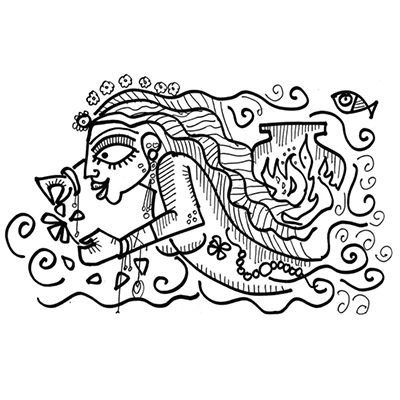
In the 16th Century, Shah Abdul Latif Bhittai wrote a set of love poems in Sindhi to express Sufi mysticism, metaphorically capturing the tension between love and law, head and heart. Each has a female protagonist, hailing from Northwest India, from Gujarat to Punjab, and from different social strata.

Marvi is a peasant who is abducted by an aristocrat called Omar. He imprisons her for many days in his fortress, but she insists on marrying the man she is engaged to in her village. So, he lets her go, but the villagers accuse her of infidelity (as in Ramayana?) and she is asked to go through a trial by fire. Omar argues that even he should be put through trial to prove he never violated her consent.

Momal is a courtesan who prefers the king’s minister, Rano, over the king. The jealous king returns to his palace across the desert with Rano. Rano works the whole day for the king, but at night returns to be with his beloved. On learning this, the king gives more and more work to Rano, until one day he is so late that Momal thinks he will not come. Longing for him, she gets one of her maids to dress up in his clothes and sleep beside her. Rano, who arrives very late, sees Momal in bed with another “man” and turns around. Depending on which version one reads, they either reconcile or their love remains unfulfilled.

Sassui is a washerwoman who falls in love with a prince called Punnhun, but the prince’s brothers take him back to his kingdom. Sassui, unable to bear the separation, walks through the desert, shouting his name, but dies midway. The earth splits open and buries her. The prince also cannot live without her and walks through the desert to meet her. On the way, he hears of Sassui’s death. He is unable to carry on and dies, too. Once again, the earth splits open to accept his body as well.

Noori is a fisherwoman who marries a king who has many wives. The jealous wives tell the king that Noori still meets a fisherman from the village every night. The king spies on her to learn the truth. He gets to know that the fisherman comes to give her a fish, which she likes to eat, but does not get in the palace. Realising how humble and honest Noori is, the king makes her his chief queen.

Recent Books

  • flowers of india book

    Flower of India: Ways of Seeing the Lotus

    In Flower of India, bestselling author and renowned mythologist Devdutt Pattanaik examines the lotus as one of the most pervasive and resonant symbols of the Indian subcontinent. Through its many avatars—as plant, resource, metaphor, design, and sacred form—he traces how the lotus has shaped India’s cultural imagination across history, religion, art, and everyday life. Concise…

  • astra shastra

    Astra Shastra: Weapons of the Hindu Gods

    Well-known mythologist Devdutt Pattanaik introduces young readers to the wonderful weapons of Hindu gods with his unique art and easy-to-read text…

  • Escape the Bakasura Trap : Let Contentment Fuel Your Growth

    This book re-discovers this path, first revealed by Hanuman in the Mahabharata. Insightful and inspiring, Escape the Bakasura Trap is another classic from one of our great mythologists and thinkers…

  • लंकेश: रावण संग एक रोमांचक यात्रा

    यह पुस्तक भारत के सबसे विख्यात महाकाव्य रामायण और इस कारण भारत के सबसे बड़े खलनायक, रावण, को विस्तार से जानने की राह खोलती है।…

Recent Posts

  • A Tamil Reimagining of the Ramayana

    A Tamil Reimagining of the Ramayana

    Kambaramayanam is one of the most celebrated works of Tamil literature. Composed by the poet Kamban around the ninth century in Tamil Nadu, in the time of Chola kings, it is a lyrical retelling of the Ramayana filled with rich poetry, elaborate metaphors, and deep moral reflection. …

  • Yama’s Journey from Vedic King to Cosmic Accountant

    Yama’s Journey from Vedic King to Cosmic Accountant

    Yama is the Hindu god of death, accountability, and the afterlife. Often ignored, his history is long and complex, reaching back to Vedic, Indo-Iranian, and Indo-European mythological traditions…

  • How India and Persia Shaped Each Other

    How India and Persia Shaped Each Other

    Connections between India and Persia stretched back to prehistoric movements of people, long before written history. Genetic and archaeological evidence suggests that populations linked to ancient Iranian farmers moved eastward into the subcontinent around 10,000 years ago, interacting with older forager communities. …