In modern Hinduism, we find a proliferation of celibate monks wearing saffron robes, almost mimicking the Buddhist monks of yore. Although they refer to the Vedas, it is clear their practices were strongly shaped by Buddhist and Jain monastic institutions.
This is why these monks insist on eating only vegetarian food, which is very different from the practices found in the Vedas. In the Vedic tradition, hermits performed various kinds of rituals which included sacrifice of horses, goats, cattle, and birds, indulged in meditation and contemplation, ate various kinds of meat, and sought to marry in order to repay their debt to their ancestors.
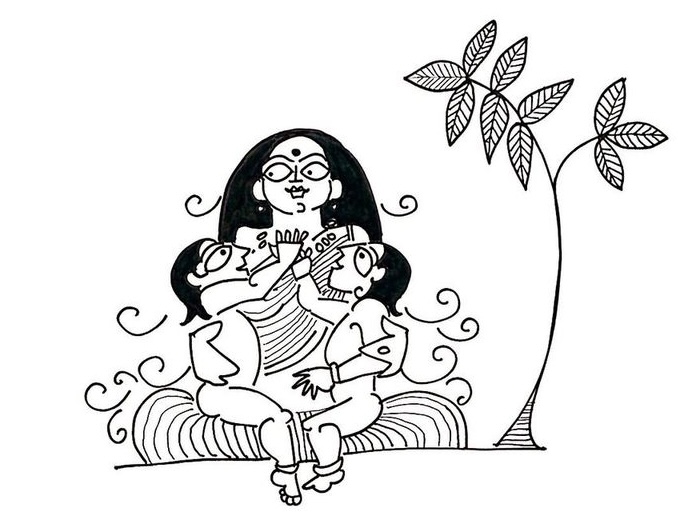
The Mahabharata is full of stories where hermits are keen to produce children. In many cases, marriage is not deemed important. For instance, Kardama Rishi asks a king for his daughter, Devahuti. Once Devahuti bears their son, Kapila, Kardama walks away, leaving the responsibility of child-rearing to her. Similarly, Agastya approaches the king for his daughter, Lopamudra. Lopamudra agrees to bear his children on the condition that he provides her with the lifestyle she is accustomed to. Consequently, Agastya is forced to travel the world to gather wealth so that Lopamudra can live comfortably and bear his children.
In another tale, Rishi Saubhari asks Manadhata for one of his daughters, but all 50 of the kingʼs daughters wish to marry him. To fulfil all their wishes, Saubhari multiplies his body 50 times, ensuring each one is happy. Meanwhile, Chyavan Rishi, who is blinded by Sukanya, receives her devoted service after her father, Sharyati, asks her to care for him.
The Vedic rituals date back over 3,000 years. Buddhist monastic practices are 2,500 years old. The 1,800-year-old Manusmriti looks down upon hermits, as they do not help their ancestors be reborn.
Around 1,200 years ago, the Mimansa scholar Mandana Mishra was married to Ubhaya Bharati. He refused to debate with the celibate Adi Shankara, who was accused of being a crypto-Buddhist.
Later hagiographies say that when Shankara defeats Mandana Mishra, Mandana Mishra becomes an ascetic. Seems odd when Mandana Mishraʼs wife, Ubhaya Bharati, challenges Shankara to discuss Kamasutra, the erotic arts, with her.
The story goes that Shankara is forced to use Tantrik occult powers to enter the body of a dead king of Kashmir to learn the erotic arts from his many queens. The experience inspires Shankara to write a collection of a hundred erotic poems known as Amaru-shataka. This story reveals the tension in the Hindu world where priests were expected to marry and produce children, but most kings venerated celibate monks. It made business sense to be a hermit.
Ancient rishis almost always had wives. The Saptarishis (Seven Sages) each had a wife. However, six of these wives were accused of infidelity. In their anger and humiliation, these women transformed into the Krithika (Pleiades) constellation, while the seven rishis became the Great Bear constellation. Notably, Arundhati, the wife of Vasishta, hailed from the Chandala (low-caste) clan, yet together they embodied the ideal marriage. The stories are found in early Vedic texts.
But by 1000 AD, we find more and more yogis promoting celibacy and devotion to god. Ramanuja establishes a Vaishnava monastic order in Kaveri river basin that eclipses Jaina practices. Though married, he embraces a monastic lifestyle. Lingayat are Shaiva monastic order that also eclipse Jaina practices in the Krishna-Tungabhadra basin. The Gorakhnath Kanphata yogis are all celibate monks, who are linked to Tantrik occult powers known as Siddha. Hanuman, the celibate devotee of Ram, becomes a role model as does Dattatreya, the ascetic embodiment of the Hindu Trinity. This, despite the fact that temples constantly celebrate the marriage rituals of Shiva with Shakti, and Vishnu with Lakshmi, especially in South Indian temple complexes.