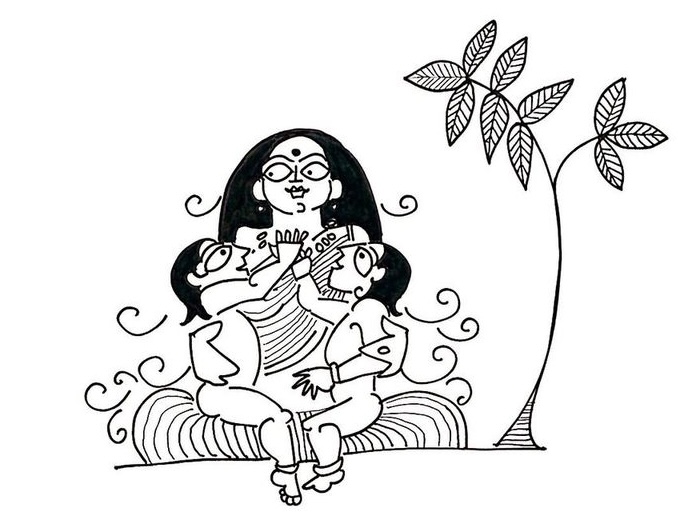
One of the unique features of Hindu temple traditions is the stories of the resident god quarrelling with the resident goddess. These take the form of a domestic spat, and through the storytelling and rituals that enact this quarrel, audiences are drawn into the lives of the gods and the divine.
This participation in divine acts (leela) was the original Bhakti practice from around the 8th century, where devotees engage in the divine activities, participate in temple ceremonies, enjoy them, and experience god. After the 12th century, the idea of submission to a deity, who protects and saves you, emerged under influence of Sufis of Central Asia who always saw the devotee as one of lower status before the almighty, not a member of godʼs family.
The story of the god and goddess quarrelling is found among both worshippers of Shiva and Vishnu.
In the case of Shiva, the tale revolves around Parvati becoming angry with Shivaʼs indifference towards her, as he prefers meditation and isolation on Mount Kailash while she is left to care for the children. Exhausted, she goes to her parentsʼ house. This tradition is observed on the Konkan coast during Gauri Puja and in Bengal as the worship of Durga.
Parvati enjoys her motherʼs hospitality, eats her food, and, once she calms down, returns home. In some stories from the Konkan coast, it is said that Shiva sends his followers (ganas) after her. Other narratives depict the goddess taking the form of a tribal woman, while Shiva follows her as a tribal man, dancing and singing to impress her. Alternatively, she takes the form of a fisherwoman, and Shiva descends to earth, appeasing her by impressing her family with his fishing skills.
The stories involving Vishnu are slightly different, and are told in regions such as the Mahanadi River delta in Puri, Odisha, and the Kaveri River delta of Tamil Nadu. In Puri, when Jagannath returns from his rath yatra with his brother and sister, Lakshmi stops him from entering the temple, insulting both his sister, for having a flat nose, and him, for having round eyes like sieves. Eventually, Jagannath calms Lakshmi down by offering her rasgulla and praising her culinary skills.
Further south, in Srirangam, the Lord Ranganatha Vishnu returns after travelling across the city. The goddess Lakshmi Ranganayaki is angry because she knows he has spent time with the goddess Neela, his other wife. To calm her down and appease her, Vishnu offers gifts and sings her praises, and the two finally reconcile and return to the temp
As in case of Puri temple ritual, Lakshmi shuts the temple door and opens it only after being cajoled with gifts. In Srirangam, the deity travels silently through the streets asking devotees to give him gifts by which he can calm his furious consort.
The common ritual practices reveal a clear connection between Srirangam temple and Puri temple. This may have something to do with the Chola influence along western coast around the 12th century, and the spread of Ramanujaʼs ideas and temple ritual practices. Additional we are told in Srirangam that Vishnu returns after visiting Goddess Neela, the blue or dark goddess, while in Puri, Vishnu returns from Nilanchal, the blue or dark mountain.
Similar stories of quarrel are found in the Tirupati temple and the Pandharpur temple. Both are Vishnu temples. Vishnu stands alone without his consort in both temples, who has a separate temple, exerting her anger and autonomy. This is very different from Shiva temples where the god and his goddess are together always in the sanctum sanctorum.
Another such quarrel takes place during the festival celebrating the wedding of Meenakshi of Madurai to Somasundara Shiva. Her brother Vishnu from the nearby Alagar temple is invited to give his sister away in marriage. But he is delayed due to the attack of robbers. When he learns his sisterʼs marriage has already taken place, he turns back in a huff. To pacify him, the newly married Meenakshi comes to Vaigai River to meet her brother and he gives her gifts in the middle of the river in a grand ceremony, and then turns back to Alagar hill without entering Madurai.
These stories of tension and reconciliation reveals the medieval tensions between communities that worshipped Shiva, Vishnu, and Shakti. Vishnu was Shaktiʼs brother, and Shiva was Shaktiʼs husband. Thus, through family ties all gods were connected. This made sense to the Hindus.
In later Bhakti traditions, shaped by Sufi ideas of submission, this family connection does not exist. Ram and Krishna become more transcendent and distant. The devotee becomes the lost wandering soul seeking union with the cosmic soul. Stories of quarrels are downplayed. This happened after the 1500s.
Bhakti, thus, changed with time. There is a pre-Sufi Bhakti of Hinduism based on temple rituals, family drama, marriages, quarrels, and reconciliations. This persists in temple traditions of the southern and eastern parts of India. The post-Sufi Bhakti of Hinduism, which was more about submission to divine and royal power, came later and dominates north Indian devotional practices.