Published on May 24, 2013 in Corporate Dossier ET.
I am a senior HR professional and I am in a fix. MY super boss has been making sexual overtures at me and I am very uncomfortable. He is a smooth operator, always says and does things that I have no proof against. But he knows it and I know what he wants. But this has started affecting my career as he takes all the critical decisions and always makes sure he has a reason of making me suffer. I love my job and also I need the money. I can’t even complain to higher ups since he is a proven performer and no one will take my side. What do I do?
You have not clarified your gender. And I will not assume it. Anyone can be sexually harassed. So read this column as gender neutral.
We inhabit three worlds at all times: Sanskriti (society), Brahmanda (imagination) and Prakriti (nature).
Sanskriti is based on rules: the rules are clear on this kind of misbehavior. Your superboss is crossing the line, and needs to back off, or be punished. But the legal system is based on evidence; you have to provide evidence else your action will be seen as maligning a good man, an achiever at that, which does not bode well for you. Since you are a senior HR professional why don’t you publicly demand workshops on sexual harassment and legal choices that people have? You can say this is important to reinforce the company value systems. No one will argue against it, in public at least. Make sure you send invitations to all senior performers and make it public who attends and who does not attend. Make it a conversation point in the company with newspaper clippings of star performers of other organizations who have been penalized for disrespecting the rules. Maybe, this will make him back off.
Brahmanda is how we imagine the situation. This depends on how we receive and interpret signals from the outside world. This world is fully under our control. We are Brahma, its creators, hence the Upanishadic maxim, Aham Brahmasmi (I am Brahma) and Tat tvam asi (So are you). You know what his signals mean and you are responding to them in a way that informs him clearly that you have understood his intentions and are uncomfortable with it. You have a choice here. You can choose not to show him that you have understood. Use the knowledge to protect yourself but do not give him the pleasure of knowing that you have got it. Play dumb, stick to your professional role, refuse to give him the slightest hint that ‘I know what you are up to’ because that will only add fuel to fire. If he feels you are not getting his messages, he may intensify his efforts, make one mistake — send an sms or email, and you will have your proof.
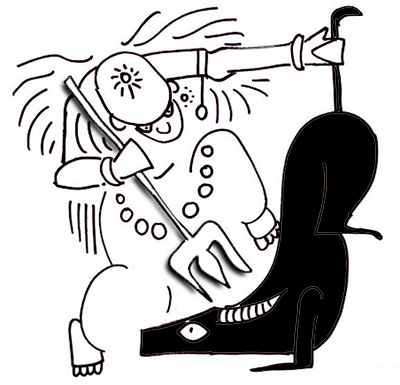
Prakriti is nature. And in nature, for all our human capabilities, we are just animals: predator or prey. We yearn for power. We therefore use every opportunity to dominate and feel safe. When a person behaves as a sexual predator, it means that they are hungry, in other words they feel inadequate, incomplete or invalidated, hence the need for food, a kind of trophy that makes them feel validated and satiated. In your eyes, your superboss is a performer but clearly he does not feel life has given him what is due to him. Hence his desire to grab and snatch things from others, especially those who he sees as weaker and vulnerable. Hence he seeks to sexually exploit. He finds power in flirting with danger and getting away with it. The more you resist, the more excited he gets. It’s the thrill of the chase. So remember, you are dealing with a beast not a human being who is rational. When confronted, he will deny it with passion. No one likes to be shown the mirror. No one likes to admit they are essentially beasts.
If you imagine yourself to be a victim, you will always feel victimized. The predator thrives in fear. Don’t nourish him. See yourself as a hero who will not be pushed around by this animal. Take firm steps to protect yourself and the organization. Tell your family and friends about your feelings and the lack of evidence. Make a joke of it, verbalize your doubts and fears, so that no one points fingers at you, but everyone is aware something is amiss. Firmly avoid being alone with the man. Reinforce the rules of Sanskriti. If confrontation is not feasible, then dilution is a possibility: make sexual harassment a major HR initiative in the company. And yes, good to befriend the family of the superboss using company initiatives. Let the predator know that he has more to lose if he crosses the line. It will take a few attempts to tame him, but remember, underlying his attempts to dominate is deep fear.