Published on 25th February, 2022, in The Hindu.
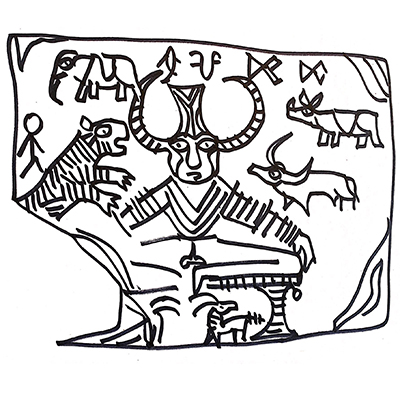
We have all heard of the Pashupati seal in Harappa. Scholars are clear that it has nothing to do with Shiva, even though it is still labelled as proto-Shiva in popular books. The Pashupati described in the Veda is the guardian of cattle, animals that have been domesticated, while the Pashupati seal in Harappa, which is 4,000 years old, shows a man, or woman, surrounded by wild animals including a tiger and a rhino.
There are two seals of the horned deity. The popular one is in Delhi and it has the animals. The less popular one in Islamabad does not show the animals. The Islamabad seal shows smoother horns and a tree branch on the headdress. The Delhi one is ithyphallic (erect penis), like the later images of Lakulish, a tantrik form of Shiva, while the Islamabad seal shows a downward pointing triangle suggesting a vagina. So is the image male, female or maybe transgender? There are bangles on both arms. The Shiva we are familiar with is never depicted wearing horns, though some have speculated that this became the crescent moon of later times. The famous three-headed Shiva, the Trimurti of Elephanta caves, is really Panchamukhi or five-faced Shiva, with the fourth head behind and the fifth head on top.
The three heads of the horned deity of Harappa are probably a crude depiction of a man with a buffalo head, with the long ears appearing like extra human heads. He is probably like Mhasoba, the buffalo-god of folk traditions worshipped even today in Maharashtra, and sometimes linked to Shiva and Durga. We forget that early Indian art did not show deities with multiple heads and arms. Though the idea is Vedic, multiple-armed deities first appear in Kushan coins, and multiple-headed deities appear in the Gupta period, which is 2,000 years after the Harappan age. What is indisputable though is the horned deity’s characteristic seating posture. It is the throne-pose or bhadra-asana of yoga today. Does that make him the Adi Yogi of pop Hinduism?
There are other seals of horned deities in Harappa that are often ignored. Some are shown with tails. One holds a bow. One fights a ‘horned’ tiger. And one is part-tiger. These are mostly female. One bird-headed goddess, not horned though, is shown wrestling tigers. No one calls her Pashupati. In our eagerness to trace Hinduism, and the Vedas, to Harappa, we confuse and conflate ideas from later times into these artefacts.
Guardian spirits
Be that as it may, the idea of a hero or a deity who protects domesticated animals is a recurring theme in Indian folklore. Across India, we find folk art and lore dedicated to men who fight and protect cattle from thieves and wild animals. Those killed in the process get deified, their stories carved in stone. These ‘virgal’ are then placed at the borders of villages, between pastures and forests, so that the guardian spirit can protect the village. On these hero stones we find images of women weeping and even immolating themselves on the funeral pyre of the hero, indicating the practice of Sati. We find such hero stones in Karnataka, Tamil Nadu, Andhra Pradesh, Goa, Maharashtra, and Rajasthan.
In folklore, these heroes are considered brahmachari or celibate, hence pure. How can a brahmachari have a sati? The story then takes an innovative twist, as we find in the Epic of Pabuji in Rajasthan, where he is called to protect cattle just when he is about to get married. He chooses social duty over marriage and gets killed. The half-married bride then becomes his sati and thus the story is completed.
Krishna’s mainstreaming
In India, mythologies related to agricultural land get more importance than deities associated with pastoral communities. This is because agricultural communities built gigantic temples that survive even today. Pastoral people were nomadic, so they put up simple altars. The altars would be made in lands where they migrated during the dry seasons, often placed next to water bodies, where animals come quench their thirst.
The only pastoral deity who has been mainstreamed by Brahmins is Krishna. In the oldest version of the Mahabharata, Krishna is no cowherd. This idea is suggested in the appendix Harivamsa, composed much later. The idea of Krishna, the cowherd, first appears in Tamil Sangam literature, where we also learn of his dalliances with women such as Napinnai. The milkmaid Radha first appears in older Prakrit poetry like Gaha Sattasai, much before the Sanskrit Gita Govinda of the 12th century. Images of Krishna as a child relishing butter and fighting wild animals to protect cattle appear first in temple sculptures of Badami and Ellora dated to the 7th century. This is elaborated in the mainstream Sanskrit Bhagavat Purana only after the 9th century.
The cow-protecting pirs
As cattle-protecting heroes became popular with the elite, they were turned into avatars of Vishnu and forms of Shiva. Khandoba and Mallana were forms of Shiva and Vitthala was a form of Vishnu adored by goatherds, shepherds and cowherds. When Islam arrived, some cattle-protecting gods became pirs. A case in point is the local legend of Ghazi Mia Masud in Uttar Pradesh. In a story that is at least 800 years old, he too is said to have left his wedding altar and died protecting cows from thieves. This aligns well with Sufi commemorative festivals known as urs, which technically means the marriage of the saint with the divine. An annual mela is organised for his bride-who-never-was, Zohra Bibi, where people offer her dowry and recount her romance and heartbreak. About 400 years ago, somebody decided to link this guardian of cattle with a relative of Mahmud of Ghazni, who invaded India multiple times. This has obviously not gone down well with the Hindutva political ideology, which now insists that the local cattle guardian was really a Hindu king called Suheldev, venerated by many local communities of the Gangetic plains.
As in the case of the Harappan seals, contemporary ideology colours our understanding of the past. As explained in the Vedanta, the ego makes us turn the rope into a snake, and that is not conducive to science or history. Humans domesticated cattle in the Stone Age itself, enabling the transition to the Agricultural Age. So gods and goddesses who protected domesticated animals from wild animals and thieves would have been venerated from ancient times. Stories, rituals and powers would have been added to them over time. And over time, the elite would have claimed these gods as their own, adding local flavours down the ages. Stories are just one more item in the list of cultural truths that ebb and flow with time.