Published in Sunday Midday, Mumbai on 13 Sept, 2009.
This is a raging controversy in America. Was it God or random chance? Creation theory states that God created the world with all its diversity. Evolution theory states that random chance turned chemicals into genes and genes into organic life form, that mutated, and depending on natural selection over millions of years gave rise to the multitude of living creatures, from the amoeba to man.
The controversy began over a century ago when Darwin published his book “The Origin of Species” that claimed that humans had descended from monkeys! The idea seemed preposterous. He was condemned as a heretic and caricatured wherever he went.
There are those who argue that the Bible must not be taken literally. In the Genesis, inorganic materials are created first, then come the birds and fishes and only then man indicating an acknowledgment of evolution. Only the timescale is different. What is stated as days may refer to millions of years in human terms. This symbolic school believes that the story of Noah’s Ark indicates how natural calamities can destroy a whole race of beings, the dinosaurs, for example. The Original Sin, they say, is not historical but metaphysical: when man submits to passion rather than reason, causing disharmony in the quest for one’s own pleasure.
At the heart of the ‘origin of species’ controversy lies the ancient divide between mythos and logos, matters of faith and matters of reason. The battle lines were drawn with the rise of the scientific revolution about three hundred years ago in Europe. Religion condemned scientists as heretics. Scientists mocked religious leaders as superstitious power-hungry fiends. From Europe this divide spread, along with Imperialism to other parts of the world, India included.
The early students of scientific thought in India were mostly affluent upper caste men, what is called “Gentlemen” in English and “Bhadralok” in Bengali. The exposure made them uncomfortable with local rituals and beliefs. It fuelled the great Indian Renaissance of the 19th century with social reformers trying to redefine Indian culture along scientific lines, or rather along lines that were more acceptable to the Imperial Masters. This was when the Left wing arose — rejecting all religious beliefs completely, seeking to create a perfect society based on reason alone. In retaliation, the Right wing arose, rejecting everything that the Left proposed. Battle lines rose: scientific thinking was contemptuously labeled as ‘foreign’ and ‘Western’ by the Right, and celebrated as ‘modern’ by the Left.
In India, the story of Dasha-avatara gave many a reason for chauvinistic pride. Vishnu descends on earth first as a fish (aquatic), then as a turtle (amphibian), then a boar (terrestrial), then a man-lion (early man?) and only then human. The conclusion was: ancient Indians were scientific, and knew of evolution, even before Darwin. It became a matter of national pride. But what was overlooked was the details of the human avatars: there was Vaman (priest) followed by Parashuram (priest-warrior), then Ram (prince), then Krishna (royal cowherd and royal charioteer), then Buddha (hermit) and finally Kalki (invader, destroyer). This very obvious reference to the caste system was ignored by all, because it embarrassed all Indians, whether on the Left or Right.
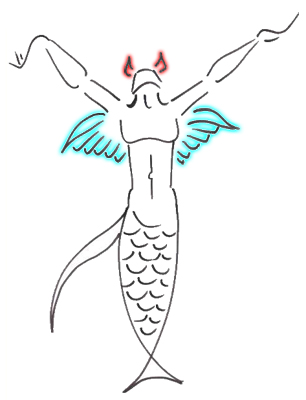
Unlike the Bible, Hindus do not have a specific book. There are many scriptures and many stories of creation. The Upanishads states that Prajapati (the soul) chased a goddess called Shatarupa (matter), she-of-myriad-forms. She took the form of various female animals and he became the corresponding male; hence the biodiversity. The Puranas state that all creatures, gods and beasts included, are Kashyapa’s children by his many wives. Fishes from Timi, domesticated animals from Surabhi, wild animals from Surasa, birds from Vinata, snakes from Kadru, gods from Aditi, demons from Danu.
The oldest Hindu text, the Rig Veda, seeks the origin of species, in a radically different way. It asks why did evolution happen? A clue perhaps lies in the fundamental difference between animal and man. Humans, no thanks to the enlarged brain, can imagine possibilities beyond survival. They can rise beyond Pashu-prakriti, the nature of the beast. They want more than survival and domination and territory. They seek meaning. This is Purusha-artha, validation of human existence.
Evolution then, concludes the Veda, is psychological: moving from Pashu-prakriti to Purusha-artha. In Biblical terms, it is the return to Eden after the Fall. Scientifically speaking, this happens only when man stops thinking about himself and starts thinking about others. Difficult but scientifically very probable.