Published on 27th July, 2014 in The Economic Times.
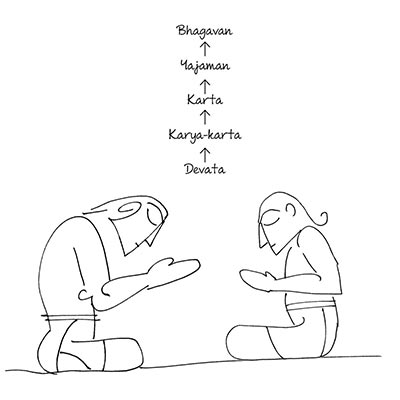
The word karta is a legal term referring to the head of a Hindu Joint Family. The word yajaman is a religious and feudal term referring to the patron. The two words are often used interchangeably but they mean very different things. They represent two levels of leadership.
Simply put, a karta is the alpha pack leader who pack is made of those lower in the pecking order: betas, gammas and omegas, while a yajaman is an alpha whose pack is made of other alpha pack leaders. Karta is a leader who leads followers. Yajaman is a leader who leads leaders.
Let us understand this in terms of cooking an Indian thali with multiple dishes.
What does a karta do when he is asked to prepare an Indian thali? The response depends on whether he knows to cook and/or whether he knows to manage. Thus we have four possibilities — he knows to cook and manage, he knows neither to cook nor manage, he knows only to cook and he knows only to manage.
If he knows to cook and manage, then he will design the thali, allot a dish to other cooks, and allocate the most important dish to himself. If he knows neither to cook nor manage, he will shout at everyone until they figure out a way to create a thali. If he only knows to cook, he will find everyone else not good enough and end up preparing the thali himself. If only knows to manage, he will use the democratic process to get one cook to design the thali and others to prepare a single dish such that process is efficient and effective.
Further, a karta demands complete obedience from his karya-karta, his followers. He is dismissive of those who challenge his authority or think differently.
A yajaman approaches the project differently. For the karta, getting the thali ready is target and the team is but a tool. For the yajaman, the team is the target and the thali is but a tool for enabling the team to be better. At the end of the project, the yajaman will have not just the thali but also a team of thali-makers who can create thalis even in his absence, enabling him to move on to other projects. He even enables the thali-makers to create more thali-makers. He allows them to think differently and invests time and energy to make them see why his approach is better. He is even ready to change tracks and learn from others if a better idea comes along without feeling hurt or insecure.
In modern objective driven management, the purpose of the institution is to achieve the target. People are just tools and mediums to do so. You matter only because you perform, because you contribute to organisation success. After that, beyond that, you have no role. This ecosystem thrives on the karta model. We seek kartas and karya-kartas, all talks of talent management notwithstanding. Those who seek in terms of legacy building and creating sustainable institutions have to think less about objective and more about people. The objective is but a tool to enable people, transform followers into leaders and leaders into leader-creators. It is all about mindset. It is all about gaze or darshan.
Attempts have been made in this direction by introducing the concept of the balance scorecard. But this is done half-heartedly for the shareholder is more interested in dividends and profits and less about people. A lot depends on timing and life cycle of an organisation. Focussing on profits rather than people is important for start-ups and new companies in early stages of evolution. But when this becomes a malignant disease when it can be seen even in later stages of evolved business houses. It indicates a lack of maturity born of deep insecurity. We are too busy achieving numbers in the short-term to think of people in long-term. One can say, a karta is trapped in tactics while a yajaman thinks strategic.
Words like karta and yajaman are mindsets. They are NOT designations. Yet, typically, in my experience, people use the words to indicate layers in a organisational pecking order. Thus all CEOs identify themselves as yajamans and want their COO and Sales heads to be kartas. The mind unfortunately has nothing to do with organisational charts. It has to deal with how we see the world around us. A karta wants to control. A yajaman wants to enable. A karta cannot handle failure. A yajaman has faith and patience to know that lasting success takes time.