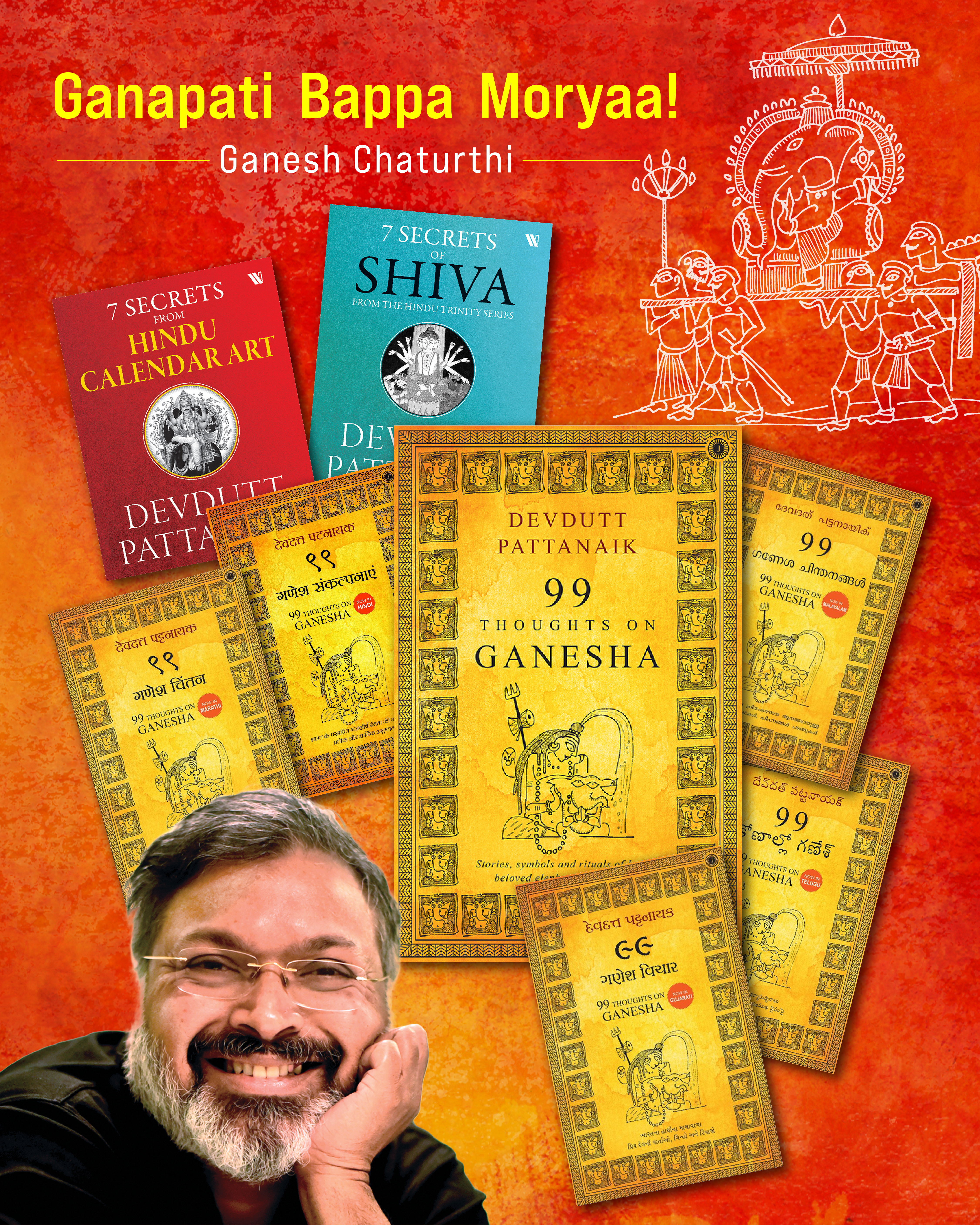
Ganesha, and his mother, Gauri, are worshipped twice in a year, once in spring and once in autumn, perhaps in response to the two agricultural seasons of India, rabi and kharif. For he is the fruit of the earth and she is the earth. Ganesh Chaturthi is celebrated on the fourth day of the waxing moon in the month of Bhadrapad after the rains when the earth is green. It marks the start of the festival season. Ganesha is worshipped over a ten day period.

99 Thoughts on Ganesha
In the game of cricket, having scored 99 runs, when a bats-man stands poised on the threshold of that much coveted century, he experiences the moment that is best associated with Ganesha.
Fear and uncertainty envelope him; between him and his achievement stand hurdles, both real and imaginary: a possible spin from the bowler can overwhelm him, his own anxiety can paralyze him, cheering fans can distract him. He needs divine intervention then. He needs to focus, get rid of all hurdles, perform, get the final run, and achieve what he so longs for. In other words, he needs to think of Ganapati.
This book brings together 99 meditations to better understand the stories, symbols and rituals of that ador-able elephant-headed Hindu god who removes hurdles and brings prosperity and peace. Known variously as Ganapati, Gajanana, Vinayaka or Pillayar, he can help all of us score a century in the game called life.
Also available in Hindi, Marathi Gujarati Telugu and Malayalam

7 Secrets of Shiva
Shiva, ʻthe destroyerʼ among the Hindu Trinity (of gods), is depicted in many contradictory manners. He is an ascetic who wears animal skin, his body smeared with ashes. Contradictory to his wild nature, he is also depicted as having a family, with a beautiful wife and two children. There are many more such varied representations of Shiva, the most prominent of these being the Linga and theNataraja. The author, Devdutt Pattanaik, introduces the readers to these varied aspects and representations and then sets about interpreting them. He explains the different anomalies and conflicts in beliefs, as well as the symbolism, rituals and reasons behind Hindu worship.
Though the son of a hermit, Ganesha’s corpulent belly indicates great affluence. He is surrounded by abundance. He is often worshipped with Lakshmi, the goddess of wealth. He is associated with several fertility symbols such as rats, serpents and blades of grass.
Also available in Hindi, Marathi, Gujarati, Kannada, Tamil Telugu and Malayalam

7 Secrets of Hindu Calendar Art
Hindu mythology abounds with fascinating gods, goddesses and characters whose visual representations — through calendar art — are equally colourful. Hindu calendar art may seem fantastic and kitsch, but it is in fact the most democratic expression of a mythic imagery that was once restricted to temple walls and palm leaf manuscripts. These portraits of the Hindu pantheon of gods and the stories that surround them can be found on the walls and puja rooms of almost every Hindu household in India. Rich in symbols, each image is a piece of an ancient metaphysical jigsaw puzzle